
Does a Polycarbonate Roof Make the Room Hot? How to Keep Daylight Without the Heat in Indian Summers
Will a polycarbonate roof make your room hot? It can, if specified badly. Here is what actually drives heat gain under translucent roofing in India, and how to keep the daylight while cutting the heat.
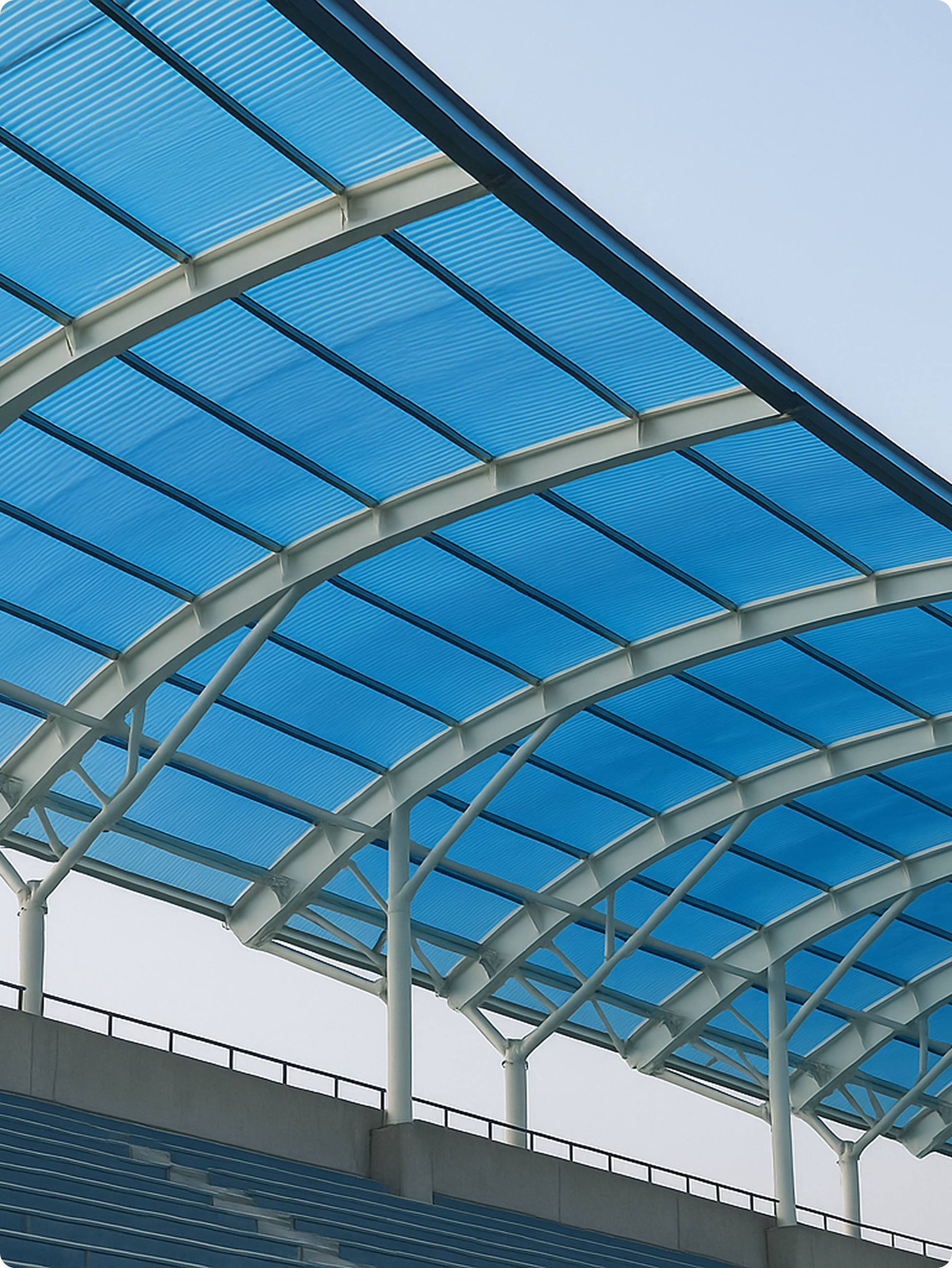
It is the first question almost every buyer asks us: "If I put a polycarbonate roof on this, will the room become unbearably hot?" The honest answer is that it depends entirely on what you specify. A clear, single-skin sheet on a west-facing roof in Rajasthan in May will heat a space badly. A well-chosen multiwall sheet in a heat-reflective tint, on the right orientation, can stay comfortable while still delivering bright daylight.
This guide explains where the heat comes from, which choices matter most, and how to specify a cooler polycarbonate roof for Indian summers.
Why Translucent Roofs Get Hot
Any roof that lets light in also lets some solar energy in. Sunlight is not only visible light. A large share of the energy that reaches a roof is infrared (heat) and ultraviolet radiation. Three things happen when it hits a polycarbonate sheet:
- Some is reflected back to the sky.
- Some is absorbed by the sheet, which warms up and then re-radiates heat inward and outward.
- Some is transmitted straight through into the room.
How the sheet splits sunlight between these three paths determines how hot the space feels. Two numbers describe this: the solar heat gain coefficient (SHGC), which tells you how much solar energy gets in, and the U-value, which tells you how well the sheet resists conducted heat. They are not the same thing, and a good specification looks at both. If you are new to the terms, start with our guide to U-value, light transmission and lux.
The Five Levers That Control Heat Gain
1. Sheet structure: multiwall beats single-skin
A multiwall sheet traps still air in its chambers, which slows heat conduction. As a reference point, our Prism 16mm system offers approximately 1.58 W/m²K, and a Snapwall 40mm system reaches approximately 0.99 W/m²K. A thin single-skin corrugated sheet has a far higher U-value, so more heat passes through. For occupied spaces, multiwall is almost always the cooler choice. See our multiwall, multicell and solid polycarbonate guide for the trade-offs.
2. Colour and tint
Clear sheets transmit the most light and the most heat. Opal (milky white) scatters light and softens it. Bronze, grey and heat-reflective grades cut solar transmission much more. The price of a cooler sheet is lower visible light, so the goal is a balance, not the darkest tint. Our colour guide compares the options.
3. Thickness
Thicker multiwall sheets generally insulate better because they hold more air and, in many designs, more walls. If budget allows, going up a thickness is often the cheapest single way to improve thermal comfort. Our thickness guide explains how to choose.
4. Orientation and roof pitch
The same sheet behaves very differently depending on where the roof faces. In most of India, the sun is high and strong for much of the year, and west-facing glazing gets the harshest afternoon load. North-facing roof lights give soft, steady light with the least heat. Our skylight orientation guide goes through each direction.
5. Area: how much of the roof is translucent
This is the lever people forget. Heat gain scales with the area of translucent material. Covering the whole roof in clear sheet is rarely necessary. For most industrial and commercial buildings, a modest proportion of the roof area is enough to deliver strong daylight, and a smaller area means less heat. Read our explainer on daylight factor and rooflight area ratio to size it properly.
Practical Specification Tips for Indian Conditions
- Do not default to clear. Use opal or a heat-reflective tint on sun-exposed roofs, especially west and south.
- Choose multiwall for occupied spaces. Use single-skin only where thermal comfort is not a priority, such as open walkways.
- Ventilate the roof zone. Hot air collects under a roof. Ridge vents, louvres or roof monitors let it escape. See roof monitors vs skylights for layouts that combine light and ventilation.
- Use shading where the sun is harshest. A pergola, louvre or external shade over a west-facing translucent roof can drop heat load sharply.
- Insist on UV protection. A UV-protected face matters for durability, and it should be on the sun-facing side. See our note on UV and yellowing.
- Ask for numbers. Request the U-value and light transmission for the exact sheet, not a generic brochure figure.
Polycarbonate vs Other Roofing: Is It Really Hotter?
Bare metal roofing absorbs and re-radiates a great deal of heat, and a bare metal roof can feel hotter than a good multiwall polycarbonate one. The difference is that metal blocks daylight entirely, so you then pay to light the space electrically. A balanced polycarbonate roof can cut daytime lighting load while keeping heat in check. Our comparison of polycarbonate vs metal roofing covers the full picture, and our post on daylighting and warehouse energy savings shows how lighting savings can offset cooling cost.
When Heat Really Is a Problem
There are cases where you should be careful. Large clear roofs over air-conditioned spaces, west-facing atria, and glazed roofs with no ventilation are the usual culprits. In these situations the answer is not to abandon daylighting, it is to reduce translucent area, move it to a better orientation, choose a heat-reflective multiwall grade, and add shading and ventilation.
Get a Heat-Aware Daylighting Recommendation
Every roof is different. Send Coxwell your roof area, orientation, location and how the space is used, and our technical team will recommend a sheet, tint and layout that balances daylight against heat. Contact Coxwell for a specification or quotation.
Frequently asked questions
Does a polycarbonate roof make a room hot?
It can if you choose a clear single-skin sheet on a sun-exposed roof. A multiwall sheet in an opal or heat-reflective tint, correctly oriented and ventilated, stays much more comfortable while still giving good daylight.
Which polycarbonate colour is coolest?
Heat-reflective, bronze and grey grades cut solar transmission the most, and opal diffuses light and softens heat. Clear transmits the most heat. The right choice balances light against heat for your roof.
Is multiwall polycarbonate cooler than single-skin?
Yes. Air trapped in the chambers slows heat conduction, so multiwall has a much lower U-value and keeps interiors cooler than thin single-skin sheet.
How can I reduce heat under a polycarbonate roof?
Reduce translucent area to what daylighting needs, choose opal or heat-reflective multiwall, add shading on west and south exposures, and provide roof ventilation.
Next step
Speak to a Coxwell engineer.
Our team can help you specify the right system, review your BOQ, or answer technical questions about your project.