
Multiwall vs Multicell vs Solid Polycarbonate: What Contractors Should Use Where
Understanding which polycarbonate product suits which application prevents mis-specification and callbacks. Here's a practical guide for contractors on when to use multiwall, multicell, or solid PC.
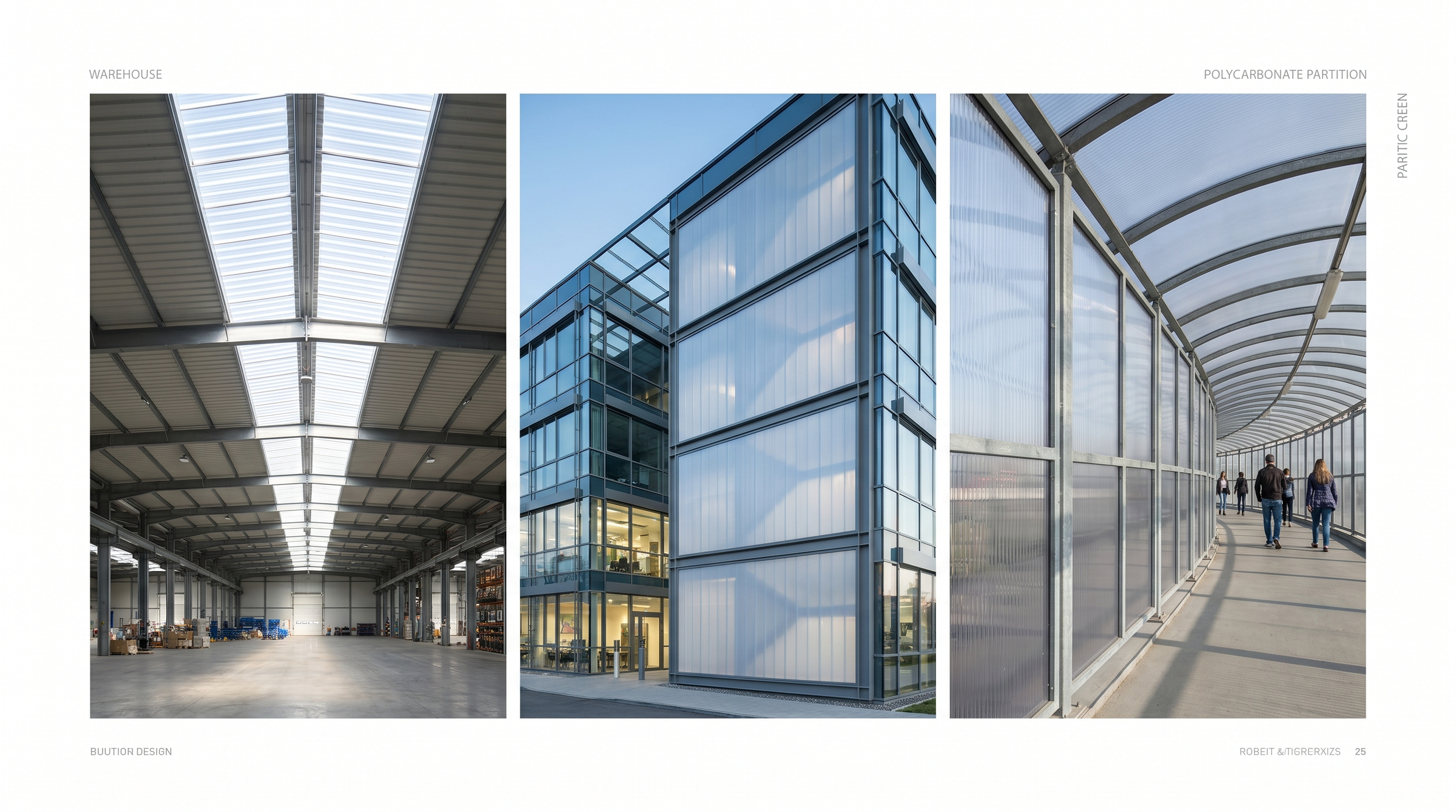
These three product types are often confused, substituted for each other incorrectly, or chosen purely on price. Each has a defined structural logic and a set of applications it is engineered for. Using the wrong one creates unnecessary cost, performance problems, and specification non-compliance.
This guide cuts through the confusion.
Understanding the Three Types
Twin Wall (Multiwall flat sheet)
A flat polycarbonate sheet with two skins connected by internal ribs, typically available in 6mm, 8mm, 10mm, and 12mm thicknesses. Comes in flat sheets, not a standing seam system. Widths typically 1200mm and 2100mm.
Multicell (Standing Seam System)
An extruded polycarbonate panel with a cellular internal structure (3-cell/4-wall or 5-cell/6-wall), integrated standing seams on both sides, and manufactured specifically for a standing seam roofing or cladding system. Widths standardised at 900mm.
Solid (Single-layer) Sheet
A single flat layer of solid polycarbonate — no internal structure. Very high clarity (up to 89% light transmission), very high impact resistance (250× glass), UV protection on both sides. Used flat or formed into shapes.
Application Guide
Industrial and Commercial Roofing (Warehouses, Factories, Logistics Centres)
Use: Multicell standing seam system (Coxwell Multicell or X-Fix)
Industrial roofs are high-span, high-wind environments that require a mechanically interlocked system with certified wind uplift resistance. Flat twin wall sheet on a long industrial span will sag, oil-can, and fail under sustained wind load. It has no standing seam and no mechanical uplift mechanism.
Multicell panels at 900mm width, on an appropriate cleat and connector system, with spans verified against manufacturer's structural tables, are the correct solution. For very long purlin spans (up to 2000mm), the Infinity Roofing system with aluminium connectors is the right upgrade.
Skylights on Commercial Buildings (Offices, Malls, Hospitals, Schools)
Use: Multicell standing seam (Prism or X-Fix, depending on daylighting requirement)
Skylights on occupied buildings need performance-driven specifications — U-value, diffusion, antiglare, and sometimes infrared reduction. Prism is the right choice when the architect or consultant cares about the quality of light, not just quantity. X-Fix is the better performance-per-rupee choice where structural strength and standard daylighting are the priorities.
Twin wall sheet is sometimes installed on small residential skylights and performs adequately for low-span, low-traffic applications. For commercial occupied buildings with consultant oversight, a standing seam system is the correct specification.
Railway Stations and Airport Canopies
Use: Multicell with continuous cleat or Large Span / Infinity system (depending on purlin spacing)
These are high-performance, high-visibility public infrastructure environments. Wind uplift, acoustic performance, and UV longevity are all critical. Span requirements often exceed standard multicell ratings — verify the purlin layout and select between the Large Span system (up to 1200mm span) or the Infinity system (up to 2000mm span) based on the actual structural grid.
Test certificates, U-value documentation, and fire ratings (B-S1-D0 on EN 13501-1) will be required by the consultant. Plan for this in your supplier procurement.
Façades and Vertical Cladding
Use: Snapwall (for click-lock modular facade) or Vivid (for design-led expression facades)
Flat twin wall sheet and standard multicell panels are not designed for vertical applications. Snapwall is the correct product for vertical polycarbonate façade work. Its 40mm depth, snap-lock mechanism, and aluminium cleat support give it the structural behaviour of a cladding system. No sealants, no fasteners through the panel face — a fully dry mechanical installation. Vivid adds design flexibility where colour and panel expression are part of the architectural language.
Covered Walkways and Pedestrian Bridges
Use: Multicell at lower spans, or Large Span / Infinity for wide-span canopy structures
For a standard walkway structure at 800–1000mm purlin spacing, any Coxwell standing seam system (Multicell, X-Fix, Prism) is appropriate. For wider walkway spans or exposed coastal locations where aluminium connectors are needed for corrosion resistance, the Infinity system is the better long-term choice.
Greenhouses, Nurseries, and Agri Structures
Use: Twin Wall (Multiwall flat sheet)
This is the correct application for twin wall flat sheet. Greenhouse spans are typically short (600–900mm), loads are light, and the primary requirement is light transmission and cost-efficiency. The mistake is specifying twin wall sheet for industrial or commercial roofing applications that have higher load, higher span, and higher performance requirements.
Partitions, Interior Screens, and Room Dividers
Use: Solid polycarbonate sheet
Interior partitions need clarity, impact resistance, and workability. Solid polycarbonate sheet offers glass-like transparency, can be cut with standard tools, and takes drilled fixings cleanly. UV protection on both sides is still required for any partition near a window or skylight.
Carports and Vehicle Shelters
Use: Multicell standing seam for quality projects; twin wall sheet for entry-level cost points
For long-life, guaranteed-watertight carport roofing, a standing seam multicell system is the correct specification. For budget carport applications where the client accepts a shorter service life, twin wall sheet at shorter spans is used widely in the market. Be explicit with the client about which they're getting and document it in writing.
Quick Selection Table
| Application | Recommended Product | Notes |
|---|---|---|
| Industrial warehouse roofing | Multicell / X-Fix | Large Span for wide purlin spacing |
| Commercial skylight | X-Fix / Prism | Prism for premium daylighting quality |
| Airport / station canopy | Large Span / Infinity | Check purlin spacing |
| Vertical façade | Snapwall / Vivid | Dry-fix system only |
| Covered walkway | Multicell / X-Fix | Infinity for spans >1200mm |
| Greenhouse | Twin Wall (flat sheet) | Short spans only |
| Interior partition | Solid PC sheet | Both-sides UV protection |
| Carport (quality) | Multicell standing seam | Aluminium connectors for coastal zones |
| Carport (budget) | Twin Wall | Short spans, document service life expectation |
Coxwell's product team can help you select the right system for your project in under 15 minutes. Send us the purlin layout, span dimensions, and application description — we'll recommend the correct product with U-value and structural data.
Next step
Speak to a Coxwell engineer.
Our team can help you specify the right system, review your BOQ, or answer technical questions about your project.