
Home/Applications/Polycarbonate Greenhouse Covering Systems

Polycarbonate Greenhouse Covering Systems

Full-spectrum diffuse light. Thermal break. UV co-extruded for long-term weathering resistance.
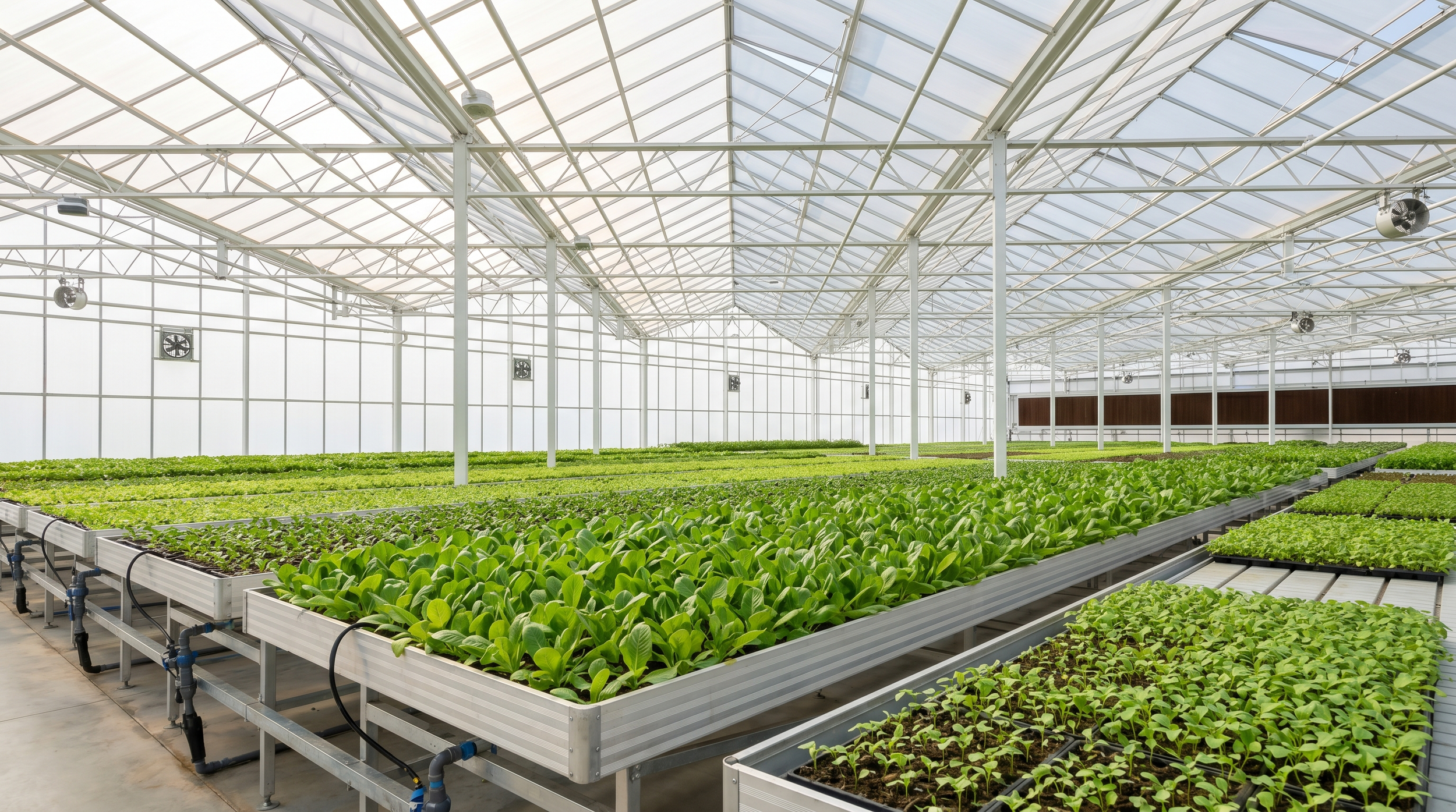
Commercial greenhouse with opal polycarbonate twinwall roof — Coxwell Spry
FIG. 01 · InstalledPolycarbonate Greenhouse Covering Systems
01 · Overview

Plants need diffuse light — not the harsh direct rays that create hotspots, burn foliage, and drive up cooling costs. Polycarbonate twinwall greenhouse covering diffuses incoming light across the entire growing surface, eliminates shadows, and provides a thermal break that protects plants from temperature extremes.

Coxwell Spry twinwall is the standard specification for commercial nurseries and research greenhouses across India. 27 commercial nurseries and counting.

02 · Why polycarbonate

Polycarbonate vs alternatives.

FeaturePolycarbonateGlassSingle-layer PE film
Light diffusion✓ Even, shadow-freeDirect rays — hotspotsPartial
Thermal insulation✓ Twin-wall air gapPoor (single pane)None
Impact resistance250× glassShattersTears
LifespanLong-term outdoor performance20+ years (with maintenance)1–3 seasons
UV protectionCo-extruded both sidesNoneDegrades in 1–2 years
MaintenanceNoneAnnual seal + cleaningAnnual replacement
03 · Products

Recommended for this application.

Primary

Coxwell Spry

The standard for commercial greenhouse covering in India. Available in 1,200 mm and 2,100 mm widths — fewer joints means less installation time and a cleaner, more uniform light environment. Opal White for maximum diffusion. Clear for research greenhouses requiring maximum PAR transmission.

Specify Coxwell Spry
Also consider

Coxwell Static

For glazed greenhouse end-walls, partitions, and lean-to greenhouses where maximum light transmission is required alongside impact resistance. UV co-extruded for long-term PAR transmission.

Specify Coxwell Static
04 · Specification

How to specify.

Specifying polycarbonate for greenhouses

6 mmResidential and small nursery greenhouses. Short spans.
8 mmStandard commercial nursery. Most common specification.
10 mmLarge commercial greenhouses. Better thermal performance.
12 mmCold-climate or high-load greenhouses.
1,200 mm widthStandard. Suitable for most greenhouse structures.
2,100 mm widthWide-format. Fewer joints, faster installation, better appearance.
Opal WhiteBest diffusion. Standard for commercial horticulture.
ClearMaximum PAR (photosynthetically active radiation). For research or high-light crops.
Blue TintUsed in some tropical species cultivation. Reduces far-red spectrum.
6 mm U-valueApproximately 3.1 W/m²K
8–10 mm U-valueApproximately 2.5–2.8 W/m²K
12 mm U-valueApproximately 2.3 W/m²K
PAR — Opal 8mmApproximately 60% PAR
PAR — Clear 8mmApproximately 80% PAR
05 · Reference projects

In the field.

Commercial Nurseries — National

27 commercial nurseries across India specify Coxwell Spry in Opal White. Applications include propagation houses, grow-out structures, and shade-net replacement.

Home Greenhouse Applications

Coxwell Static 4–6 mm and Spry 6–8 mm are available for residential greenhouse, grow house, and cold frame construction.

View project →
06 · FAQ

Common questions.

What is the best polycarbonate for a greenhouse in India?+

For most Indian commercial greenhouses, Coxwell Spry Twinwall 8 mm in Opal White is the standard specification. The Opal tint provides full diffusion (no hotspots), the twin-wall structure provides a thermal break, and the UV co-extruded coating is designed to maintain PAR transmission throughout the product life. For maximum light transmission in research greenhouses or high-light crops, Clear tint is specified.

How does polycarbonate compare to glass for greenhouse covering?+

Polycarbonate is lighter (1.5–2 kg/m² vs 10–15 kg/m²), more impact resistant (250× glass), and provides better thermal insulation through its multi-wall cell structure. Unlike glass, polycarbonate twinwall diffuses incoming light — eliminating the hotspots that direct glass transmission creates. The main advantage of glass is marginally higher light transmission, but this is outweighed by the diffusion and thermal benefits of polycarbonate for most commercial horticulture.

Will polycarbonate greenhouse panels yellow over time in Indian sun?+

All Coxwell polycarbonate panels have UV protection co-extruded into the surface layer — not coated on. This means the UV protection is integral to the material and cannot peel or wash off independently of the panel.

What width of polycarbonate sheet is best for a greenhouse?+

Coxwell Spry is available in 1,200 mm and 2,100 mm widths. The wider 2,100 mm format reduces the number of joints in the greenhouse structure, speeds installation, and creates a more uniform light environment. For curved greenhouse structures, 1,200 mm is easier to handle during installation.

Can polycarbonate greenhouse panels handle hailstorms?+

Yes. Polycarbonate has 250× the impact resistance of glass. In typical Indian hailstorms, polycarbonate greenhouse panels will not break, crack, or deform. This is one of the primary reasons commercial nurseries specify polycarbonate over glass in hail-prone regions of India.

What is the difference between Coxwell Spry and Coxwell Static for greenhouses?+

Spry is a twinwall (two-layer) sheet that provides light diffusion and thermal insulation — it is the primary greenhouse covering choice. Static is a single solid sheet with high clarity (up to 89% transmission) and no thermal insulation — it is used for greenhouse end-walls, side panels, and dividing partitions where maximum light and structural clarity are required alongside impact resistance.

07 · Specify

Specify polycarbonate greenhouse covering with Coxwell →

Tell us your greenhouse dimensions, crop type, and climate zone. We respond with a product and quantity recommendation in 48 hours.

Get a greenhouse quote →
Have a project to spec?Engineering response within 48h
Get a quote →