
U-Value vs Light Transmission vs Lux: What Actually Matters for Your Polycarbonate Roof
Most buyers confuse U-value, light transmission, and lux when specifying polycarbonate roofing. Here's what each actually measures — and why getting them mixed up leads to expensive mistakes.
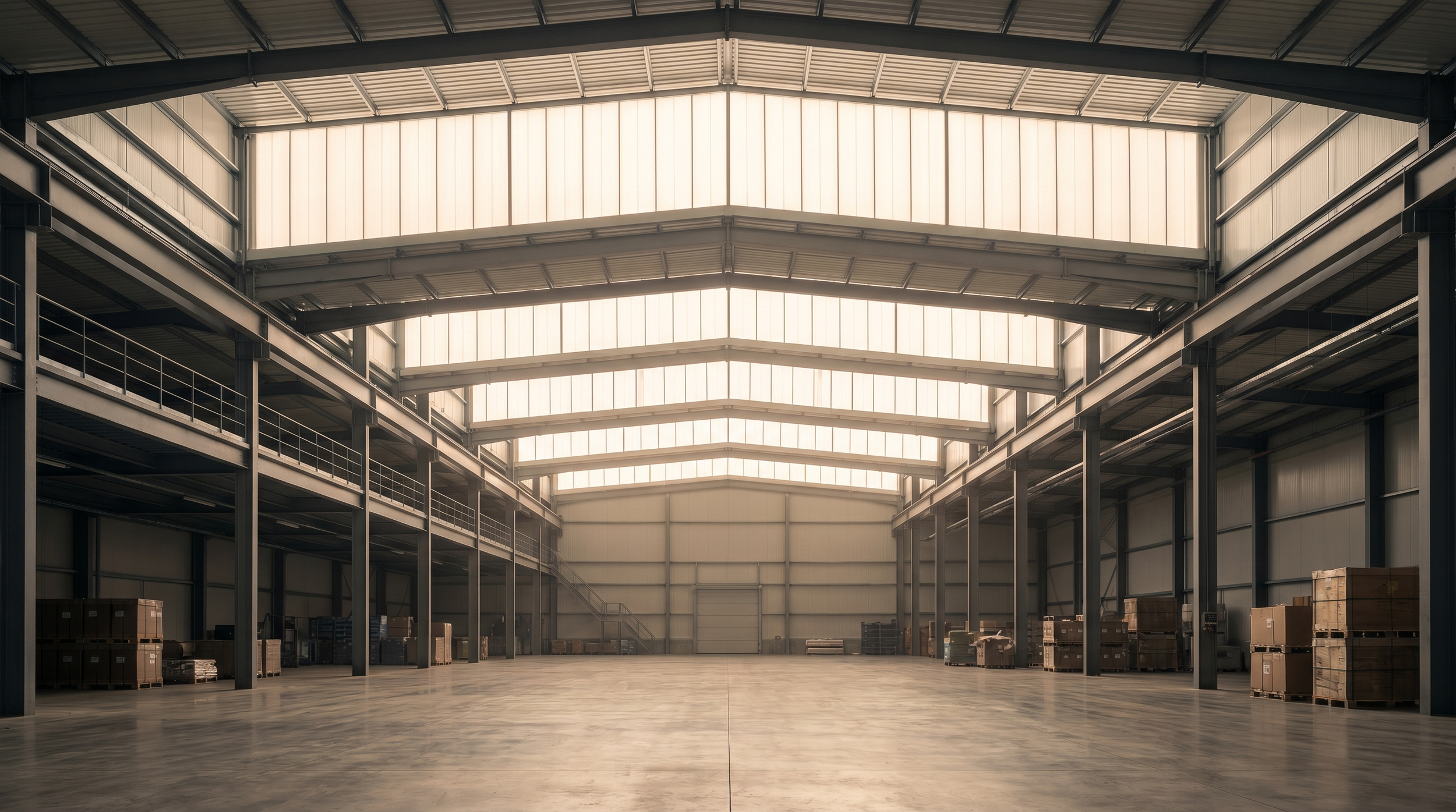
When clients brief us on a skylight or translucent roofing project, three numbers come up most often: U-value, light transmission, and lux. They're used interchangeably. They shouldn't be. Each measures something completely different — and confusing them is one of the most common reasons a polycarbonate roof disappoints after installation.
This post breaks down each metric precisely, explains how they interact, and gives you a framework for using them to make better specification decisions.
What Is U-Value?
U-value (also called thermal transmittance) measures how much heat flows through a material per unit of surface area, per degree of temperature difference. It is expressed in W/m²K.
The rule is simple: lower U-value = better insulation.
A polycarbonate panel with a U-value of 1.4 W/m²K resists heat transfer significantly better than one rated at 3.0 W/m²K. In practical terms, lower U-value means:
- Less heat entering the space in summer
- Less heat escaping in winter (relevant for heated spaces)
- Reduced cooling load, which can meaningfully impact HVAC sizing and running costs
- More thermally comfortable interiors under a daylighted roof
As a reference point: our Prism 16mm system offers approximately 1.58 W/m²K, while a Snapwall 40mm system reaches approximately 0.99 W/m²K — comparable to a double-glazed aluminium window system.
When does U-value matter most?
U-value matters most when occupant comfort is a design requirement — factories, warehouses, sports halls, atria, railway canopies, and any space where people spend extended time. It is also increasingly specified in projects with sustainability or energy efficiency targets.
If you're pricing purely on area and thickness without asking for U-value, you're leaving a major variable unaccounted for.
What Is Light Transmission (LT)?
Light transmission is the percentage of visible light that passes through the panel under standardised test conditions. It is a material property — it belongs to the panel itself, not the project.
A panel with 60% LT lets through 60% of incident visible light. A 40% LT panel lets through 40%.
Higher LT = more light entering. But that is not always better.
What LT does not tell you:
- How bright the floor will actually feel
- Whether occupants will experience glare
- Whether light distribution will be even across the space
- How much solar heat gain accompanies the light
LT is a useful input for product comparison and application matching. A cold-storage facility may want high LT to maximise natural light. A call centre or school might want moderate LT to avoid glare on screens and working surfaces.
The mistake buyers make is treating LT as the only daylighting metric — specifying the highest available LT and expecting the best result. In many real-world projects, this produces glare, heat discomfort, and eventually a request to paint over the skylights.
What Is Lux?
Lux is a measure of illuminance: the amount of light falling on a surface, measured in lumens per square metre. It is the actual light level in the room.
Unlike U-value and LT, lux is not a product property. It is a project outcome.
The lux level inside any given space depends on:
- The LT of the panel (product input)
- The angle of the sun at the time of measurement
- Seasonal variation and weather
- The orientation of the roof
- The height of the roof above the occupied plane
- Internal wall and floor reflectance
- Obstructions from structural members
- The diffusion characteristics of the panel
This is why no responsible manufacturer should quote lux to you as a product specification. Lux can only be calculated or modelled for a specific project with specific site conditions. A daylight engineer can do this using tools like VELUX Daylight Visualiser, Dialux, or Radiance — but the lux outcome is a simulation result, not a panel spec.
LT is what the panel does. Lux is what happens in your building.
How the Three Work Together
Here's a practical way to think about specification:
- U-value governs thermal comfort and energy performance. Set your target U-value first based on the thermal requirements of the space.
- Light Transmission governs how much daylight enters. Match LT to the intended use of the space — higher for task-neutral environments like warehouses or sports halls; moderate or diffused for offices, schools, and assembly spaces.
- Lux is verified by daylight simulation after the panel selection is made. It is a check, not a starting point.
Getting the sequence wrong leads to real problems. Choosing maximum LT without considering diffusion creates glare. Ignoring U-value on a south-facing roof in Rajasthan means an overheated interior regardless of how beautiful the panel looks.
The Question to Ask Your Supplier
The next time you're evaluating a polycarbonate system, ask for all three:
- "What is the tested U-value for this panel and thickness?"
- "What is the light transmission of this specific colour and thickness?"
- "What diffusion characteristic does this panel have?"
If the supplier gives you lux numbers as a panel spec — be sceptical. Lux is determined by your project, not their factory.
Coxwell manufactures standing seam polycarbonate panel systems — Multicell, X-Fix, Vivid, Prism, Snapwall and more — with tested U-values ranging from 0.99 to 2.4 W/m²K across the product range. Ask us for the full technical data sheet for any system.
Next step
Speak to a Coxwell engineer.
Our team can help you specify the right system, review your BOQ, or answer technical questions about your project.