What Buyers Should Check: UV Ageing, Yellowing, and Long-Term Transparency in Polycarbonate Panels
Yellowing and hazing in polycarbonate roofing are not inevitable — they're the result of inadequate UV protection. Here's exactly what to check before you buy.
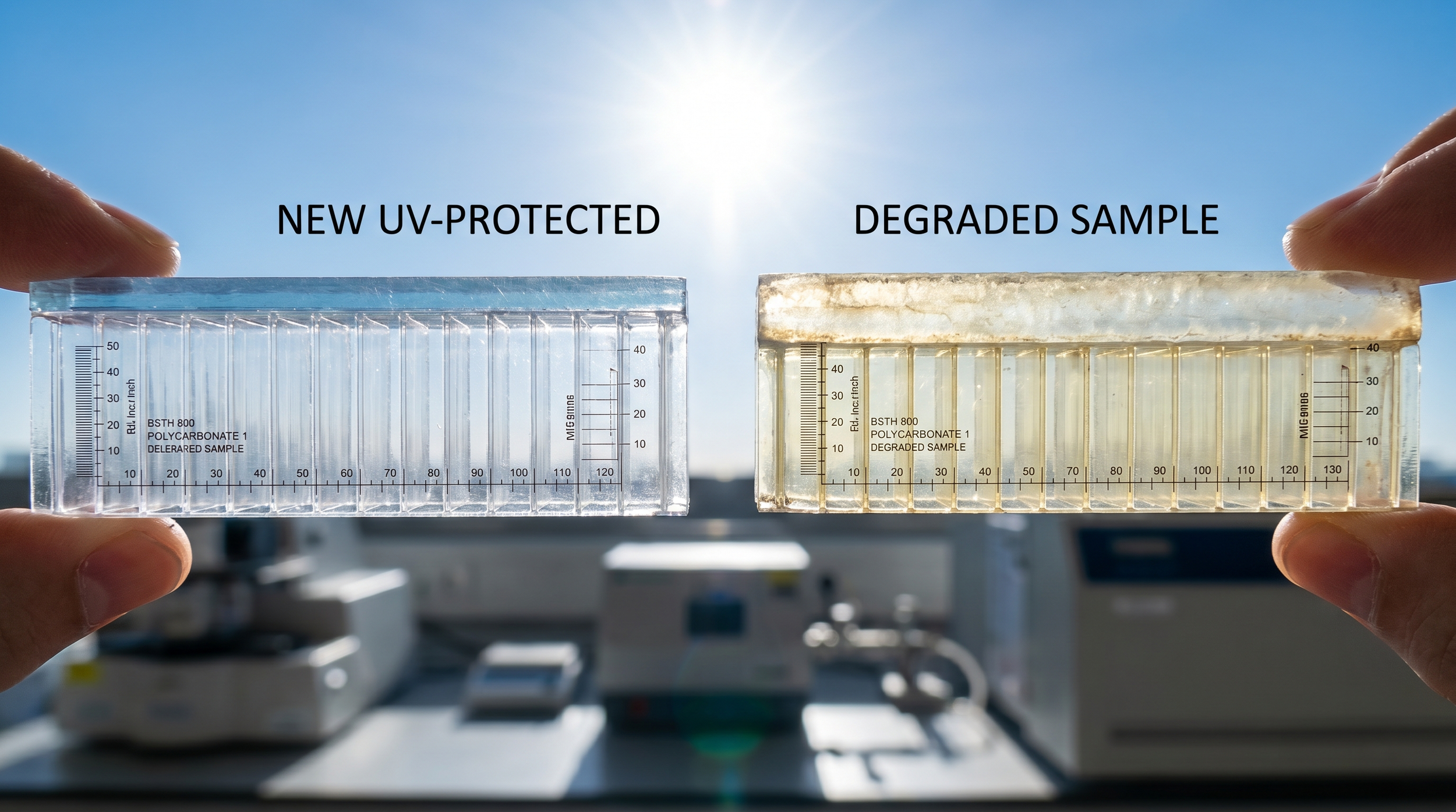
Walk into any building with a polycarbonate skylight that was installed without proper UV protection, and you'll see it immediately: a brownish-yellow tint, reduced light transmission, a material that looks brittle and tired. This isn't a polycarbonate problem. It's a UV protection problem — and it's entirely avoidable if you know what to check before purchasing.
This post explains the science of UV degradation in polycarbonate, what the industry tests measure, and the specific numbers you should demand from any supplier before signing off on a purchase.
Why Polycarbonate Yellows Without Protection
Polycarbonate is a polymer. Like all organic polymers, it is susceptible to photodegradation — a chemical breakdown triggered by ultraviolet radiation. Without protection, UV exposure breaks the polymer chains, causing:
- Yellowing (increased yellowness index): The material shifts from clear/neutral to yellow and eventually brown
- Hazing: Surface becomes increasingly opaque and dull
- Embrittlement: The material loses impact toughness and becomes more likely to crack under load
- Reduced light transmission: Less visible light passes through as the material degrades
In India's climate — where UV index frequently reaches 10–11 in northern and central regions during summer — unprotected polycarbonate can show visible degradation within 2–3 years.
The solution is co-extruded UV protection: a UV-absorbing compound bonded into the surface of the polycarbonate during manufacturing, making it a permanent part of the material rather than a coating that can wear off.
Understanding the Yellowness Index
The Yellowness Index (YI) is the industry-standard measurement of colour shift in clear and near-clear materials. It is measured according to ASTM E-313 (or the older ASTM D1925).
A lower YI means less yellowing. A new, clear polycarbonate panel might have a YI around 2. Industry standards require that after accelerated UV exposure testing, the change in YI — expressed as ΔYI — should not exceed 10 units.
The accelerated ageing test is conducted per ASTM G-155 — a Xenon arc lamp test that simulates years of outdoor UV exposure in a controlled timeframe. The minimum industry standard exposure is 500 hours under this test protocol.
What this means in practice: if a panel starts with YI = 2 and ends with YI = 8 after 500 hours of ASTM G-155 exposure, the ΔYI = 6 — it passes. If it ends at YI = 16, ΔYI = 14 — it fails the standard.
Any supplier who cannot provide a third-party ASTM E-313 test certificate conducted after ASTM G-155 exposure is not selling to an adequate quality standard.
European Classification: BS EN 16240
The European standard BS EN 16240 classifies polycarbonate panels into four durability classes (ΔA through ΔF) based on how their yellowness index and light transmittance change after accelerated weathering at 18 GJ/m² radiant exposure:
| Class | Max ΔYI (uncoloured) | Max Δτv (light transmittance loss) |
|---|---|---|
| ΔA | ≤10 | ≤5% |
| ΔD | n/a (from same resin as ΔA) | ≤10% |
| ΔE | ≤10 | ≤10% |
| ΔF | n/a (from same resin as ΔE) | ≤20% |
Class ΔA is the highest durability classification for uncoloured panels. For a long-life installation — schools, airports, railway stations, industrial facilities — specifying a panel that meets Class ΔA criteria is the correct baseline.
Co-Extrusion vs Surface Coating: The Critical Difference
There are two ways to add UV protection to a polycarbonate panel:
1. Co-extrusion (correct method)
The UV-absorbing compound is incorporated during the extrusion process itself. The UV protection layer is a permanent, integral part of the panel structure. It cannot peel, delaminate, wash away, or be removed by cleaning. Co-extruded layers are typically measured in microns of thickness.
Standard specification for quality panels:
- Top (sun-exposed side): 45–50 microns co-extruded UV protection
- Bottom (interior side): 15–25 microns co-extruded UV protection
2. Surface coating (inferior method)
A UV-protective lacquer or coating is applied to the surface of the finished panel. These coatings can achieve short-term test performance but degrade through weathering, cleaning abrasion, and thermal cycling. Surface-coated panels should not be specified for external applications with a required service life over 5 years.
How to tell the difference: ask the manufacturer for the co-extrusion confirmation in writing. A co-extruded layer has a measurable, consistent thickness across the panel width. A coating does not have the same structural integrity.
The Impact Test Connection
UV testing is not only about aesthetics. Polycarbonate's structural performance — specifically its impact resistance — also degrades with UV exposure.
The correct impact test for polycarbonate is the Dart Drop Impact Test per IS 14443-97. Critically, this test must be performed on panels that have already been subjected to 500 hours of UV exposure per ASTM G-155 — not on fresh, unexposed samples.
A panel that passes the dart drop test when new but fails after UV exposure is not suitable for external use. The sequence of testing matters.
What to Ask Your Supplier
Before signing any order for polycarbonate panels, request:
- ASTM E-313 Yellowness Index test certificate — ΔYI after 500 hrs ASTM G-155 must be ≤10
- ASTM G-155 UV exposure protocol confirmation — minimum 500-hour test
- IS 14443-97 Dart Drop test certificate — conducted on UV-exposed samples
- Co-extrusion thickness declaration — 45–50 microns top side, in writing
- Testing lab credentials — must be NABL-accredited (India) or equivalent internationally accredited lab
If any of these certificates are unavailable, are more than 8 years old, or cover a different panel configuration than what is being supplied, treat it as a disqualifying issue.
A Note on "Lifetime Guarantees" in Marketing
Some suppliers offer impressive-sounding lifetime or 25-year warranties. Read the terms carefully. Most such warranties cover only manufacturing defects — not yellowing, not haze, not light transmission loss. The metrics that actually define long-term performance are covered by the test certificates, not the marketing warranty.
The only warranty that matters for UV performance is one that commits to specific, measurable limits on YI change and light transmittance loss over the warranty period, backed by test evidence.
Coxwell panels are co-extruded with a minimum 45–50 micron UV protection layer on the sun-exposed side. All products are tested to ASTM E-313, ASTM G-155, and IS 14443-97 by NABL-accredited laboratories. Request our test certificates for any system.
Next step
Speak to a Coxwell engineer.
Our team can help you specify the right system, review your BOQ, or answer technical questions about your project.