
How Orientation Changes Everything: North, South, East and West Skylights Compared
The same skylight facing north, south, east, or west delivers completely different light quality, heat load, and design performance. Here's what every architect should know before placing an aperture.
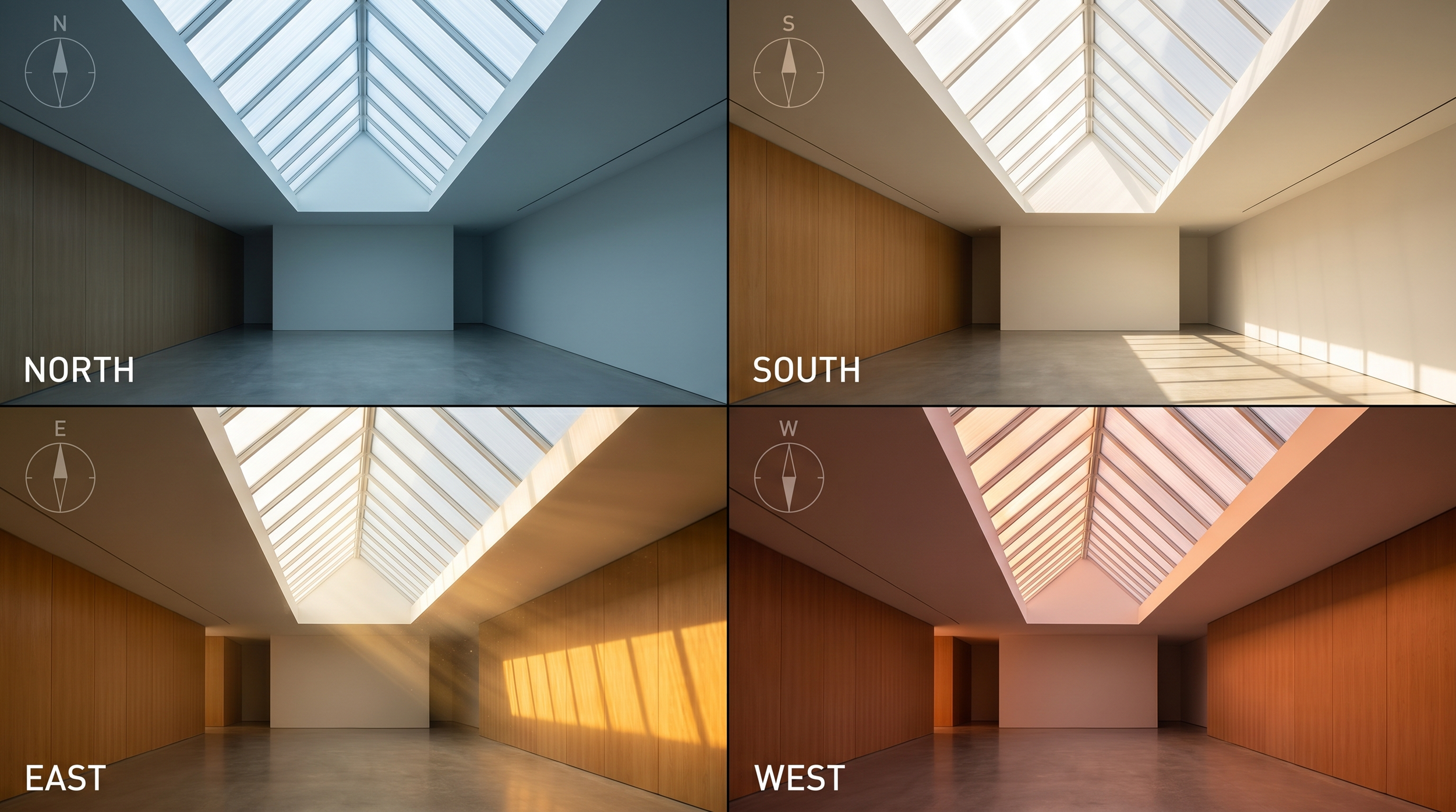
Two architects specify identical skylights over identical floor areas. One faces north. The other faces south. The result is not "the same skylight in a different direction." The result is a fundamentally different daylighting system — with different light quality, different thermal behaviour, different glare characteristics, and different occupant experience throughout the day and across the seasons.
Orientation is the single most consequential decision in skylight design, and it is made before any product is specified. This post covers what each orientation actually delivers — and what it costs.
Why Orientation Matters
The sun does not behave the same from all directions. In India's tropical and subtropical climate (roughly 8°N to 37°N latitude), the sun:
- Rises in the east, sets in the west, reaching peak altitude in the southern sky (for locations north of the Tropic of Cancer) or overhead/slightly north (for locations near the tropics)
- Is low in the eastern sky in the morning and low in the western sky in the evening
- Is highest in the southern sky at solar noon
- Never appears in the northern sky (for latitudes above 23.5°N)
This geometry means that north-facing apertures receive no direct sunlight at all north of the Tropic of Cancer, while south, east, and west openings receive direct sun at varying angles and intensities throughout the day.
The practical consequences determine everything that follows.
North-Facing: The Preferred Studio Light
In the northern hemisphere, north-facing skylights and clerestories receive only diffused skylight — no direct sun. This produces a light that is:
- Constant throughout the day. Diffuse skylight varies gradually with cloud cover and time of day, but does not produce the sharp intensity shifts of direct sunlight. A north-lit room will look broadly similar at 9am and 4pm.
- Cool in colour temperature. Diffuse skylight has a higher colour temperature than direct sunlight — typically 6,000–8,000K on a clear day. This cool, neutral quality is why north light has been prized by artists for centuries. Colours appear accurately; the light does not cast warm shadows.
- Free of glare under most conditions. Because no direct beam enters the space, north skylights rarely produce specular glare on work surfaces or visual discomfort from direct sun entry.
- Lower in lux. The trade-off for the quality of north light is quantity. A north-facing skylight will deliver lower lux than an equivalent south-facing skylight under the same sky conditions, because it only sees the diffuse sky dome rather than the direct solar disc.
Best applications: Art studios, architecture studios, galleries (especially those displaying sensitive artworks), design offices, laboratories where accurate colour rendering matters, and any application where consistent, glare-free natural light is the primary requirement.
Material implication: For north-facing skylights, clear or lightly diffused panels with higher light transmission are appropriate — the lack of direct sun means the risks of glare and overheating are low, and higher LT maximises the available diffuse daylight.
South-Facing: High Performance, High Management
In India, south-facing skylights receive the sun at its highest altitude — particularly between 10am and 2pm on clear days, when the sun is in the southern sky. This produces:
- The highest available daylight levels during midday hours. South-facing skylights can deliver more lux per unit area than any other orientation, because they receive direct sunlight at high angles that penetrate deep into the space.
- Seasonal variation. In summer, the sun is high in the southern sky and enters steeply — providing good daylight with a relatively small direct-sun zone. In winter, the sun is lower, and the direct beam penetrates further into the space at a shallower angle. South-facing skylights in India's climate can produce useful passive solar heating in winter and challenging overheating in summer.
- The highest solar heat gain. South is where direct solar radiation is most intense in India. A south-facing skylight without thermal management will contribute significantly to cooling load in summer months.
- Potential for direct glare. When the sun is low (early morning or late afternoon in winter), even south-facing skylights can admit high-angle direct beams that produce specular glare on screens and work surfaces.
Best applications: Industrial facilities where thermal load management is less critical and maximum daylight is the priority; passive solar designs where winter heat gain is intentional; spaces used primarily in the morning or evening when the sun angle is more favourable.
Material implication: South-facing skylights in India's climate benefit significantly from panels with infrared-reducing finishes (which reduce heat entry without proportionally reducing visible light) and from diffusing characteristics that scatter the high-intensity beam into a more even distribution. Lower LT panels (40–50% rather than 60–70%) also help manage heat gain.
East-Facing: The Morning Worker
East-facing skylights and roof lights receive direct sun in the morning hours (typically 7am to 11am, depending on season and latitude) and skylight thereafter. This produces:
- Strong, warm morning light. East light has a lower colour temperature than midday south light — warmer tones, longer shadows. This quality of light is often described as invigorating and is associated with a sense of beginning.
- Afternoon shade. After approximately 11am–noon, east-facing skylights receive only diffuse skylight. An east-lit space will feel brighter in the morning and progressively more reliant on artificial light as the afternoon progresses.
- Moderate heat gain. Morning solar radiation is lower in intensity than midday south radiation, so east-facing skylights generate less heat gain than south-facing equivalents. The heat load peaks in the morning, when the building's thermal mass has not yet accumulated the day's heat.
- Low-angle morning glare. The sun is low in the eastern sky in the morning, and if not controlled, can produce uncomfortable direct beam glare on east-facing working surfaces.
Best applications: Spaces primarily occupied in the morning (breakfast areas, morning meeting rooms, classrooms used in the first half of the day); buildings where morning activation and energy is a design intent; retail environments where morning visual appeal matters.
Material implication: Diffusing panels at low-to-moderate LT (40–55%) are well-suited to east-facing skylights, managing the morning direct beam without eliminating the morning light quality.
West-Facing: The Afternoon Challenge
West-facing skylights are the most problematic orientation in most building types. The sun is in the western sky from approximately noon to sunset, and it is at its lowest angle in the late afternoon when the building and its contents are at their warmest.
- The hottest light. West-facing solar radiation arrives in the afternoon when outdoor temperatures are at their peak and the building's thermal mass has already absorbed the day's solar load. West windows and skylights add heat at the worst possible time, compounding cooling demand.
- The lowest, most intense glare. The setting sun at 3–5pm is at a very low angle — between 10° and 30° in most Indian locations. This nearly horizontal light is the most glare-producing of any orientation, and almost impossible to control without completely obstructing the view.
- Warm, dramatic light quality. Late afternoon western light has a very warm colour temperature and produces long, dramatic shadows. Photographically and experientially, it is often described as the most beautiful light of the day — but it is also the most uncomfortable for sustained task work.
Best applications: Corridors and circulation spaces where glare at screen or desk level is not a concern; dramatic reception or atrium spaces where the evening light quality is valued and the space is not used for sustained tasks; spaces with active solar shading that can be fully deployed in the afternoon.
Avoid for: Office workstations, classrooms in afternoon use, hospital wards, any space where occupants need to look in the direction of the aperture during afternoon hours.
Material implication: If west-facing skylights are used in task environments, the highest priority is aggressive diffusion to scatter the low-angle beam — together with the lowest acceptable LT to limit heat and glare intensity.
Practical Orientation Principles for Architects
- North light is the safest choice for task environments — consistent, glare-free, and requires the least management.
- South light is the most productive for industrial daylighting — highest lux yield, manageable with the right material selection.
- East light serves morning-biased uses well — consider time-of-use patterns before specifying.
- West light is the hardest to manage in occupied task spaces — use only where the risks are understood and addressed.
- Mixing orientations on a complex roof gives more consistent daylight across the day than a single orientation — but requires more careful balance in product selection to avoid uneven light levels between zones.
Coxwell can provide orientation-specific product recommendations for your project, including guidance on light transmission, infrared finishes, and diffusion characteristics suitable for each aperture orientation.
Next step
Speak to a Coxwell engineer.
Our team can help you specify the right system, review your BOQ, or answer technical questions about your project.