
Polycarbonate Daylighting for Poultry Farms and Livestock Sheds in India: A Practical Guide
Daylighting a poultry or livestock shed has different priorities than a factory or home — heat stress, light distribution, and ventilation. Here's how to specify polycarbonate roofing correctly.
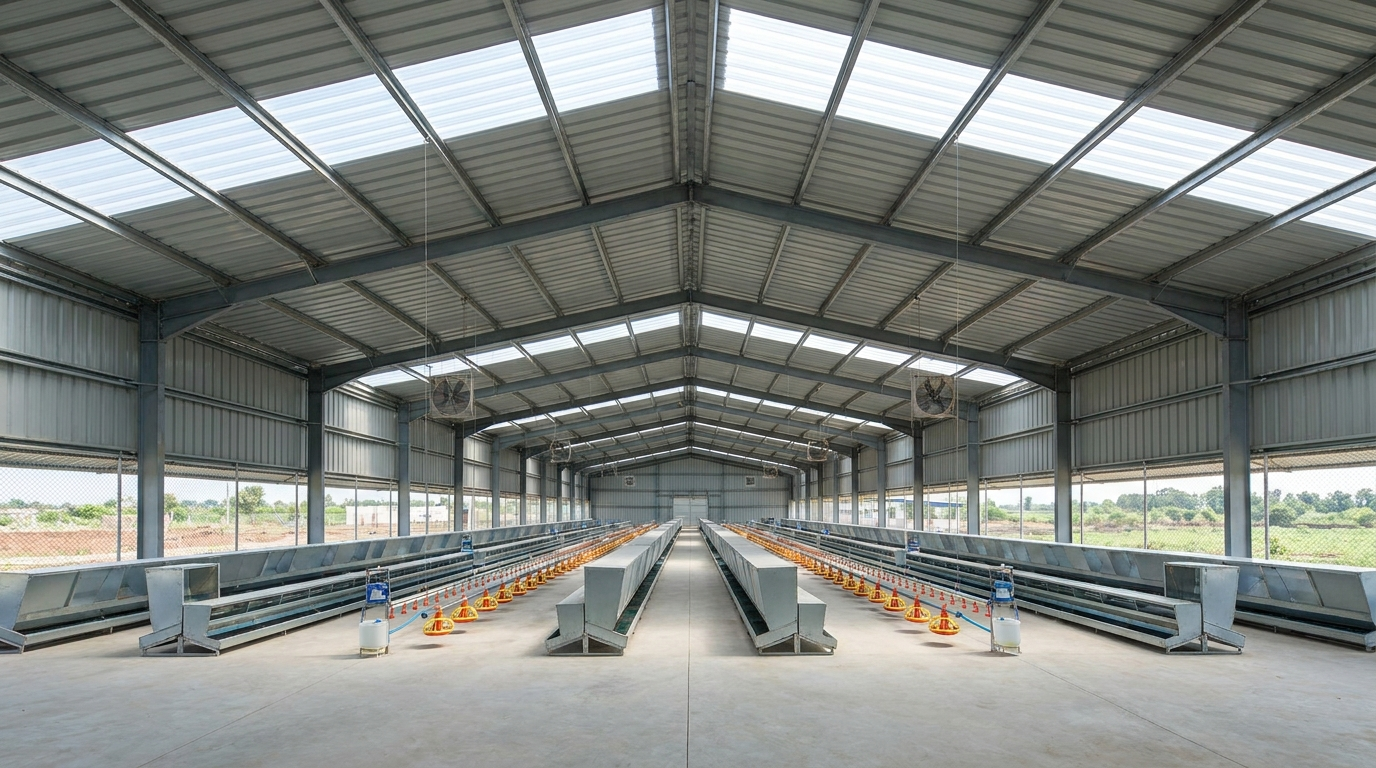
Poultry and livestock sheds are one of the largest categories of translucent roofing in rural and semi-urban India, yet they get almost none of the specification attention that warehouses or greenhouses receive. Most sheds are still roofed with a mix of asbestos, plain GI sheet, and the occasional strip of clear plastic sheeting nailed in as an afterthought — a combination that gets the daylighting brief wrong on almost every count that matters for animal health and farm output.
This guide covers what's actually different about daylighting a poultry or livestock shed compared to an industrial or residential roof, and how to specify polycarbonate correctly for it.
Why Poultry Sheds Need a Different Daylighting Brief
Unlike a warehouse, a poultry or livestock shed has a living, temperature-sensitive occupant that cannot ask for the blinds to be adjusted. Three factors dominate the brief:
- Heat stress control. Poultry, in particular, are highly sensitive to heat stress — reduced feed intake, lower egg production, and higher mortality all follow from sustained high shed temperatures. A roof that lets in daylight but also traps heat is actively working against production.
- Even light distribution. Uneven lighting inside a shed causes birds to cluster in the dimmer or cooler zones, leading to crowding, stress, and inconsistent growth across a flock.
- Ventilation integration. In naturally ventilated, open-sided sheds, daylighting and ventilation are often part of the same roof detail — a ridge vent combined with a translucent strip, for instance. Closed or mechanically ventilated houses (tunnel or negative-pressure systems) are different: they depend on a sealed envelope and controlled inlets, and an uncoordinated ridge vent can short-circuit the designed airflow and pressure. Confirm which ventilation strategy the shed uses before assuming the two can be detailed together.
Why Plain GI Sheet and Asbestos Fall Short
Solid GI sheet or asbestos roofing offers zero daylighting on its own, which is why many sheds are lit almost entirely with electric bulbs or tube lights running through daylight hours — an ongoing running cost that a well-designed translucent roof section can significantly reduce. Asbestos in particular also carries well-documented health and regulatory concerns that have pushed many state agriculture departments to recommend against it for new poultry construction.
Introducing a polycarbonate daylighting strip into an otherwise metal-sheeted shed roof solves the lighting problem, but only if the thermal performance and diffusion are specified correctly — a clear, high-transmission strip in a hot region can do more harm than good by concentrating heat and glare directly over the birds below it.
Specifying Light Transmission and Diffusion for a Shed
The right approach mirrors what we recommend for greenhouse daylighting in our poly house daylighting guide: diffused panels that spread light evenly across the floor plate rather than clear panels that create a single bright band. For poultry sheds specifically, even light distribution is directly tied to even bird distribution — a shed with patchy lighting produces a shed with patchy occupancy, and patchy occupancy is one of the more common, preventable causes of inconsistent flock performance.
A Multicell or opal-tinted polycarbonate strip, sized as a percentage of roof area rather than as an isolated strip, gives more consistent results than a narrow clear insert. Our daylight factor guide explains how to calculate a rooflight-to-floor-area ratio for human-occupied industrial buildings — useful background, but not a direct substitute for poultry lighting design. Poultry illumination and photoperiod requirements (light and dark hours) vary by species, age, and production programme, and are normally set by the flock's lighting programme first; the translucent roof area should then be sized, or checked by simulation, against those targets rather than applied from a warehouse daylight-factor baseline.
Thermal Performance Matters More Here Than Almost Anywhere Else
Because heat stress is a direct production and welfare issue in poultry and livestock housing, thermal performance deserves more weight in a shed daylighting brief than it typically gets in a general industrial roof — and it isn't a single number. U-value measures conductive heat flow through the panel, driven by temperature difference; it does not measure the solar radiation a translucent roof admits directly, which for a sun-exposed shed is usually the bigger driver of heat stress. That's measured separately, as Solar Heat Gain Coefficient (SHGC, also called g-value or total solar transmittance). A panel can have a good U-value and still let through substantial solar heat if its SHGC isn't checked. Our U-value guide covers thermal transmittance and light transmission as separate specs — for a poultry or livestock shed, ask your supplier for SHGC/g-value figures alongside U-value, not U-value on its own.
Multiwall and Multicell structures, which trap air between internal ribs, perform meaningfully better here than solid clear sheet, reducing the direct heat load transmitted into the occupied space below.
Rain Noise and Structural Durability
Livestock sheds in India are frequently in regions with intense monsoon rainfall, and rain noise on a metal or thin plastic roof can measurably stress animals housed beneath it. Our rain noise guide explains why properly specified multiwall polycarbonate, correctly fixed, performs significantly better acoustically than bare metal sheeting — a genuine welfare consideration, not just a comfort one, for animals confined beneath the roof during heavy rain events.
Structurally, a shed roof should also be specified with hailstorm and wind-load performance in mind for regions prone to severe weather; our impact resistance guide covers what to check before committing to a panel and thickness.
A Practical Poultry/Livestock Shed Daylighting Checklist
- Use diffused (opal/Multicell) rather than clear panels to avoid hotspots and uneven flock distribution
- Size the translucent roof area against the flock's lighting/photoperiod programme, not a generic industrial daylight-factor ratio
- Ask for SHGC/g-value alongside U-value — U-value alone doesn't capture the solar heat a translucent roof admits directly
- Confirm the shed's ventilation strategy (naturally ventilated vs. tunnel/mechanically ventilated) before coordinating the daylighting strip with ridge or inlet vents
- Specify a fixing system rated for the region's wind and hail exposure
- Avoid asbestos and unrated clear plastic sheeting, both for compliance and long-term performance reasons
Coxwell supplies diffused polycarbonate daylighting systems for agricultural and livestock structures across India, engineered for thermal performance alongside light. Talk to our technical team about specifying the right system for your shed.
Frequently asked questions
Is polycarbonate roofing suitable for poultry sheds?
Yes, when specified correctly. Diffused polycarbonate panels (such as opal or Multicell) sized as a proportion of roof area provide even natural daylight while helping manage heat gain, which is preferable to clear panels that can create hotspots and encourage crowding in cooler zones.
Why does even light distribution matter in a poultry shed?
Birds tend to cluster in dimmer or cooler zones when lighting is uneven, which leads to crowding, stress, and inconsistent growth across a flock. Diffused, evenly distributed daylighting reduces this effect compared to a single bright clear-panel strip.
Does polycarbonate roofing help with heat stress in livestock housing?
It can, but only if you check Solar Heat Gain Coefficient (SHGC/g-value) alongside U-value. U-value measures conductive heat flow and doesn't capture the solar radiation a translucent roof admits directly, so a panel with a good U-value can still let through significant solar heat if its SHGC is high. Multiwall or Multicell polycarbonate structures generally perform better on both measures than solid clear sheet, but ask your supplier for both figures rather than U-value alone.
Is asbestos or plain GI sheet better than polycarbonate for shed roofing?
Plain GI sheet and asbestos provide no natural daylighting, requiring electric lighting to run through daylight hours, and asbestos carries recognised health and regulatory concerns that many state agriculture departments now advise against for new construction. A correctly specified polycarbonate daylighting section addresses both issues.
Next step
Speak to a Coxwell engineer.
Our team can help you specify the right system, review your BOQ, or answer technical questions about your project.