
Polycarbonate Sheets for Greenhouses: A Light Diffusion and Daylighting Guide for Poly Houses in India
Light diffusion, not just light transmission, is what actually drives crop growth under a greenhouse roof. Here's how polycarbonate panels compare to plastic film for poly houses in Indian growing conditions.
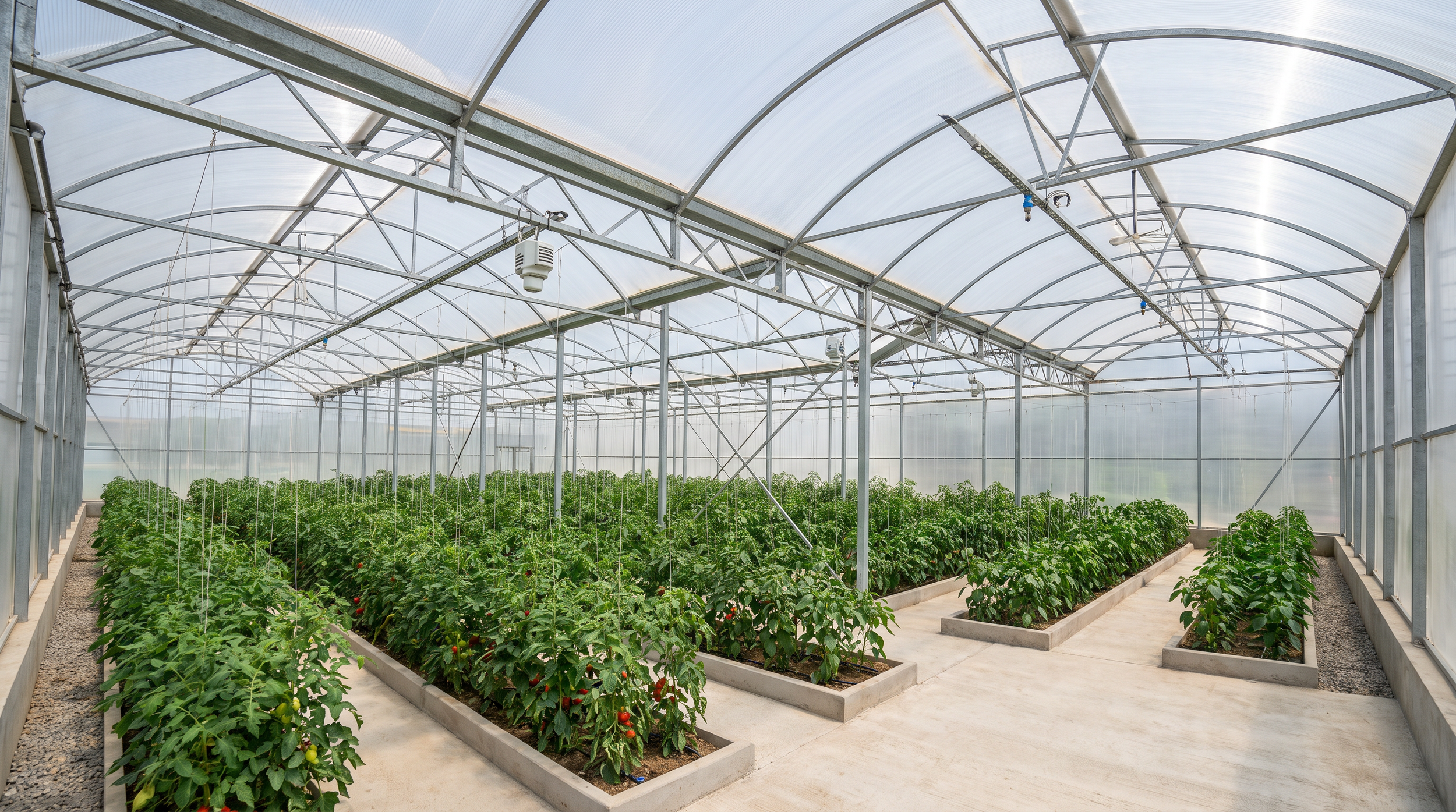
Ask most people what a greenhouse roof needs to do and they'll say "let light in." That's true, but incomplete — it's the quality of that light, not just the quantity, that determines crop yield, canopy temperature, and disease pressure inside a poly house. This is exactly why commercial protected-cultivation projects across India are increasingly moving from plain plastic film to engineered multiwall polycarbonate roofing: the material doesn't just transmit light, it diffuses it — and diffusion is the variable that actually matters for plant growth.
This guide explains how polycarbonate roofing performs in greenhouse and poly house applications, why light diffusion outperforms raw light transmission for crops, and how to select the right panel for an Indian growing climate.
Why Diffused Light Grows Better Crops Than Direct Light
Direct sunlight passing through a clear roof creates a plant canopy with bright, hot patches directly under the sun's angle and shaded, cooler patches elsewhere — the same unevenness problem we cover from a building-design angle in our glare and light transmission guide. In a greenhouse, that unevenness translates directly into inconsistent growth, localised leaf scorch on plants nearest the hotspots, and shadowing that limits lower-canopy photosynthesis.
A diffusing multiwall polycarbonate panel scatters incoming sunlight as it passes through the internal cell structure, spreading it evenly across the growing area regardless of the sun's angle through the day. The practical results growers report are:
- More even canopy temperature, reducing localised heat stress
- Light reaching lower leaves and inter-row spacing, not just the top canopy
- Reduced leaf scorch risk compared to concentrated direct sunlight
- More consistent photosynthesis across the full growing area, supporting more uniform yield
In greenhouse design, light transmission tells you how much light gets in. Diffusion tells you how evenly it lands on the crop. For plant growth, the second number matters as much as the first.
Light Transmission and Diffusion by Panel Type
The same fundamentals we explain for building daylighting in our U-value, light transmission, and lux guide apply directly to greenhouse roofing — light transmission (LT) is a panel property, while what the plant canopy actually experiences depends on diffusion, orientation, and structure height.
| Panel type | Typical light transmission | Diffusion characteristic |
|---|---|---|
| Clear multiwall (4–10mm) | 75–82% | Low — closer to direct transmission |
| Diffused / opal multiwall | 65–75% | High — scatters light evenly across the cell structure |
| Clear solid sheet | 85–90% | Minimal — behaves closer to glass |
For most vegetable and floriculture poly houses in Indian growing conditions, a diffused multiwall panel in the 65–75% LT range is the standard recommendation — high enough for strong photosynthesis, diffused enough to prevent scorch and hotspotting, particularly in the intense midday sun common across much of the country.
Thermal Performance: The Second Reason Polycarbonate Wins Over Plastic Film
Plastic film greenhouses lose their thermal advantage almost entirely — a single layer of film has essentially no insulation value, so internal temperature tracks the outside air closely, minus whatever passive solar gain accumulates. Multiwall polycarbonate's internal air-gap structure works the same way it does on building roofs: it resists heat transfer, moderating both extreme daytime heat buildup and rapid overnight heat loss.
This matters most in two scenarios common to Indian protected cultivation:
- Peak summer months, where an insulated, diffusing roof reduces the internal temperature spike compared to film or clear glazing, lowering ventilation and cooling load
- Winter nights in northern growing regions, where the insulation value reduces the rate of heat loss, protecting sensitive crops from cold shock
Polycarbonate also carries a structural advantage plastic film simply can't match: it doesn't tear, rip, or require replacement every 2–4 years the way agricultural film does. A well-specified polycarbonate poly house roof is typically rated for 10+ years of UV exposure, provided it carries genuine co-extruded UV protection — the same specification point we detail in our specification checklist, which applies just as much to agricultural structures as commercial buildings.
Selecting the Right System for a Poly House
- Choose diffused over clear for most food and ornamental crops, unless the crop specifically benefits from higher direct light (consult your agronomist on crop-specific light requirements).
- Match thickness to span and local wind/hail exposure — our thickness guide applies directly to greenhouse spans, and our hailstorm resistance guide is particularly relevant for open agricultural sites with no surrounding wind break.
- Confirm co-extruded UV protection on both surfaces — greenhouse roofs see more cumulative sun exposure hours than most building roofs, making UV grade a bigger long-term cost factor, not a smaller one.
- Plan for ventilation design alongside the roof — a well-diffused roof reduces but doesn't eliminate the need for ridge or side ventilation to manage humidity and prevent fungal pressure.
- Verify drainage slope — a minimum 5–7° slope is required for proper water shedding, the same standard we specify for commercial roofing.
Is Polycarbonate Worth It Over Standard Greenhouse Film?
For low-value, short-cycle crops with tight capital budgets, film remains a reasonable choice. For commercial floriculture, high-value vegetable production, export-grade produce, or any operation where consistent yield and reduced replacement cycles matter, the higher upfront cost of a polycarbonate roof is typically recovered through longer service life, lower replacement frequency, and more consistent crop output from better light distribution.
Coxwell supplies diffused multiwall polycarbonate systems engineered for protected cultivation, with tested UV protection and light diffusion data for every panel. Talk to our team about the right specification for your poly house or commercial greenhouse project.
Frequently asked questions
Is polycarbonate better than plastic film for greenhouses?
For commercial floriculture, high-value vegetable production, or export-grade produce, polycarbonate is typically worth the higher upfront cost because it lasts 10+ years versus the 2-4 year replacement cycle of plastic film, and it diffuses light more evenly across the crop canopy.
What light transmission is best for a poly house roof?
For most vegetable and floriculture poly houses in Indian conditions, a diffused multiwall panel in the 65-75% light transmission range is standard — high enough for strong photosynthesis while diffused enough to prevent leaf scorch and hotspotting.
Why does light diffusion matter more than light transmission for plants?
Light transmission only tells you how much light enters. Diffusion determines how evenly that light lands on the crop canopy — direct, undiffused light creates hot, bright patches and shaded, cooler patches, causing uneven growth and localised leaf scorch.
Does polycarbonate roofing help regulate greenhouse temperature?
Yes. Multiwall polycarbonate's internal air-gap structure provides insulation value that plastic film lacks, moderating daytime heat buildup in summer and reducing overnight heat loss in winter, which plain film cannot do.
Next step
Speak to a Coxwell engineer.
Our team can help you specify the right system, review your BOQ, or answer technical questions about your project.