
Glare: Why Higher Light Transmission Does Not Mean Better Daylight
The instinct to maximise light transmission in a skylight is understandable — but often wrong. Glare, discomfort, and occupant-blocked skylights are the result. Here's how to specify for daylight quality, not just quantity.
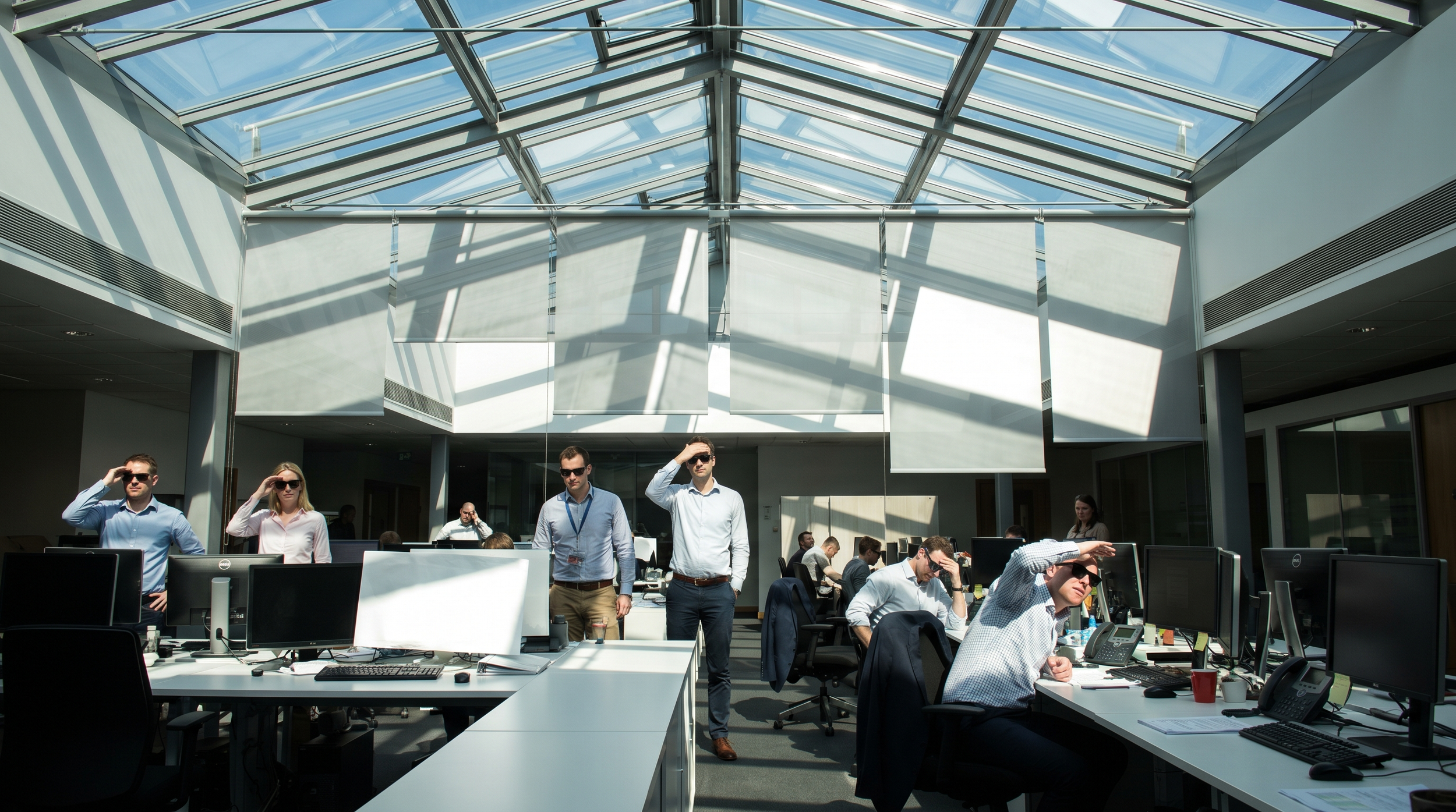
Walk into almost any building with clear glass or high-LT polycarbonate overhead, and you will witness the same failure pattern: blinds drawn against the sky, desks turned away from the windows, occupants complaining about headaches. The building was designed to be daylit. The occupants have made it a cave.
The cause, in nearly every case, is glare. The intention to maximise natural light has produced the opposite of what was wanted — a space that its users have rejected.
Understanding glare is essential to understanding daylighting. A high light transmission value in a product specification is not a proxy for good daylight. It is a starting point that, without the right context, can produce actively worse daylight than a lower-LT alternative.
What Is Glare?
Glare is visual discomfort caused by excessive luminance contrast within the visual field. It occurs when a bright source — a window, a skylight, a shaft of direct sunlight — is significantly brighter than the surrounding surfaces that the eye is adapted to.
There are two types relevant to daylighting:
Disability glare reduces visual acuity — the bright source scatters light inside the eye, reducing contrast and making it harder to see. A driver looking into a low sun is experiencing disability glare. In buildings, direct sunlight entering at a low angle can produce the same effect on occupants looking towards the aperture.
Discomfort glare does not necessarily reduce visual acuity, but causes discomfort, fatigue, and the instinct to shield the eyes or adjust the position. Sustained exposure to discomfort glare is associated with headaches, eye strain, reduced concentration, and lower productivity.
The standard metric for discomfort glare in a lit space is the Unified Glare Rating (UGR). A UGR of 19 is the maximum recommended value for office spaces (CIBSE). Below 16 is considered comfortable for most sustained task work. Values above 22 are considered uncomfortable for most occupants.
How Daylighting Produces Glare
Daylight produces glare when the luminance of the daylit aperture is significantly higher than the luminance of the surrounding interior surfaces. The key variables are:
Direct sun entry. The solar disc, when visible through a clear aperture, has a luminance of approximately 1.6 × 10⁹ cd/m². A white ceiling in a daylit room might have a luminance of 100–300 cd/m². The ratio is approximately 5–15 million to one. Any aperture that allows direct view of the solar disc will produce severe disability and discomfort glare.
High-LT panels with no diffusion. Even without the solar disc being directly visible, a high-LT clear panel transmits direct sunlight as a coherent beam that creates bright spots on surfaces and high-contrast luminance patterns across the interior. These bright patches cause discomfort glare when they fall within the visual field.
Aperture-to-interior contrast. If the interior surfaces are dark (absorbing light rather than redistributing it), the aperture appears very bright by contrast even at moderate light levels. This is why dark finishes in daylit spaces often produce more perceived glare than pale finishes, even at the same lux level.
The 80% LT Skylight That Made the Building Darker
This sounds counterintuitive, but it is a real failure mode.
A high-LT clear or lightly translucent skylight over an office space introduces intense, high-contrast light that is concentrated in the zone directly below the aperture. The occupants in that zone experience glare and discomfort. The occupants in the surrounding zones, beyond the reach of the direct beam, are not significantly better lit than before. The result is that everyone draws blinds, repositions desks, or requests installation of internal shading — and the space ends up darker, more expensive to operate, and less pleasant than if a lower-LT diffusing product had been used from the start.
A 50% LT diffusing panel that distributes light evenly across a 20-metre floor plate may deliver more useful illumination — and certainly delivers better occupant experience — than an 80% LT clear panel that floods one zone and leaves the rest in contrast shadow.
Diffusion: The Variable That Changes Everything
Diffusion is the scattering of light as it passes through or reflects off a surface. In polycarbonate panels, diffusion occurs when the panel's internal structure (cell walls in multiwall panels, prismatic surfaces in Prism systems, matte finishes) scatters the incoming directional light into a broader angular distribution.
The practical effect of diffusion:
- Reduces the peak luminance of the transmitted beam (lowering the probability of glare)
- Spreads light over a larger area, improving uniformity across the floor plate
- Eliminates the "hot spot" effect of direct sun beams
- Softens shadows under the skylight, making the space more visually comfortable
Diffusion does not reduce lux in proportion to its light-scattering effect — it redistributes the lux more evenly rather than absorbing it. A diffusing panel at 55% LT may deliver higher useful illumination at 6 metres from the aperture than a non-diffusing panel at 75% LT, because the diffusing panel spreads its light further while the non-diffusing panel concentrates it nearby.
Antiglare Finishes in Polycarbonate Systems
Polycarbonate standing seam systems can be specified with an antiglare finish on the inner (bottom) surface of the panel. This is a structured matte surface that scatters transmitted light at the point of entry into the space, reducing specular reflections and the perception of bright spots.
Antiglare finish is particularly valuable for:
- Office and educational environments where screens, glossy surfaces, or white papers are likely to reflect transmitted sunlight
- South and east-facing skylights that admit direct sun during occupied hours
- Spaces where the roof mount height is low relative to the occupied zone, meaning the skylight is within the visual field of seated occupants
Antiglare does not affect the total lux delivered — it changes how the transmitted light is distributed across the surfaces below.
Specifying for Quality, Not Just Quantity
The correct specification sequence for daylighting quality is:
- Define the visual task and its lux requirement
- Assess the risk of glare based on orientation, sun angle, aperture geometry, and interior layout
- Select light transmission based on the minimum level needed to achieve the target lux — not the maximum available
- Specify diffusion level appropriate to the glare risk: for south and east-facing skylights in task environments, always specify a diffusing or antiglare panel; for north-facing skylights in studios and galleries, a clear or lightly diffused panel may be appropriate
- Consider infrared control separately from visible light — in hot climates, panels with infrared-reducing finishes block a significant proportion of solar heat while maintaining visible light transmission
The product with the highest LT on the datasheet is not the correct choice unless the glare risk analysis supports it. For most occupied buildings in India — offices, schools, hospitals, mixed-use spaces — a diffusing panel at moderate LT delivers better daylight quality than a clear panel at maximum LT.
Coxwell systems are available in standard, antiglare, and infrared-reducing finishes. All products come with tested light transmission data. Contact us for guidance on which finish combination suits your project's daylighting brief.
Next step
Speak to a Coxwell engineer.
Our team can help you specify the right system, review your BOQ, or answer technical questions about your project.