
Colour Rendering Index (CRI) and Polycarbonate Skylights: Why Light Quality Matters as Much as Light Quantity
Light transmission tells you how much daylight gets through a polycarbonate panel. Colour Rendering Index tells you how accurate that light actually looks. Here's why both matter.
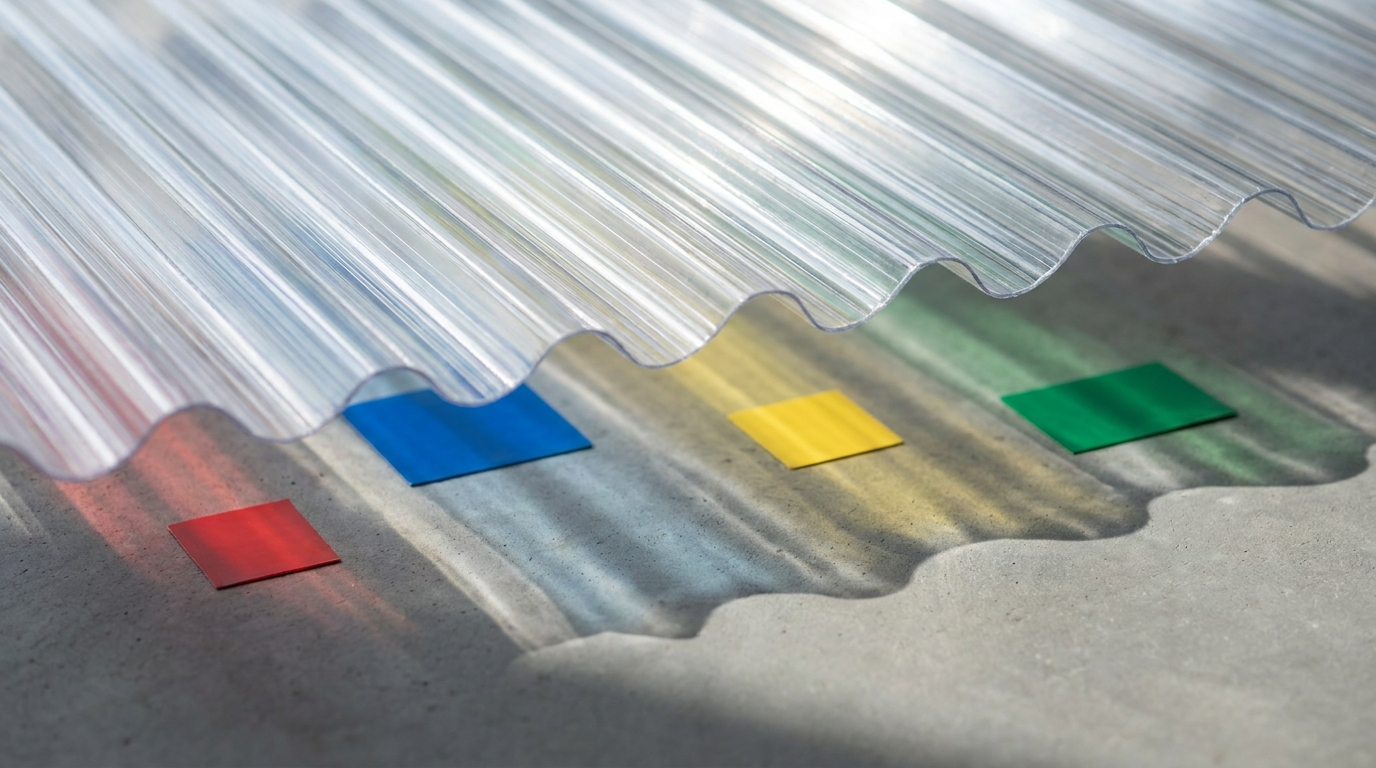
Ask most buyers what makes a good daylighting panel and they'll answer with a single number: light transmission. It's the spec that gets quoted, compared, and sold on. It's also, on its own, an incomplete answer to the question that actually matters to occupants: does the light in this space look right?
That second question is answered by a different metric entirely — Colour Rendering Index, or CRI — and it's one that gets almost no attention in polycarbonate roofing conversations despite mattering directly to anyone specifying daylighting for retail, healthcare, art, textiles, or any space where colour accuracy is part of the brief.
What CRI Actually Measures
Colour Rendering Index measures how accurately a light source reveals the true colours of objects compared to a reference light source (natural daylight itself, or an equivalent blackbody radiator, depending on colour temperature). It's scored on a scale up to 100, where 100 represents perfect colour fidelity — objects look exactly as they would under a full, unfiltered daylight reference.
Unfiltered daylight itself has a CRI at or near 100. The moment you pass that daylight through a coloured or heavily pigmented material — a tinted window, a coloured roofing panel — you risk shifting the CRI of the light that actually reaches the space below, even if the panel's light transmission percentage looks perfectly respectable on a spec sheet.
Light transmission tells you how much light gets through. CRI tells you how truthfully that light represents colour once it does.
Why This Gets Confused with Light Transmission
We've covered before, in our U-value vs light transmission vs lux guide, why buyers routinely conflate specs that measure genuinely different things. CRI is a third case of the same problem. A panel can have:
- High light transmission and high CRI — clear, minimally pigmented polycarbonate, close to daylight-neutral
- High light transmission and reduced CRI — a heavily coated or additive-treated clear panel that filters certain wavelengths unevenly enough to distort colour rendering, while still passing most incident light
- Lower light transmission and high CRI — a diffusing panel that scatters light without significant colour filtering
- Lower light transmission and reduced CRI — heavily tinted or coloured panels, such as bronze or smoke tones
None of these combinations is inherently wrong — they're simply suited to different applications. The mistake is assuming light transmission alone tells you which one you're getting.
It's also worth being precise about a related but separate effect: a panel can shift the colour temperature (CCT) of transmitted light — making a space feel slightly warmer or cooler — without necessarily lowering its CRI. CRI is measured against a reference illuminant at the corresponding colour temperature, not against neutral daylight regardless of tint, so a colour-temperature shift and a CRI drop are two different problems. Ask your supplier for both the transmitted CCT/spectral behaviour and the tested CRI — one is not a reliable proxy for the other.
Where CRI Actually Matters
For a large share of industrial daylighting — warehouses, factory floors, car parks — CRI is a secondary concern behind lux and U-value, because colour accuracy isn't central to the space's function. But CRI becomes a first-order spec in several common project types:
- Retail and showrooms, where customers judge product colour and quality under whatever light is falling on the merchandise — see our retail daylighting guide for the full picture.
- Healthcare facilities, where accurate colour perception of skin tone can matter clinically, alongside the general wellbeing benefits covered in our schools and hospitals daylighting guide.
- Art galleries, design studios, and print/textile workshops, where colour-critical work is the entire point of the space.
- Architectural showpieces — atria, entrance lobbies — where a colour-shifted wash of light undercuts the visual effect the design intended.
How Panel Colour and Structure Affect CRI
Our colour guide covers how clear, opal, and bronze/tinted panels behave for light transmission and heat, and the same colours have a parallel effect on colour rendering. As a general pattern:
- Clear panels stay closest to true daylight colour rendering, since they filter the least.
- Structurally diffused panels — clear polycarbonate with a prismatic or micro-textured surface that scatters light through geometry rather than colourant — tend to preserve daylight-neutral colour rendering well, since nothing is added to filter specific wavelengths.
- Opal panels get their white, milky appearance from colour and diffusion additives in the material itself, not from structure alone — "opal" should not be assumed pigment-free. Spectral transmission and CRI can vary between opal formulations, so ask for measured data on the specific panel rather than assuming any opal panel automatically preserves colour rendering.
- Bronze and heavily tinted panels filter selectively by wavelength, which is precisely what shifts CRI downward — useful for glare and heat control, but a poor choice wherever colour accuracy is part of the brief.
What to Ask Your Supplier
Very few polycarbonate manufacturers publish CRI data by default, because most projects don't ask for it. If colour accuracy matters for your space, ask directly:
- "Does this panel colour and thickness have tested CRI data, or only light transmission?"
- "Is there a colour-shift/whiteness index measurement available for this specific tint?"
- "Would a diffused clear or opal panel meet my light and glare requirements without the colour shift of a tinted option?"
Where CRI data genuinely isn't available for a specific panel, treating clear or lightly diffused panels as the safer colour-accuracy default — and reserving heavier tints for zones where colour fidelity isn't a priority — is a reasonable working rule, consistent with how we approach panel selection in our daylighting brief guide.
Coxwell manufactures clear and diffused polycarbonate daylighting systems engineered for both light performance and colour fidelity. Talk to our technical team about the right panel for colour-critical spaces.
Frequently asked questions
What is Colour Rendering Index (CRI) in daylighting?
CRI measures how accurately a light source reveals the true colours of objects compared to a natural daylight reference, on a scale up to 100. It is a different measurement from light transmission, which only measures how much light passes through a material, not how accurately that light represents colour.
Does a higher light transmission polycarbonate panel mean better colour rendering?
Not necessarily. A panel can have high light transmission and reduced CRI (for example, some coated or specially treated clear panels), or lower light transmission with good CRI (such as a diffusing panel that scatters rather than filters light). The two specs need to be checked separately.
Which polycarbonate panel colour has the best colour rendering?
Clear and structurally diffused panels (textured to scatter light rather than pigmented) generally stay closest to true daylight colour rendering. Opal panels rely on colour and diffusion additives rather than structure alone, so their colour rendering varies by formulation and should be confirmed with measured data rather than assumed. Bronze and heavily tinted panels filter selectively by wavelength, which typically shifts CRI downward.
Where does CRI matter most in polycarbonate roofing projects?
CRI matters most in retail and showroom spaces, healthcare facilities, art galleries and design studios, textile or print workshops, and architectural showpieces like atria or lobbies — anywhere accurate colour perception is part of the space's function, rather than general industrial or warehouse daylighting.
Next step
Speak to a Coxwell engineer.
Our team can help you specify the right system, review your BOQ, or answer technical questions about your project.