
Daylighting in Schools and Hospitals: The Evidence and the Design Approach
The research on natural light in schools and hospitals is among the strongest in building science. Here's what it shows, what it means for specification, and how to design daylighting systems that actually deliver the benefits.
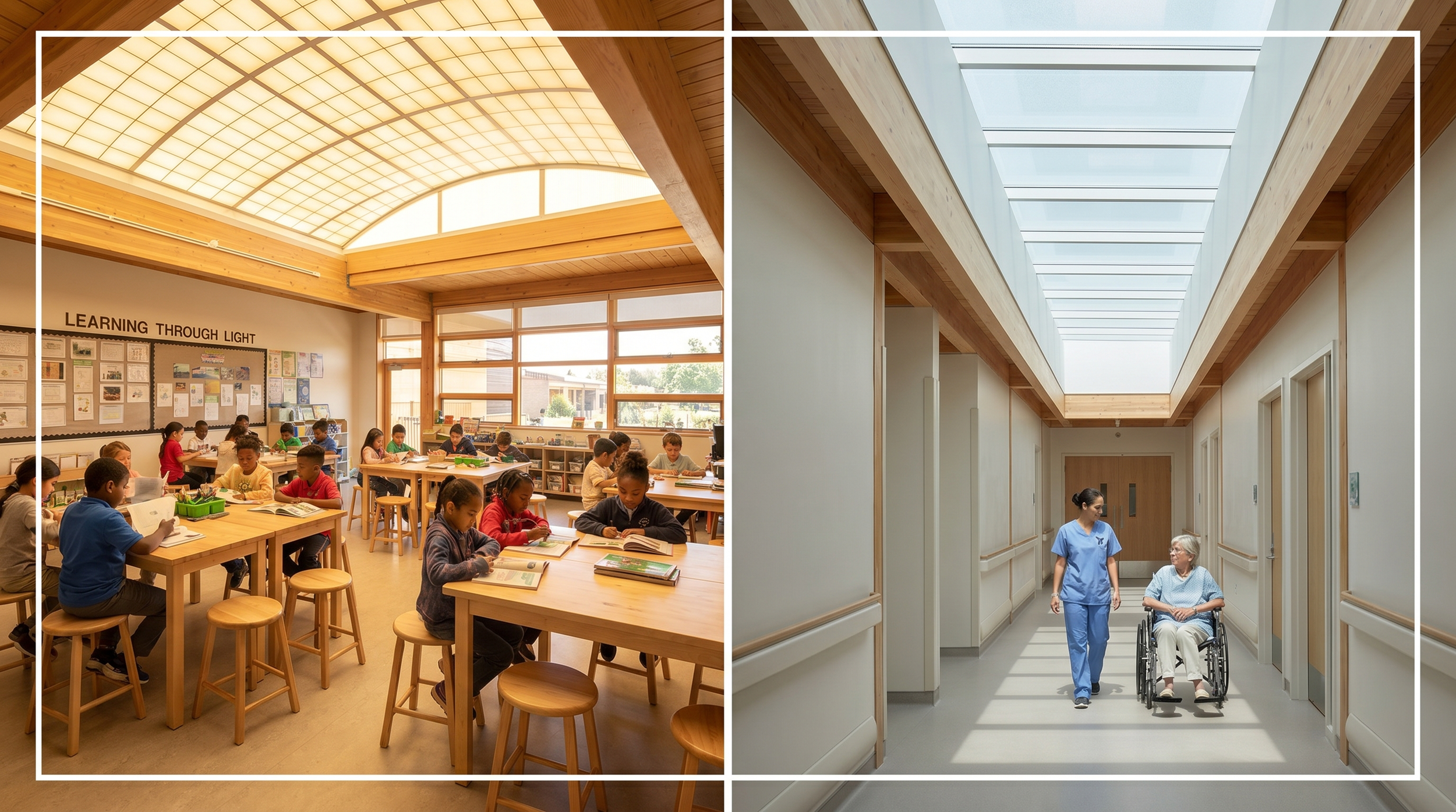
Of all the building types where daylighting research has been conducted, schools and hospitals have the most compelling evidence base. The research is not anecdotal. It is quantified, replicated, and in some cases large enough to have influenced national building standards. Architects designing these building types who are not familiar with this evidence are working with incomplete information.
This post covers what the research actually shows, and what it means for how these buildings should be designed and specified.
Schools: What the Research Shows
The most influential research on daylighting in schools came from the Heschong Mahone Group, a California-based architectural research firm commissioned by the Pacific Gas and Electric Company. Between 1999 and 2003, the group conducted a series of studies on the relationship between natural light, windows, and student performance across thousands of students in the US.
Key findings from the school studies:
In a study of 21,000 students across three school districts, students in classrooms with the most daylighting showed:
- 20% faster progress in mathematics tests compared to students in classrooms with the least daylight
- 26% faster progress in reading tests over a year compared to the least-daylit classrooms
- Improved attendance rates
The study controlled for teacher quality, school type, and socioeconomic factors. The daylight variable remained statistically significant after controlling.
These findings align with the physiological understanding of natural light's effects. Daylight exposure suppresses melatonin production and supports alertness through the activation of the retino-hypothalamic tract, which connects light-sensitive retinal cells directly to the brain's alertness and circadian rhythm centres. Children in better-daylit classrooms are, quite simply, more awake and better able to learn.
A separate body of research (Küller and Lindsten, 1992; Baker, 2011) found that children in classrooms without windows showed elevated cortisol levels at the beginning of the school year and less stable circadian rhythms, with associated effects on mood, behaviour, and immune function throughout the school year.
For Indian schools: The implications are significant. India has some of the world's highest UV exposure levels — and also some of the most densely occupied, poorly daylit school buildings. Large public school buildings with deep floor plates and small window-to-wall ratios are a national typology. Retrofitting adequate daylighting into these buildings, or designing new schools with daylighting as a performance requirement, is not an aesthetic aspiration. It is an evidence-based investment in learning outcomes.
What Good Daylighting in a Classroom Looks Like
A well-daylit classroom in India's climate needs:
Lux levels: 300–500 lux at the working plane (student desk, approximately 0.75m AFG) for general teaching. 500 lux at the chalkboard or presentation wall. These are maintained average targets — they should be achievable on a typical overcast day, not just on clear days.
Uniformity: CIBSE recommends a minimum uniformity ratio (minimum ÷ average) of 0.7 for task areas in schools. A classroom where the front row gets 800 lux and the back gets 80 lux fails this requirement, regardless of what the average calculation shows. Uniformity is why top-lit daylighting (skylights) is superior to side-lit daylighting (windows) in deep-plan classrooms — skylights distribute light more evenly across the full floor plate.
Glare control: Classrooms are VDU and chalkboard environments. Direct sun entry onto student desks or projection screens is unacceptable. All south and east-facing skylights in classrooms require diffusing panels with antiglare finish. North-facing skylights can use lower-diffusion panels with moderate LT.
Thermal performance: In Indian climate conditions, classroom comfort depends on controlling heat gain through glazing elements. A translucent roof with U-value below 1.6 W/m²K and infrared-reducing finish on south-facing elements significantly reduces cooling demand, which matters both for building energy performance and for occupant thermal comfort.
Recommended systems: For standard classroom skylights in India — multicell standing seam panels (16–22mm), south or mixed orientation with antiglare + infrared finish, LT 40–55%, U-value 1.6–2.4 W/m²K. For schools aiming for high daylighting quality or sustainability certification (GRIHA, LEED): Prism system with antiglare finish, higher panel thickness for improved U-value, daylight simulation to verify targets.
Hospitals: What the Research Shows
The evidence base for natural light in healthcare settings goes back to Florence Nightingale, who argued in her 1859 "Notes on Nursing" that sunlight was essential for recovery in hospital wards. Modern research has validated and quantified what she observed.
The Ulrich study (1984): In a study that became a cornerstone of evidence-based healthcare design, Roger Ulrich compared post-surgical patients in a Pennsylvania hospital. Patients in rooms with a window view of nature were compared with patients in identical rooms facing a brick wall. Patients with the nature view:
- Required significantly fewer doses of potent pain medication
- Had fewer negative evaluative notes from nurses in their medical charts
- Were discharged from hospital on average one day earlier than the brick-wall group
One additional day in a hospital bed carries significant cost implications — for the patient, the institution, and the healthcare system. Natural light is not a quality-of-life amenity in hospital design. It is a clinical performance variable.
Circadian disruption in hospital patients: Hospitalised patients who are confined to rooms without adequate natural daylight experience disruption to their circadian rhythm — the body's internal 24-hour clock. This disruption has been associated with:
- Disrupted sleep-wake cycles, which impair immune function and slow recovery
- Increased delirium incidence in ICU patients (a condition called "ICU psychosis" that is associated with continuous artificial light and loss of day-night cues)
- Elevated stress hormones and increased pain perception
- Longer recovery times across multiple post-surgical conditions
Neonatal intensive care: Studies in neonatal units have found that infants in units with day-night light cycling — adequate daylight during the day and dim conditions at night — showed better weight gain, shorter hospital stays, and fewer breathing complications than infants in continuously lit standard NICU environments.
Staff productivity and error rates: The benefits of natural light in hospitals extend beyond patients. Research has found that healthcare staff in better-daylit environments show lower fatigue levels, fewer errors on vigilance tasks, and lower rates of stress-related absence. In an environment where attention errors have life-or-death consequences, the design of the lighting environment is a patient safety issue as well as a staff welfare one.
What Good Daylighting in a Hospital Looks Like
Healthcare daylighting is more complex than educational daylighting because the range of space types and lux requirements is wider, and because the consequences of getting it wrong — glare in an examination room, insufficient light in a ward, excessive heat gain in an ICU — can affect patient welfare and clinical outcomes.
Wards and patient rooms: 100–300 lux general, with a view of sky or outside. Bed-level light (at bed head for reading, approximately 100–200 lux) should be individually controllable. Day-night cycling is clinically important — the daylighting system should support adequate daylight during the day and allow the ward to be genuinely dim at night.
Corridors and circulation: 150–200 lux general. Wayfinding quality matters — uniform distribution avoids the disorienting contrast of bright zones and dark zones that can be particularly difficult for patients who are unwell or elderly.
Examination and treatment rooms: 500–1,000 lux at the examination plane. These areas require high lux and high colour rendering. If daylighting is used, it must be controllable — blinds or dimmers — because examination lighting must be adjusted for specific procedures.
Operating theatres: Daylighting is not typically appropriate for operating theatres, which require highly controlled lighting at very high intensity (up to 10,000 lux at the operating field). Perimeter daylighting in the prep and scrub areas outside the main theatre is beneficial for staff circadian health.
Paediatric wards and NICU: Maximum daylighting with day-night cycling. Views of outside. Diffused, non-glare light quality — not direct sunlight.
The Design Principle for Both Building Types
Schools and hospitals share a design principle: the people who occupy them are among the most sensitive to their environment. Children are developing cognitively, physically, and emotionally. Hospital patients are in physiological distress. Both groups are more affected by poor environmental quality — including poor light quality — than healthy adults in a typical office.
For architects designing either building type, daylighting is not a green credential or a design aspiration. It is a functional requirement backed by a substantial evidence base. Specifying it correctly — with the right lux targets, the right diffusion, the right thermal performance, and the right controls — is the professional obligation.
Coxwell has supplied polycarbonate daylighting systems to AIIMS Jammu, AAI Chennai, metro station canopies, and commercial institutions across India. We provide full technical product documentation for healthcare and educational specifications, including U-value data, test certificates, and product selection guidance for GRIHA and LEED assessments.
Next step
Speak to a Coxwell engineer.
Our team can help you specify the right system, review your BOQ, or answer technical questions about your project.