
Condensation on Polycarbonate Roofs: Causes, Prevention, and Fixes
Dripping under a polycarbonate roof isn't always a leak — it's often condensation. Here's how to tell the difference, why it happens, and how to stop it.
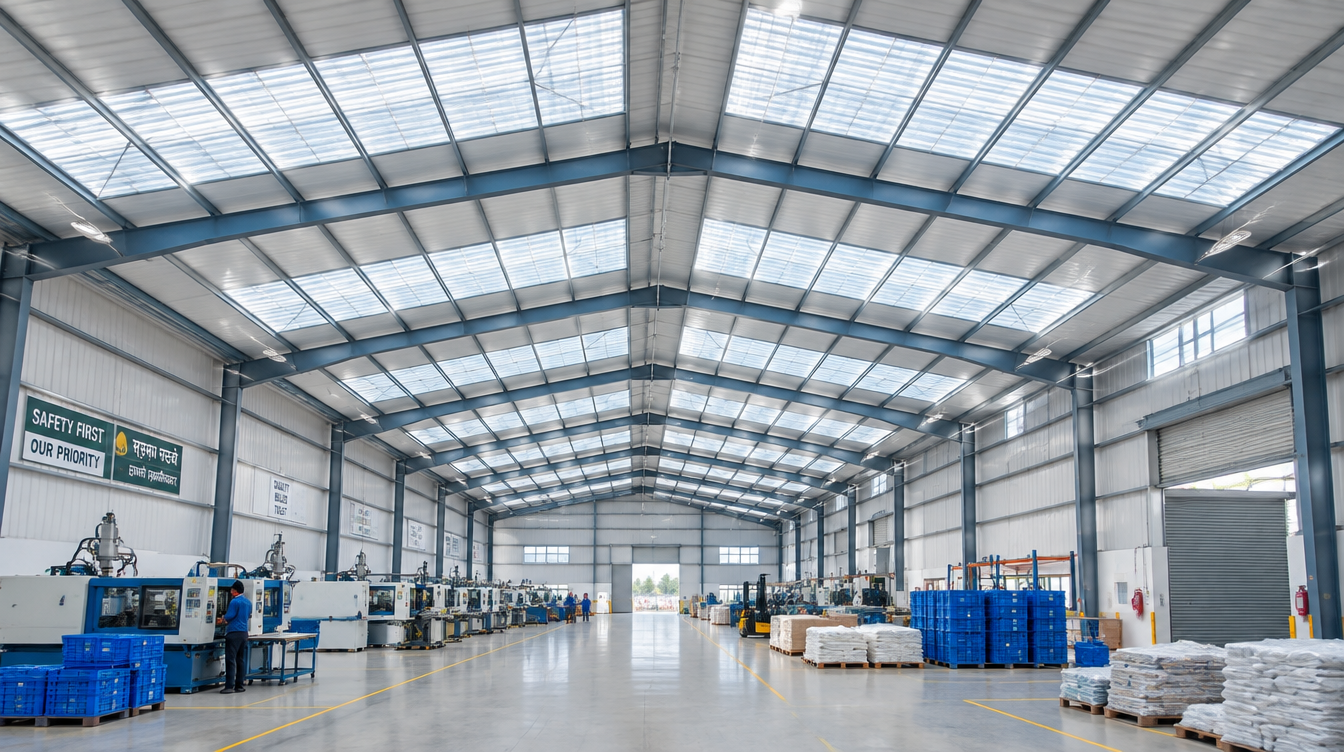
Every monsoon, we get the same call: "Our polycarbonate roof is leaking — but only some mornings, and only in certain areas, and the rain isn't even that heavy." Nine times out of ten, it isn't a leak at all. It's condensation. The two problems look identical from the floor — water appearing where it shouldn't — but they have completely different causes and completely different fixes. Treating condensation as a leak means resealing joints that were never the problem, while the actual cause goes unaddressed.
This post explains why polycarbonate roofs sweat, how to tell condensation apart from an actual leak, and what to do about it at both the design stage and on an existing roof.
What Condensation Actually Is
Condensation forms when warm, moist air inside a building meets a surface that is colder than the air's dew point. Polycarbonate is a good insulator relative to a bare metal sheet, but the underside of any roofing panel still cools faster than the air below it once the sun goes down. Water vapour in the room-side air condenses on that cooler surface, and once enough droplets form, they combine and drip.
This is exactly the same phenomenon as a cold glass of water sweating on a humid day — the roof panel is the glass, and the building's internal air is the humid room. It has nothing to do with the panel's seams, fixings, or end caps, which is why resealing a condensation-affected roof does nothing to stop the dripping.
How to Tell Condensation Apart From a Leak
Before assuming a roof needs resealing, check these indicators:
- Timing: Condensation typically appears early morning or after a clear, cold night — not necessarily during or right after rainfall. A leak tracks with rainfall events.
- Distribution: Condensation drip points are usually spread across the underside of panels, often worse at the coolest, lowest points of the roof. A leak is localised to a specific joint, fixing, or penetration.
- Panel underside: Look at the panel from below in the early morning — a fine, even film of moisture or fogging across large areas points to condensation. A wet patch tracing back to one screw or seam points to a leak.
- Weather correlation: Condensation is worse on cold, clear nights with high humidity the next morning (classic in the transition seasons and in coastal or high-humidity regions). Leaks correlate with wind-driven rain and storm events.
For a systematic walkthrough of leak-specific failure points, see our guide on avoiding leakage in polycarbonate roofing — if none of those points match what you're seeing, condensation is the likely culprit.
Why Some Buildings Are More Prone to It
Condensation risk scales with internal humidity and how poorly ventilated the roof void is. It shows up most often in:
- Warehouses and food processing units with washdown areas or high internal moisture load
- Poultry sheds and livestock housing, where animal respiration and cleaning routines raise humidity significantly
- Greenhouses and poly-houses, where high humidity is often intentional for plant growth
- Kitchens, laundries, and any enclosed space generating steam
- Buildings with sealed, unventilated roof voids where moist air has nowhere to go
Single-wall solid panels also condense more readily than multiwall panels, because a multiwall panel's air cells act as a thermal break, keeping the internal-facing surface slightly warmer and further from the dew point than the outer surface. This is one of several performance reasons we cover in our multiwall vs. solid polycarbonate guide.
Prevention at the Design Stage
Condensation is far cheaper to design out than to retrofit around. The key levers:
- Specify multiwall over solid panels wherever thermal performance allows — the trapped air layer raises the internal surface temperature and reduces the frequency and severity of condensation events.
- Lower the panel's U-value. A lower U-value roof stays closer to internal air temperature, which keeps the internal surface further above the dew point. Our U-value guide explains how to read and compare this spec across suppliers.
- Design for roof void ventilation, not sealed cavities — ridge vents, gable vents, or a ventilated air gap between the polycarbonate and any secondary ceiling allow moist air to escape rather than pool against the underside of the roof.
- Control internal humidity at source where the building type allows it — extraction fans in wash areas, dehumidification in sensitive storage, and humidity-aware HVAC sizing.
- Keep multiwall panel ends draining, not sealed. Multiwall panels need solid, impermeable tape at the top (high) end to keep rain and dust out, and breathable, vented tape at the bottom (low) end, so any moisture that does form inside the internal cells can drain and vent out rather than being trapped — a detail worth flagging explicitly on your specification.
Fixing Condensation on an Existing Roof
If a roof is already dripping and you've confirmed it's condensation, not a leak, the practical fixes are:
- Add or improve ridge and gable ventilation to let moist air escape the roof void
- Increase mechanical extraction in high-humidity zones directly below the affected roof areas
- Check that multiwall panel end caps haven't been sealed on both ends, trapping moisture inside the cells
- Where the space allows, introduce a ventilated air gap or a secondary insulated ceiling below the polycarbonate rather than mounting fixtures directly against the underside
- In persistent cases, install discreet condensation channels or gutters at the low points of the roof to collect and direct drips away from occupied areas, as an interim measure while ventilation upgrades are carried out
What to Ask Your Supplier
Before specifying or accepting a polycarbonate roofing quote for a humidity-prone building, ask directly:
- "What is the tested U-value of this panel, and how does it compare across thicknesses?"
- "Is this a multiwall panel with a sealed top end and breathable/drainable bottom end?"
- "Do you have a recommended ventilation detail for roof voids in high-humidity applications?"
A supplier who can answer these with tested data, rather than general reassurance, is one who understands that condensation is a design problem to be solved upfront — not a maintenance issue to be managed later.
Coxwell's technical team reviews roof void ventilation and panel specification for humidity-prone buildings before installation. Talk to us about the right system for your project's internal conditions.
Frequently asked questions
Is condensation on a polycarbonate roof a sign of a defective panel?
No. Condensation is a physical response to warm, humid internal air meeting a cooler roof surface — it happens on any roofing material, including glass and metal, when internal humidity and ventilation aren't managed. It is not a manufacturing defect in the polycarbonate panel itself.
How can I tell if my polycarbonate roof is leaking or just sweating?
Check the timing (condensation appears on cold, clear mornings regardless of rainfall; leaks track with rain events), the spread (condensation is broad and even; leaks are localised to a joint or fixing), and the underside surface (a fine even film points to condensation, a wet trail back to one point points to a leak).
Does a thicker polycarbonate panel prevent condensation?
A thicker multiwall panel generally has a lower U-value and better insulates the internal surface from outside cold, which reduces condensation frequency. But panel thickness alone won't solve condensation in a building with high internal humidity and no roof void ventilation — both factors need to be addressed together.
Can I stop polycarbonate roof condensation without changing the roof itself?
Often yes. Improving roof void ventilation (ridge or gable vents) and reducing internal humidity at source (extraction in wash or wet areas, dehumidification in sensitive spaces) resolves most condensation issues without needing to replace the panels.
Next step
Speak to a Coxwell engineer.
Our team can help you specify the right system, review your BOQ, or answer technical questions about your project.