
How to Avoid Leakage in Polycarbonate Roofing Systems
Polycarbonate roofs don't leak — bad installations do. Here's how contractors eliminate every common source of water ingress: slope, flashing, fixing, sealing, expansion, gutter junctions, and wall abutments.
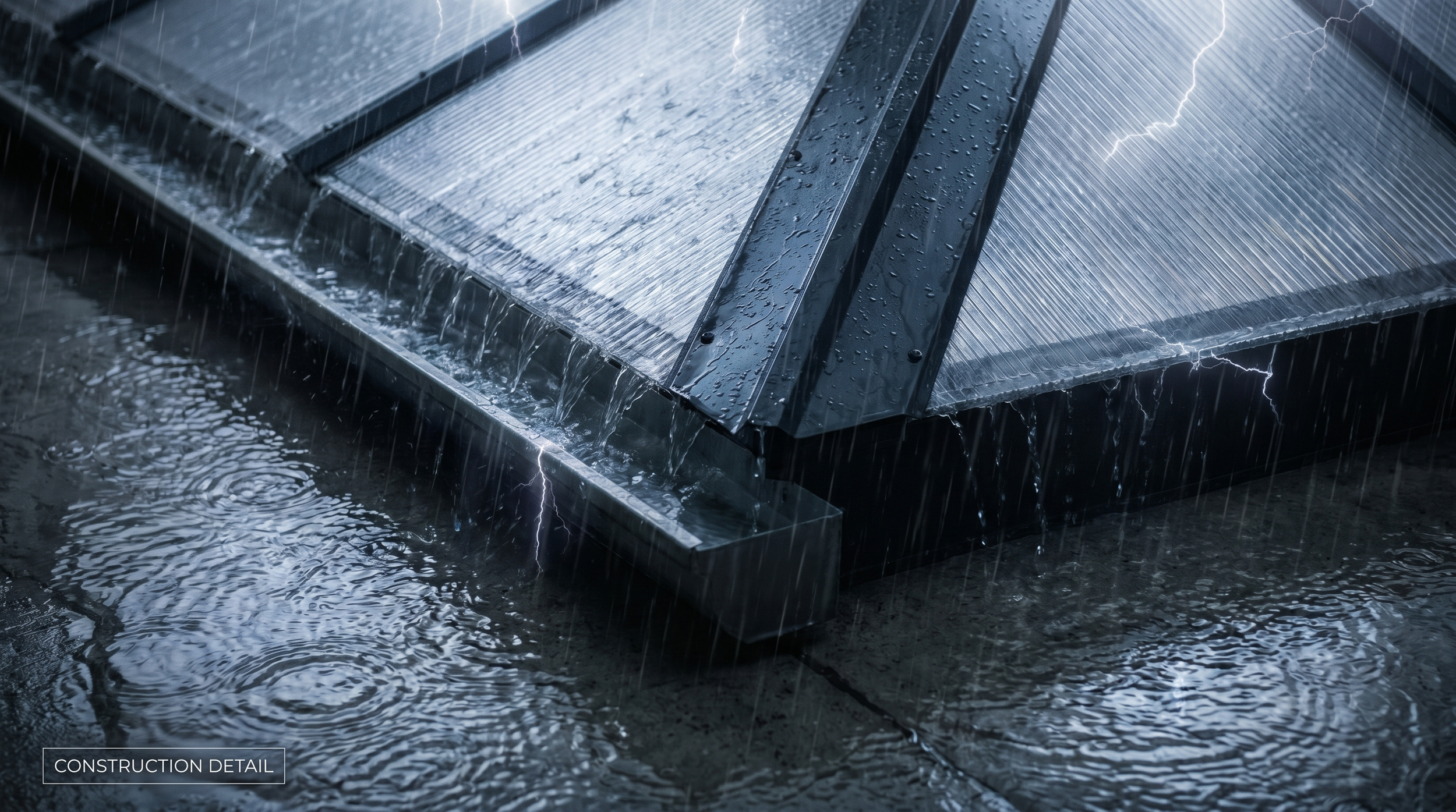
A well-installed polycarbonate standing seam roof should not leak. When they do, the cause is almost always traceable to one of a small number of installation or design failures — none of which are inevitable if you know what you're dealing with.
This post maps every common polycarbonate leakage source and the correct fix for each.
Source 1: Inadequate Slope
The single biggest cause of polycarbonate roof leakage is insufficient slope. Water cannot drain reliably below 5°. Wind-driven rain can reverse drainage direction below 7°.
Symptoms: Water collects at eave-side joints, at end closure profiles, and seeps under connectors that are technically watertight in dry conditions.
Prevention: Verify slope before installation. If the structure is below 5°, do not proceed without structural correction or written confirmation from the engineer that the design intent has changed. You cannot make a low-slope roof perform like a high-slope roof through better sealing alone.
Source 2: Unsealed Panel Ends
Open cellular panel ends are the most common actual leak source on installed roofs. Water enters through the open cells at the top (ridge) end of the panel by direct rain entry, and at the eave end through wind-driven splash.
Symptoms: Water drips from the underside of the panel between connector lines, appearing to come from inside the panel.
Prevention:
- Aluminium tape across every cell at both panel ends, before U-profile fitting
- PC end caps on all connectors at panel ends
- Aluminium U-profile fitted over the taped end, with compatible sealant at the interface between profile and panel face
- At the ridge: the ridge flashing must lap the U-profile end closure by 100mm minimum — this prevents direct rain entry from above
Source 3: Failed Connector Seating
A connector that has not fully engaged the cleat creates a micro-gap between the connector body and the panel seam. In heavy rain at wind pressure, water migrates through this gap.
Symptoms: Leak follows the panel joint line precisely, dripping at connector positions.
Prevention:
- Press every connector firmly down until audible click confirms seating
- Visually inspect every connector from beneath the panel before proceeding to adjacent panel
- Do not jam connectors in from the side — they must be pressed vertically from above
- If connector won't engage, check that the panel seam is not deformed by handling damage
Source 4: Fixing Through the Panel Face
On face-fixed systems, every fastener hole is a potential water entry point. The sealing washer compresses against the panel to create a seal, but this seal is not permanent — thermal cycling, UV degradation of the washer, and fastener loosening over time all create leak paths.
Symptoms: Circular drips at regular intervals along purlin lines.
Prevention:
- Use correctly sized sealing washers (over-size washers don't seal; under-size washers don't bridge the hole)
- Never over-tighten — the washer should compress to contact, not deform
- Use SS fasteners, not GI, to avoid rust staining and corrosion at the hole
- For premium projects, eliminate face-fixing altogether by specifying a standing seam system with cleat-based fixing
Source 5: Rigid Flashing at Expansion Joints
Polycarbonate panels expand and contract more than steel or aluminium. A flashing that is fixed rigidly to both the polycarbonate roof and a fixed wall or curb will be stressed at every thermal cycle. After 50–100 cycles, the sealant cracks and the mechanical fixing pulls loose.
Symptoms: Leaks at flashings that appear to have been installed correctly but have cracked at the interface.
Prevention:
- Fix all flashings to the fixed structure (wall, curb), not to the polycarbonate
- Use flexible sealant (e.g. silicone compatible with the specific polycarbonate product) at the interface between the flashing and the panel face
- Never use rigid epoxy or two-part sealants at expansion joints
- For long runs, use two overlapping flashings with a movement joint between them rather than a single long flashing
Source 6: Inadequate Flashing Laps at Ridge
Short laps at the ridge flashing are a common detail that fails in the first heavy monsoon with strong prevailing wind.
The ridge is the highest point of the roof — the point where wind changes direction and uplift is maximum. Wind-driven rain at ridge level is driven upward, against the slope of the flashing. A 50mm lap that works in dry conditions fails when rain is being driven at 70–80km/h.
Prevention:
- Ridge flashing must lap over the U-profile end closure by minimum 100mm
- At exposed sites (coastal, high-altitude, open agricultural land), increase this to 150mm
- Mechanical fix the ridge flashing to the purlin structure — not just to the panel end
- Check the ridge on site after the first wet season and re-seal any points showing water marks
Source 7: Blocked or Undersized Gutters
This is the leakage source that isn't actually a polycarbonate failure at all — but the contractor gets blamed anyway.
When a gutter is full or undersized, water backs up behind the eave trim and enters the panel end at the bottom of the U-profile. It looks exactly like a panel-end leak but the root cause is elsewhere.
Prevention:
- Confirm gutter size has been designed for the catchment area (a qualified structural or civil engineer should verify this)
- Make sure the eave-side U-profile is left open at the bottom for drainage
- Include gutter clearance in your handover checklist and advise the client in writing to clear gutters before and after monsoon
Source 8: Wall Abutment Without Kick-Out
Wall abutment flashings without a kick-out profile at the bottom allow water to run behind the flashing and into the wall cavity, appearing as an internal wall leak rather than a roof leak.
Prevention:
- All wall abutment flashings must terminate in a kick-out profile that directs water away from the wall
- The kick-out must clear the wall face by at least 25–30mm
- Seal the interface between the flashing and the wall with flexible sealant — not just pressed metal contact
Source 9: Penetration Detailing Done by Hand
When structural columns, hangers, bracing, or mechanical services penetrate the roof plane, the detail around the penetration is almost always done on site by improvisation. The result is usually a sealant bead around an irregular gap — and the sealant cracks within 2–3 cycles.
Prevention:
- Use purpose-designed penetration flashings for columns and circular services
- The flashing collar must allow for thermal movement of the panel relative to the fixed column
- For irregular penetrations, use a pre-formed lead or flexible EPDM collar, not sealant
- Inspect all penetration details at the end of the first monsoon season
Source 10: Condensation Mistaken for Leakage
In thermally active buildings — cold storage, refrigerated warehouses, buildings with significant temperature differentials between inside and outside — condensation can form on the underside of polycarbonate panels and drip to the floor. This is not a leak; it is a thermal performance issue.
How to distinguish: Condensation-based drips occur when outdoor temperatures are hot relative to the interior (or vice versa) and are not correlated with rainfall. Leak-based drips occur during and after rain events.
For condensation-critical applications, specify a higher-U-value system (lower U-value number = less condensation risk), consider a vapour barrier, and ensure adequate ventilation inside the building.
Coxwell's technical team can review your planned installation details and identify potential leak sources before you start. Contact us at coxwell.in.
Next step
Speak to a Coxwell engineer.
Our team can help you specify the right system, review your BOQ, or answer technical questions about your project.