
Polycarbonate Canopies for EV Charging Stations: A Daylighting Design Guide for India
Weather protection, visibility, heat load, and solar integration — a practical guide to specifying polycarbonate canopy roofing for EV charging stations in India.
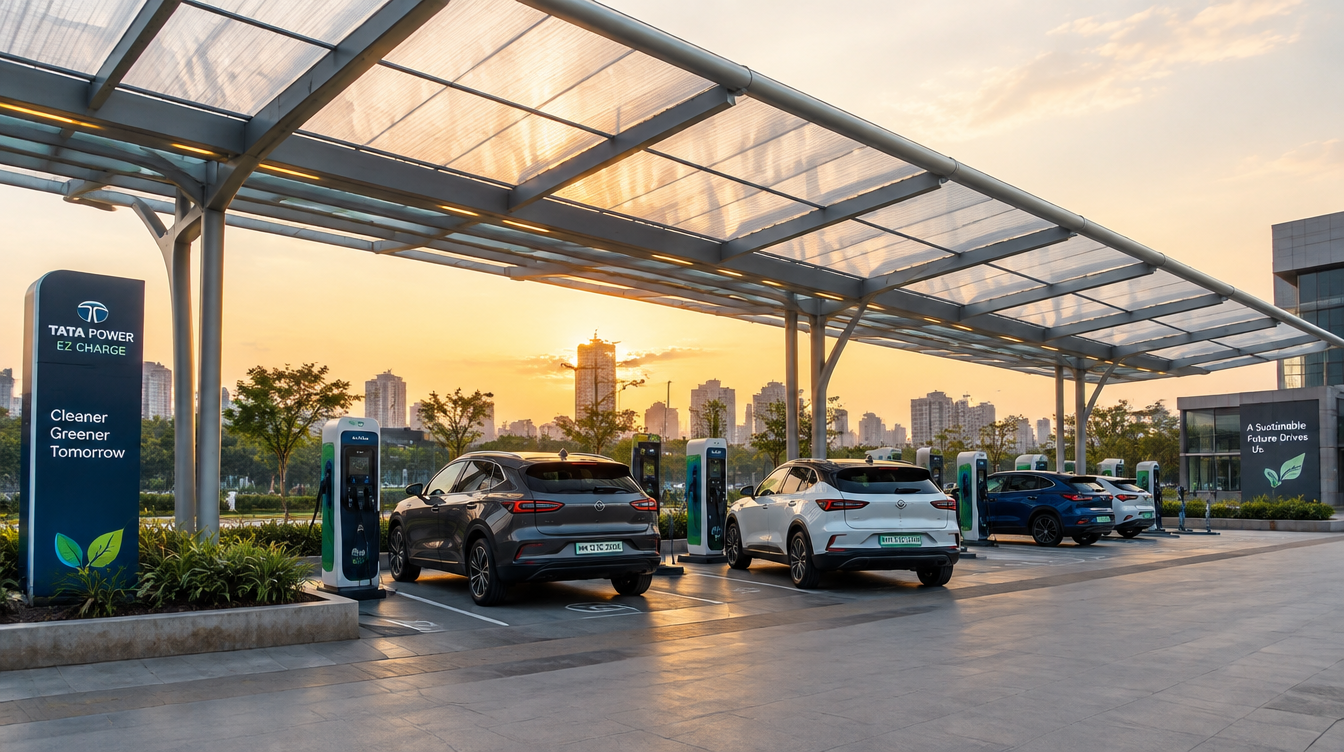
India's EV charging network is being built at a pace that outstrips the design conventions for it. Highway plazas, mall parking decks, office campuses, and fleet depots are all adding charging bays, and most of them need a canopy — for weather protection over the charging equipment and vehicle, for visibility and safety at night, and increasingly, for solar integration to offset grid draw. The roofing material choice for that canopy is not a minor detail. It affects driver comfort, equipment life, night-time visibility, and how well the canopy pairs with solar.
This guide walks through why polycarbonate is increasingly the default choice for EV charging canopies, and what to specify to get it right.
Why the Roofing Material Choice Matters Here
An EV charging canopy has requirements that differ from a standard parking shed:
- Weather protection for exposed electrical equipment — charging connectors, cable management, and metering enclosures need protection from direct monsoon rain and standing water, without creating a fully enclosed, poorly ventilated space around live equipment.
- Driver visibility and comfort while plugging in — a dim, fully opaque canopy roof creates a cave-like charging bay. Daylighting keeps the connection point legible and reduces the need for daytime artificial lighting.
- Heat load on parked vehicles — EV battery packs perform and charge more efficiently within a moderate temperature range. A canopy that blocks direct solar gain without trapping heat underneath it protects both charging efficiency and battery health during dwell time.
- Night-time visibility and branding — many charging operators backlight or uplight the canopy roof for signage and safety. A translucent roof diffuses this light evenly; an opaque metal roof requires additional fixtures to achieve the same effect.
Polycarbonate vs. Metal vs. Glass for EV Canopies
Metal sheeting is the cheapest option upfront and requires no daylighting design, but it creates a dark charging bay that needs artificial lighting even at midday, absorbs and re-radiates heat downward, and offers none of the branding-friendly translucency operators increasingly want.
Glass gives the daylighting and visual quality but is heavier, requires a substantially stronger (and costlier) structural frame to span typical canopy bays, and is a liability in India's hailstorm-prone regions — see our note on polycarbonate's impact resistance versus glass for the comparison.
Polycarbonate sits in between: roughly one-sixth the weight of glass at equivalent thickness, which reduces structural steel requirements for wide-span canopies; available in diffusing grades (opal or textured) that scatter light rather than transmitting harsh direct sun, where a clear solid sheet is chosen instead; and, with UV-stabilised coextrusion, resistant to the yellowing that would otherwise dull a canopy's appearance within a few seasons. For a fuller side-by-side, see our glass vs. polycarbonate comparison.
Design Considerations Specific to EV Charging Sites
Clearance and Span
Canopy height needs to clear the tallest vehicle type expected at the site — SUVs and light commercial EVs need more clearance than hatchbacks — while the structural bay spacing should be planned around charger spacing rather than reused from a standard parking shed layout. Polycarbonate's low dead weight allows longer spans between structural supports than an equivalent glass roof, which keeps sightlines to the connector and cable open.
Wind Uplift
EV charging canopies are typically open on three or four sides, which means wind loading calculations differ meaningfully from an enclosed building roof. Fixing systems and panel-to-structure connections need to be specified against local wind zone data, not a generic roofing detail — this is a point worth raising explicitly with your structural engineer and roofing supplier together.
Fire and Electrical Safety
Because the canopy sits directly above live charging equipment, specify a fire-rated, flame-retardant polycarbonate grade rather than a standard commercial-grade sheet. See our fire safety rating guide for what to check on a supplier's datasheet before approving the specification.
Signage and Illumination
If the canopy will carry backlit branding or uplighting, opal or lightly tinted panels diffuse light more evenly than clear panels, which tend to create visible hotspots around each fixture. Discuss illumination intent with your polycarbonate supplier before finalising panel colour.
Combining Polycarbonate with Solar
Many EV charging canopy projects now pair rooftop solar with the canopy structure — either to offset the charging load directly or as part of a broader campus solar strategy. Two integration approaches are common:
- Split roof: opaque solar PV panels cover the majority of the canopy for generation, with polycarbonate strip skylights along the edges or between PV rows to keep the charging bay daylit rather than fully shaded.
- Structural framing: polycarbonate forms the weatherproofing layer of the canopy while solar panels are mounted on a secondary frame above or alongside it, keeping the canopy's daylighting function independent of the solar array's layout.
Either way, polycarbonate's light weight is an advantage — it keeps the combined dead load (canopy roof plus solar array plus mounting frame) lower than an equivalent glass canopy, which eases the sizing of structural steel sections. This is a starting advantage, not a substitute for engineering: the final column and frame sizing still depends on the specific span, array layout, and local wind zone, and should be confirmed with a project-specific structural calculation before finalising the frame.
Specification Checklist for EV Charging Canopies
- Standing seam or multiwall polycarbonate system rated for the site's wind zone
- Flame-retardant grade, with fire rating data on the supplier's datasheet
- Light transmission and colour selected for the intended daylighting and signage function
- UV-stabilised coextrusion with a manufacturer warranty against yellowing (see our warranty checklist)
- Structural design coordinated for open-canopy wind uplift, not adapted from an enclosed-roof detail
- If solar is planned, confirm the mounting and load-sharing approach with both the polycarbonate and PV suppliers before finalising the structural frame
Coxwell supplies daylighting canopy systems for EV charging, parking, and mixed-use infrastructure projects across India. Talk to our technical team about span, wind loading, and solar integration for your site.
Frequently asked questions
Why use polycarbonate instead of metal roofing for an EV charging canopy?
Polycarbonate keeps the charging bay daylit without needing daytime artificial lighting and is significantly lighter — which allows longer spans and reduces the structural steel needed for the canopy frame. Whether it also reduces heat buildup compared with opaque metal depends on the panel's solar heat-gain properties: a diffusing or tinted grade with a lower solar transmission value cuts heat gain, while a clear, high-transmission sheet can admit as much or more direct solar heat than a reflective metal roof, so this should be checked against the specific panel's datasheet.
Is polycarbonate roofing safe to use above EV charging equipment?
Yes, when a flame-retardant, fire-rated grade is specified rather than a standard commercial sheet. Confirm the fire rating on the manufacturer's datasheet and check it against local electrical and fire code requirements for canopies over charging equipment.
Can polycarbonate canopies be combined with solar panels at EV charging stations?
Yes. Common approaches use polycarbonate strip skylights alongside opaque solar PV panels to keep the canopy daylit, or mount the solar array on a secondary frame above a fully polycarbonate weatherproofing layer. Polycarbonate's low weight makes it easier to support the combined roof and solar load on standard structural steel.
What wind load considerations apply to EV charging canopy roofing?
EV charging canopies are typically open-sided, which changes wind uplift behaviour compared with an enclosed building roof. Fixing systems and structural connections should be designed against local wind zone data specifically for an open-canopy configuration, not reused from a standard enclosed-roof detail.
Next step
Speak to a Coxwell engineer.
Our team can help you specify the right system, review your BOQ, or answer technical questions about your project.