Is Polycarbonate Roofing Fire Safe? Understanding Fire Ratings and Compliance in India
UL-94 and EN 13501-1 explained in plain terms — what polycarbonate fire ratings actually mean, how they compare to FRP and metal roofing, and what to ask before specifying an occupied or fire-code-reviewed building.
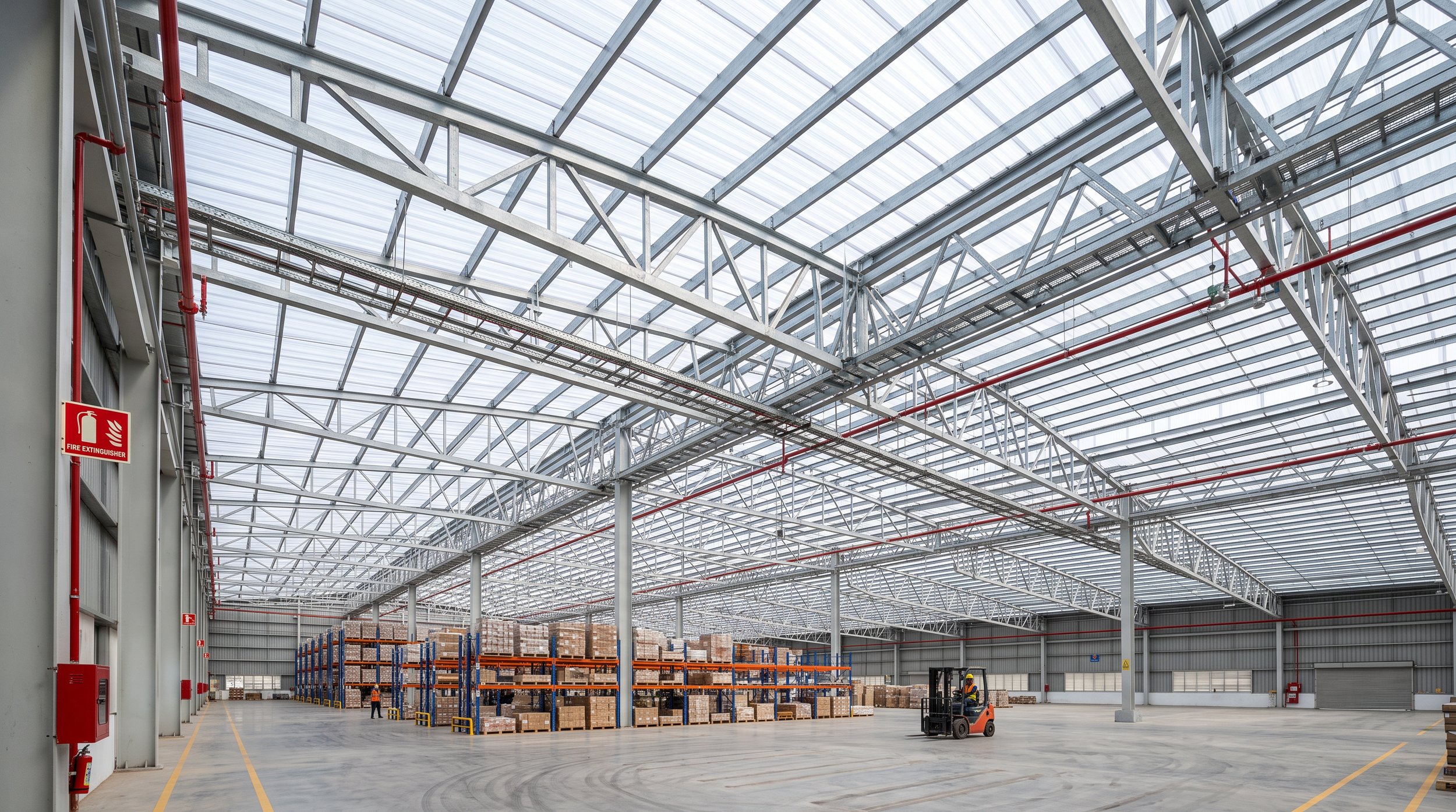
"Is polycarbonate roofing a fire hazard?" is one of the most common questions we get from architects and safety officers specifying industrial roofing — and one of the most poorly answered by generic supplier brochures. The honest answer is: it depends entirely on the grade of polycarbonate and how it was tested, not on the material category as a whole.
This post explains what fire ratings on polycarbonate actually mean, which standards matter, and what to ask a supplier before you specify a roof over an occupied building, a factory, or a warehouse with fire-code obligations.
Polycarbonate Does Not "Not Burn" — and No Supplier Should Claim That
Polycarbonate is a thermoplastic. Like almost every roofing material that isn't glass, concrete, or metal, it will burn under sustained direct flame contact at high temperature. The question that actually matters for building safety isn't "does it burn" — it's how it behaves when it does: does it self-extinguish once the flame source is removed, does it drip flaming material, and how much smoke and toxic gas does it produce.
This is exactly what fire rating standards are designed to measure, and it's why "fire-resistant" is a meaningless claim on its own. The only useful claim is a specific rating, from a specific test, with a certificate you can check.
The Two Standards That Actually Matter
UL-94: Flammability Classification
UL-94 is the standard vertical/horizontal burn test used to classify how plastics behave in direct flame contact. For roofing and façade-grade polycarbonate, the relevant classifications are:
- UL-94 V2 — self-extinguishes within a set time after the flame source is removed, but may drip flaming particles. This is the minimum acceptable classification for most standard polycarbonate roofing applications.
- UL-94 V0 — a stricter classification: shorter self-extinguishing time and no flaming drips. Reserved for higher fire-safety-grade formulations, generally specified for enclosed occupied spaces or projects with stricter fire codes.
Ask your supplier for the exact UL-94 classification of the panel grade being quoted — not just "fire rated." Every polycarbonate roofing system on the market is not automatically V2, and standard clear glazing-grade sheet without fire additives may not carry any UL-94 classification at all.
EN 13501-1: European Fire Classification (B-S1-D0)
For larger commercial, institutional, and export-spec projects, EN 13501-1 is the more rigorous reference standard. It classifies materials on three axes simultaneously:
| Code | What it measures |
|---|---|
| Reaction to fire class (A1–F) | Overall combustibility and flame spread contribution |
| Smoke production (S1–S3) | How much smoke is generated — S1 is lowest |
| Flaming droplets (D0–D2) | Whether burning material drips — D0 means none |
A B-S1-D0 classification — the benchmark for premium fire-safety-grade polycarbonate roofing systems — means the material has good fire resistance (B), low smoke output (S1), and produces no flaming droplets (D0). This is the classification to look for on projects where occupant evacuation time and smoke visibility genuinely matter: railway platforms, factories with dense occupancy, atria, and institutional buildings.
Why This Matters More for Some Buildings Than Others
Fire rating isn't equally critical on every roof. It matters most where:
- The roof is over an occupied space where evacuation time and smoke visibility are safety-critical — factories, warehouses with staff floors, railway canopies, sports halls, and institutional buildings.
- The project falls under local fire-safety code review, where a fire officer or NOC authority may specifically ask for classification certificates before sign-off.
- The roof sits close to a heat or spark source — near welding bays, electrical switchyards, or process areas with elevated fire risk.
It matters comparatively less on unoccupied ancillary structures like open carports or covered walkways, though a baseline UL-94 V2 classification is still good practice on any project.
How Polycarbonate Compares to Other Roofing Materials on Fire Behaviour
This is where buyers most often get misled. Polycarbonate with a proper fire-safety-grade formulation and current test certification generally performs better on smoke and droplet behaviour than uncertified FRP (fibre-reinforced plastic) sheeting, which is frequently sold without any fire classification at all and can produce significant smoke and flaming resin drips under fire exposure. We've covered this material comparison in more detail in our polycarbonate vs FRP roofing guide.
Metal roofing, of course, does not burn — but it conducts heat rapidly and offers no daylighting benefit, which is a different trade-off entirely and one we've addressed in our polycarbonate vs metal roofing comparison.
The point isn't that polycarbonate beats every material on every fire metric — it's that "polycarbonate" is not a single fire-safety category. A B-S1-D0 certified panel and an uncertified budget sheet sold under the same generic description can behave very differently in a fire scenario.
What to Ask Before You Specify
Add these questions to your specification checklist — they belong alongside the UV, dimensional, and structural questions we cover in our architect's specification checklist:
- "What is the exact UL-94 classification of this panel grade, tested by whom, and when?" Ask for the certificate, not a verbal claim.
- "Does this system carry an EN 13501-1 classification, and what is the S and D rating?" If the project requires B-S1-D0, confirm this in writing before order.
- "Is the fire-retardant additive present throughout the sheet, or only in a surface layer?" As with UV protection, a fire-safety property that's only surface-deep degrades faster than one built into the resin formulation.
- "Do you have a fire test certificate for the specific thickness and colour I'm ordering?" Fire behaviour can vary between panel thicknesses and additive loadings — a certificate for one spec doesn't automatically cover another.
A fire rating is only as good as the certificate behind it. If a supplier can't produce a dated test report from an accredited lab for the specific product being quoted, treat "fire-resistant" as a marketing claim, not a specification.
Coxwell's fire-safety-grade polycarbonate systems are tested to UL-94 and EN 13501-1 standards, with certification available for the specific thickness and colour you're specifying. Speak to our technical team before you finalise a roofing spec for an occupied or fire-code-reviewed building.
Frequently asked questions
Is polycarbonate roofing fire resistant?
It depends on the specific grade and certification. Polycarbonate is a thermoplastic and will burn under sustained direct flame, but fire-safety-grade formulations are certified to UL-94 V2 or V0 for self-extinguishing behaviour, and premium systems carry an EN 13501-1 classification such as B-S1-D0. Always ask for the certificate for the specific product being quoted, not a general claim.
What does UL-94 V2 mean for polycarbonate roofing?
UL-94 V2 means the material self-extinguishes within a set time after the ignition source is removed, though it may drip flaming particles. It is the minimum acceptable flammability classification for most standard polycarbonate roofing applications.
What is a B-S1-D0 fire rating?
B-S1-D0 is an EN 13501-1 classification combining reaction-to-fire class B (good fire resistance), smoke production class S1 (low smoke), and droplet class D0 (no flaming droplets). It's the benchmark fire-safety classification for premium polycarbonate roofing systems used in occupied or fire-code-reviewed buildings.
Is polycarbonate roofing safer than FRP sheeting in a fire?
Certified fire-safety-grade polycarbonate generally performs better on smoke output and flaming-droplet behaviour than uncertified FRP sheeting, which is frequently sold without any fire classification. The comparison depends entirely on whether each material has current, product-specific fire test certification.
Next step
Speak to a Coxwell engineer.
Our team can help you specify the right system, review your BOQ, or answer technical questions about your project.