
Polycarbonate vs FRP Roofing Sheets — An Honest Comparison for Indian Projects
FRP and polycarbonate are both used for industrial and commercial roofing in India — but they perform very differently over time. Here's what the spec sheet doesn't tell you.
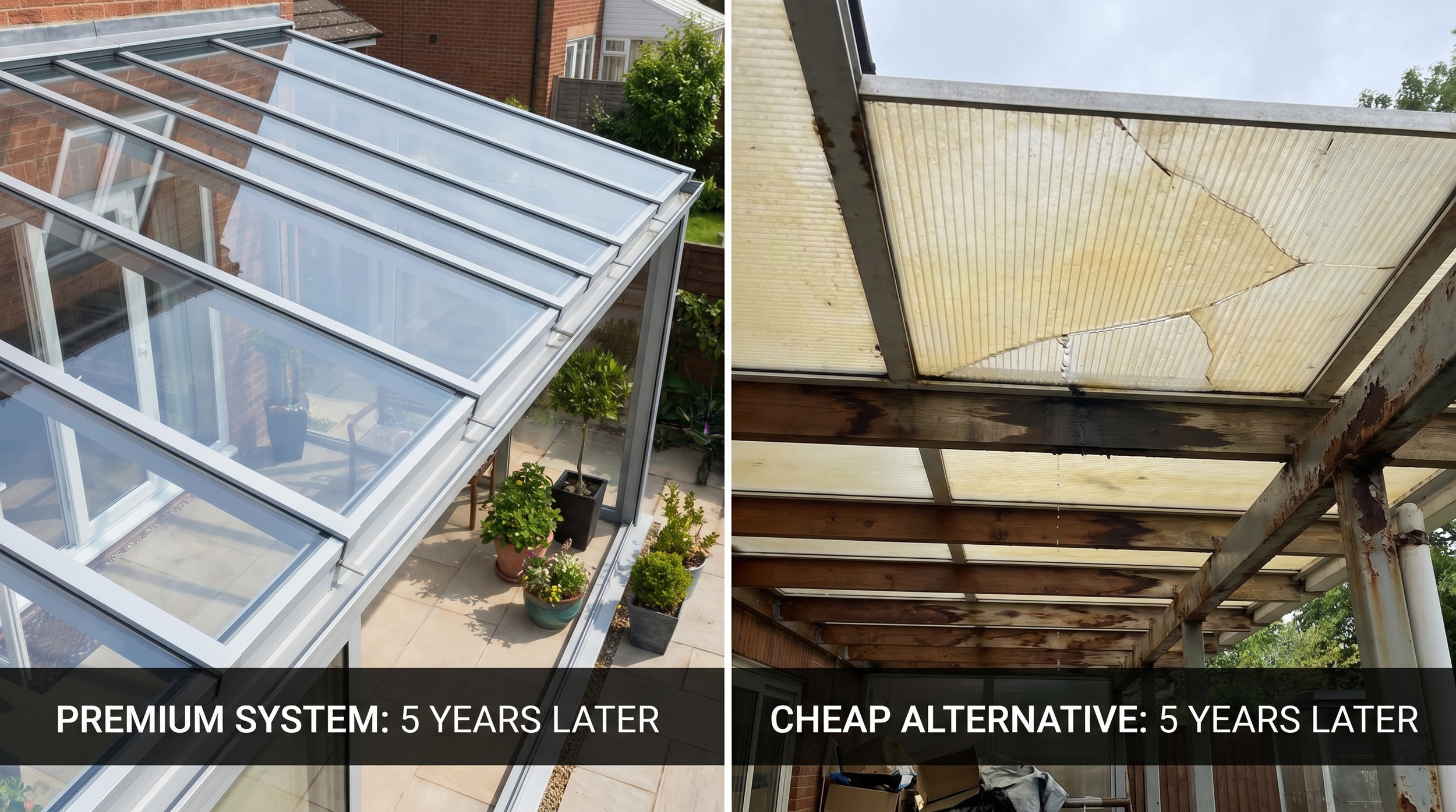
FRP (fibre-reinforced plastic, also called fibreglass roofing sheet) and polycarbonate are two of the most common translucent roofing materials specified for factories, warehouses, and industrial buildings across India. On a price list they look similar. In practice, they perform very differently — and the differences matter a great deal over a 10–15 year building life.
This post covers the technical distinctions honestly, including where FRP has a legitimate advantage and where polycarbonate is clearly the better specification.
What They Are
FRP (Fibre-Reinforced Plastic) sheets are composite panels made from glass fibres embedded in a polyester or vinyl ester resin matrix. They are manufactured by continuous lamination processes and are typically available in corrugated or flat profiles at 0.8–3 mm effective thickness. FRP has been used in Indian industrial construction since the 1980s and is widely available from commodity suppliers at low unit cost.
Polycarbonate sheets are thermoplastic panels moulded from polycarbonate resin — the same material class used in safety glazing, riot shields, and aircraft windows. In roofing applications they are used in corrugated (single skin), twinwall, and multiwall configurations. The multiwall format — where multiple parallel walls create hollow channels — provides structural rigidity and thermal insulation that FRP cannot replicate.
Where They Differ: The Key Parameters
1. UV Degradation
This is the most important difference and the one most commonly ignored at the procurement stage.
FRP panels are vulnerable to UV degradation. The glass fibres in the panel are held in a resin matrix that photooxidises under UV exposure. Over time — typically 5–8 years in Indian conditions — the surface resin breaks down, exposing the glass fibres. The result is a rough, chalky surface that traps dirt, reduces light transmission, and eventually begins to delaminate. Once fibre bloom starts, it cannot be reversed.
Polycarbonate yellows differently. Without UV protection it degrades too — but the industry solved this problem with co-extruded UV stabilisation layers that are permanently bonded to the panel surface. A polycarbonate panel with co-extruded UV protection maintains its optical clarity and structural integrity for 15–20 years under the same conditions. The UV layer doesn't peel, scratch off, or wear away because it is the surface, not a coating applied to it.
The practical implication: An FRP roof in Rajasthan, Gujarat, or any high-UV environment in India will typically need to be replaced or patched within 7–10 years. A properly specified polycarbonate system runs 15–20+ years without significant degradation.
2. Light Transmission and Quality
New FRP panels transmit reasonable amounts of diffuse light — typically 70–80% for clear grades. But the light quality is diffuse and slightly milky from the start because of the glass fibre matrix, and this worsens progressively as the resin surface degrades. By year 5–7, many FRP installations in India have dropped to 40–50% light transmission or less.
Polycarbonate starts at 80–88% light transmission for clear panels and, with co-extruded UV protection, retains the majority of this over the full service life.
3. Structural Performance
FRP in standard corrugated 1.5–2 mm thickness has moderate structural capability. For long spans — say, 3 m or more between purlins — it deflects significantly under point loads and is vulnerable to damage from foot traffic during installation or maintenance.
Polycarbonate multiwall panels are genuinely structural. A 16 mm multiwall panel spans 3–4 m between supports without significant deflection, can carry the load of a maintenance worker, and maintains dimensional stability across the temperature cycles of Indian climates (−5°C to +60°C in north India).
4. Thermal Performance
FRP is a single-layer composite with no meaningful thermal insulation value. A corrugated FRP roof over a factory in summer is essentially a glass-fibre radiator.
Multiwall polycarbonate panels contain insulating air chambers that reduce heat transfer significantly. A 25 mm multiwall polycarbonate panel has a U-value of approximately 1.5 W/m²K, compared to 5.5+ W/m²K for single-layer FRP.
5. Fire Performance
FRP panels, depending on the resin formulation, range from combustible to self-extinguishing. Many standard commodity grades are combustible and will fail fire safety requirements for covered public spaces, transportation facilities, and buildings requiring compliance with NBC 2016 or client-specific fire codes.
Polycarbonate has better inherent fire performance. Coxwell's multiwall polycarbonate panels carry UL-94 V-2 fire ratings and are available to V-0 specification for projects with stringent fire requirements.
6. Price
This is where FRP has a real advantage. Commodity FRP corrugated sheet is available in India at ₹20–₹40/sq ft. Standard corrugated polycarbonate starts at ₹30–₹55/sq ft, and multiwall polycarbonate systems run ₹80–₹200/sq ft depending on thickness and specification.
The honest answer is: if you are roofing a temporary agricultural structure or a shed with a 5-year life expectancy, FRP at the lower price point is a defensible choice. For anything with a 10+ year life expectation, the replacement cost of FRP within that period typically makes it the more expensive option over time.
Quick Reference Comparison
| Parameter | FRP (Standard Grade) | Polycarbonate Multiwall |
|---|---|---|
| Initial cost | ₹20–₹40/sq ft | ₹80–₹200/sq ft |
| Service life (India) | 7–10 years | 15–20+ years |
| UV degradation | Significant from year 5 | Minimal with co-extruded UV |
| Light transmission (new) | 70–80% | 80–88% |
| Light transmission (year 10) | 40–60% | 70–82% |
| Structural spans | Up to ~1.5 m | Up to 4 m (16 mm multiwall) |
| Thermal performance | Poor (U ~5.5 W/m²K) | Good (U ~1.5–2.5 W/m²K) |
| Fire rating | Variable; many combustible | UL-94 V-2 standard; V-0 available |
| Weight | 1.8–3.5 kg/m² | 3.5–6.5 kg/m² |
| Recyclability | Difficult (composite) | Fully recyclable thermoplastic |
The Specification Recommendation
Specify polycarbonate for:
- Any roofing application expected to last 10+ years
- Spans above 1.5 m between supports
- Projects where thermal performance, fire rating, or acoustic performance are specified
- Public-facing or civic buildings where long-term appearance matters
- Applications requiring documented product certifications
FRP may be appropriate for:
- Short-term or temporary structures
- Low-cost agricultural or storage applications with a clear 5–8 year replacement cycle built into the budget
Getting the Right Specification for Your Project
Coxwell's technical team works with architects, PMCs, and contractors at the specification stage to recommend the right product and thickness for the application.
Related reading: Why the cheapest polycarbonate is often the most expensive on site → | Polycarbonate roofing systems → | Multiwall polycarbonate →
Next step
Speak to a Coxwell engineer.
Our team can help you specify the right system, review your BOQ, or answer technical questions about your project.