
Why the Cheapest Polycarbonate Sheet Can Become the Most Expensive on Site
The panel that saves ₹15/sqm on day one can cost ten times that in rework, replacements, and client disputes two years later. Here's how to calculate the real cost of cheap polycarbonate.
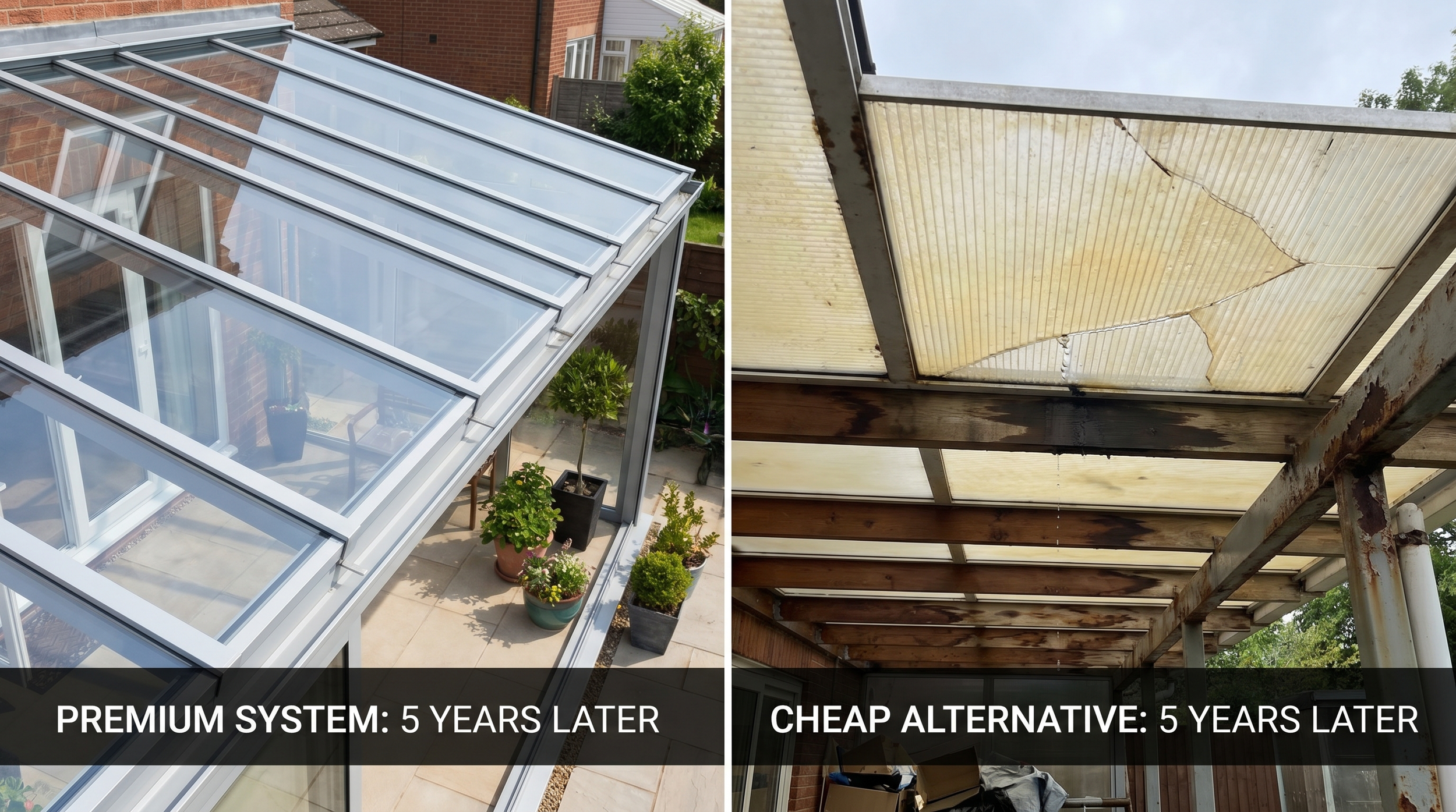
The decision to save money on polycarbonate panels feels rational at the time of purchase. The panels look the same. The area is the same. The client won't know the difference — yet. But the calculation changes completely when you factor in what happens two monsoons later.
This post works through the real cost of cheap polycarbonate, one failure category at a time.
The Procurement Gap
The Indian polycarbonate market has a significant quality spread. At the top, you have manufacturers with co-extruded UV protection, third-party NABL-accredited test certificates, and manufacturing facilities producing consistent product over many years. At the bottom, you have panels with surface-applied UV coatings, no test certificates, inconsistent dimensional quality, and cell walls that aren't uniform.
The price difference between these two ends of the market can be ₹40–80/sqm on the panel itself. On a 2,000 sqm roof, that's ₹80,000–₹1,60,000 in apparent savings.
The question is: what happens after installation?
Failure Category 1: Yellowing and Transparency Loss
Low-quality UV protection means the panels begin to yellow within 2–3 years in harsh Indian climate conditions. By year 5, a roof that was specified to deliver natural daylight has become a brown-tinted filter that blocks more light than it transmits.
Cost consequence for the contractor:
- Client complaint and demand for replacement
- If you're within the defects liability period, the replacement cost falls to you
- Panel replacement on an installed roof requires scaffold re-erection, panel removal, new panels and accessories, reinstallation, and disposal of old material
- Replacement cost on a 2,000 sqm roof: typically 60–80% of the original installation cost
The ₹80,000 "saving" has become a ₹8,00,000+ problem.
Failure Category 2: Leakage from Inferior Panel Geometry
Cheap panels frequently have dimensional inconsistencies — varying widths along the panel length, inconsistent standing seam heights, and cell walls that are not uniform. These create problems during installation that only manifest as leakage after the first season.
When a standing seam panel doesn't have consistent seam geometry, the connector doesn't grip evenly along the full length. Gaps develop at the seam. Water finds its way in.
Cost consequence:
- Return visits for leak investigation and repair
- Each leak investigation on a completed roof takes 4–8 hours minimum, plus scaffold cost
- Sealant-based "remediation" of a structural seam problem is temporary — the leaks return
- Client retention withheld and legal exposure
Failure Category 3: Cracking During Installation
Panels without adequate UV-aged impact resistance are more brittle at the point of installation. In Indian conditions where panels are often stored in the sun before installation (sometimes for weeks), UV degradation can begin before the panel is even fitted.
Cheap panels crack during handling, drilling, or when a worker accidentally steps on them. Each cracked panel must be replaced. The replacement material cost is the same as the original (sometimes higher, because you need an emergency delivery). The labour to remove and reinstall is additional.
Cost consequence:
- 3–5% additional material cost on a poor-quality batch is not unusual
- Labour rework on cracked panels typically adds ₹25–40/sqm to installation cost
- Project programme delay if replacement material is not immediately available
Failure Category 4: Premature Structural Failure
This is the rarest failure mode but the most expensive. When panels are installed on spans that exceed what their cell structure can support — which is more likely with cheap panels that have inconsistent cell wall thickness — deflection under wind or point load can cause sudden failure.
A panel that fails structurally on a commercial project creates:
- Immediate safety risk and project shutdown
- Insurance claim exposure
- Regulatory investigation
- Replacement and structural review cost
- Reputational damage that affects future work
Failure Category 5: Client and Project Delays
Even before physical failure, cheap panel batches cause delays:
- Rejected on arrival by a vigilant site manager or consultant who asks for test certificates
- Held at site pending approval while the project programme slips
- Approved initially, then flagged by a visiting architect who notices yellowing on a sample in strong sunlight
Every day of programme delay on a project carries indirect costs — extended scaffold hire, extended supervision, extended accommodation for out-of-town crews, late-release of retention.
The Real Cost Calculation
Before you choose the cheaper panel, run this calculation:
| Item | Base case (quality panel) | Low-cost panel scenario |
|---|---|---|
| Panel cost saving | — | −₹1,60,000 |
| Risk of leak repair (2 visits) | — | +₹60,000 |
| Risk of replacement at year 3 (30% probability) | — | +₹2,40,000 expected cost |
| Risk of site rejection / delay (1 week) | — | +₹80,000 |
| Reputational cost (loss of repeat client) | — | Unquantifiable |
| Net position | 0 | −₹2,20,000 |
The maths only works in favour of the cheap panel if none of the failure scenarios occur. On a risk-adjusted basis, the cheap panel costs more every time.
What Contractors Who Win Repeat Work Do Differently
The contractors who build durable client relationships on polycarbonate work are the ones who own their supply chain. They specify the product, not just the area. They ask for test certificates. They use the same system supplier project after project, building institutional knowledge about what works.
A roof that performs for 12 years without a callback is worth more to a contractor's reputation than the ₹80,000 saved on panels. That 12-year roof generates referrals, repeat orders, and the ability to price at a margin that reflects quality.
The cheap panel is a short-term calculation. The right panel is a long-term business decision.
Coxwell supplies polycarbonate systems with full third-party test certificates and a 10-year manufacturing warranty. If you're pricing a project, ask us for a technical datasheet and test certificate pack before you commit to a supplier.
Next step
Speak to a Coxwell engineer.
Our team can help you specify the right system, review your BOQ, or answer technical questions about your project.