
Glass vs Polycarbonate: The Honest Comparison Architects Should Make
Glass dominates architectural education. Polycarbonate is treated as a cheaper substitute. The real comparison is more nuanced — and in many applications, polycarbonate is the superior choice. Here's the evidence.
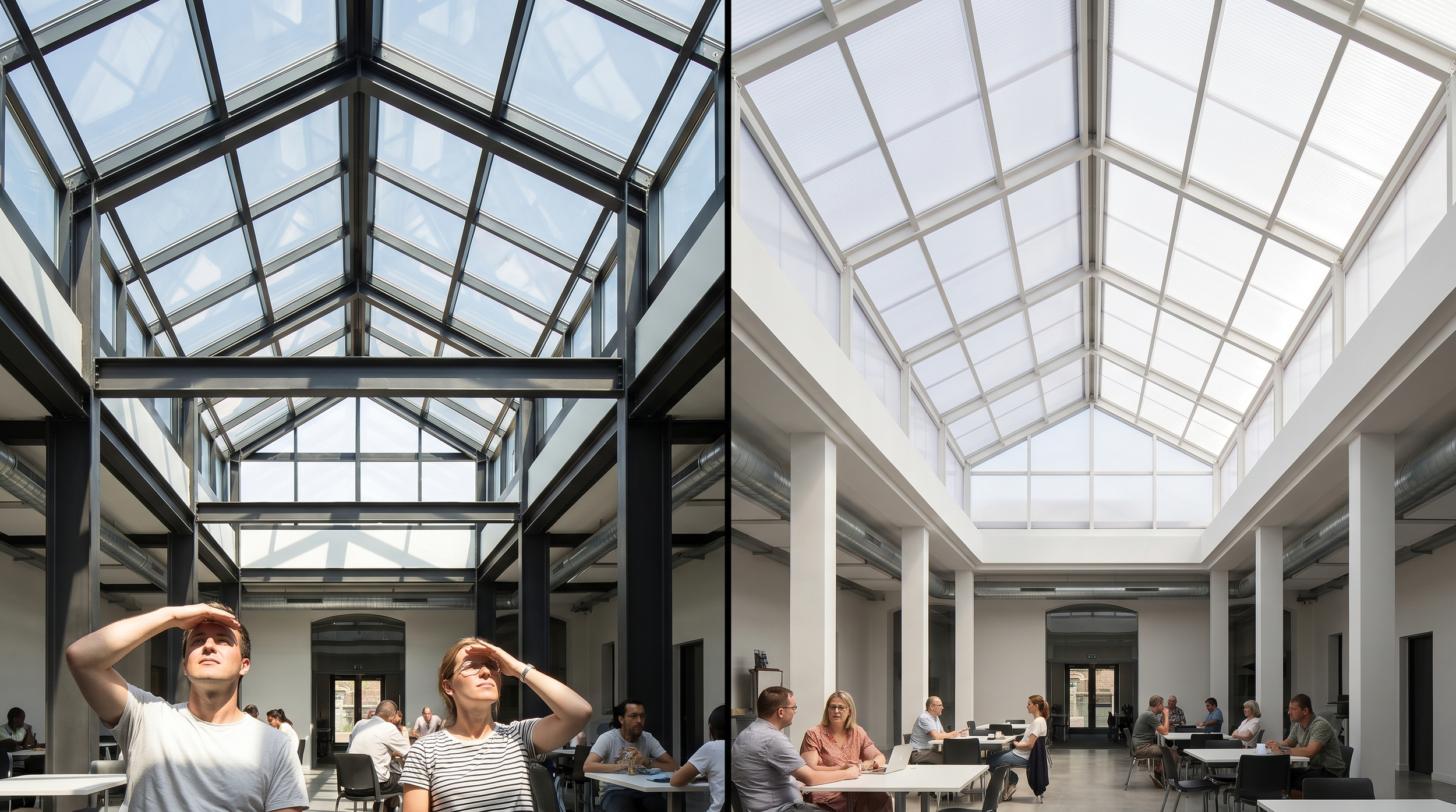
Architecture education treats glass as the default transparent material. Polycarbonate is mentioned, if at all, as the cheaper industrial alternative — acceptable for warehouses, not for serious buildings. This framing is outdated, and it leads architects to make specification decisions that don't serve their projects.
The real comparison between glass and polycarbonate is more nuanced. Neither material is universally superior. Each has a set of properties that makes it the right choice for a defined range of applications — and understanding that boundary is what distinguishes a considered specification from a default one.
This post covers the honest comparison across the properties that actually matter in a building envelope decision.
Weight
Glass is approximately twice as heavy as polycarbonate per unit volume. Standard architectural glass has a density of roughly 2.5 g/cm³. Polycarbonate is approximately 1.2 g/cm³. In a large-span translucent roof — say, 2,000 sqm — this difference in density translates directly into structural load.
A 10mm single sheet of glass weighs approximately 25 kg/m². A 16mm multicell polycarbonate standing seam panel weighs approximately 3–4.5 kg/m². That is a 5–8x difference in dead load at the roof plane, which propagates through the entire structural design: smaller purlins, lighter primary structure, smaller foundations.
For spans above 20m, for curved or complex geometry structures, for buildings where foundation cost is a significant proportion of budget, and for retrofit projects over existing structures with limited reserve capacity, the weight difference is not an aesthetic consideration — it is an engineering one.
Impact Resistance
Polycarbonate is significantly stronger than glass under impact. The most commonly cited figure — which comes from material testing, not marketing — is that polycarbonate is approximately 200 times more impact-resistant than standard glass of equivalent thickness, and approximately 30 times more resistant than acrylic.
Glass shatters. Polycarbonate deforms under impact and returns to shape within its elastic limit, or — in the event of a more severe impact — deforms plastically without shattering into sharp fragments. This property is why polycarbonate is used in police riot shields, aircraft canopies, vehicle windows, and safety glazing applications where glass failure would create a hazard.
For buildings in hail-prone regions, areas with risk of mechanical impact, or applications where post-breakage safety is a concern (overhead glazing, canopies over pedestrian areas), polycarbonate's impact behaviour is a meaningful functional advantage.
Thermal Performance
Here the comparison becomes more complex, because both materials span a wide range of thermal performance depending on configuration.
Single-layer comparison: A single layer of 4mm glass has a U-value of approximately 5.7 W/m²K. A single layer of 4mm solid polycarbonate sheet is comparable — around 4.5–5.0 W/m²K. In this form, neither material is particularly well-insulating.
Configured systems: Both materials improve dramatically when configured as multi-layer systems. A standard double-glazed unit (DGU) achieves approximately 2.7–3.0 W/m²K. A 16mm multicell polycarbonate panel achieves approximately 1.8–2.4 W/m²K. A 30mm multicell polycarbonate panel reaches approximately 1.2–1.6 W/m²K. Specialist polycarbonate systems with air gaps and multiple layers can reach below 1.0 W/m²K.
Importantly, polycarbonate's heat conductivity is approximately five times lower than glass at the material level — meaning that, thickness for thickness, polycarbonate is a better thermal insulator. The multi-layer system benefits from the same principle of air-space insulation as double glazing, but without the fabrication cost of a sealed unit.
For large-area translucent roofing — factory skylights, station canopies, sports hall roofs — the cost difference between a polycarbonate system and a comparable glass system is significant, while the thermal performance is comparable or better.
Thermal Expansion
This is where polycarbonate's most important limitation emerges, and where glass has a clear technical advantage.
Polycarbonate's coefficient of thermal expansion is approximately 7 times higher than glass. A 6-metre polycarbonate panel will expand by approximately 12.6mm over a 35°C temperature differential — a typical range in northern India between a winter night and a summer afternoon. Glass of the same dimension would expand approximately 1.8mm.
This difference has direct implications for detailing. Polycarbonate installations require:
- Expansion gaps at panel ends (minimum 3–5mm, more for longer panels)
- Fixing systems that allow panel movement without stress (standing seam and cleat systems are designed for this; face-fixing is not)
- Flashings detailed with movement joints rather than rigid connections
- Sealant selection that remains elastic through the full movement range
Architects who specify polycarbonate and apply standard glazing detailing — tight connections, rigid perimeter seals — will encounter failures. Architects who understand the movement requirement and design for it will have installations that perform for 15–20 years without maintenance issues.
Glass's lower thermal expansion makes it more forgiving in tight or complex perimeter details. For installations where the detailing constraints make expansion management difficult — narrow mullion systems, complex geometry, very cold climates with large temperature swings — glass may be the more practical choice.
Light Transmission and Optical Quality
Clear glass has excellent optical clarity — typically 85–90% light transmission. Polycarbonate solid sheet can approach this (up to 89%) but structured panels (multicell, multiwall) are lower due to the internal cell walls, ranging from 30–80% LT depending on cell configuration and colour.
The meaningful difference is in optical quality: glass maintains image clarity over long distances; polycarbonate diffuses light to varying degrees depending on the structure of the panel. For applications requiring clear visual transmission — storefront glazing, frameless partitions, view windows — glass is the better material. For applications where diffusion is an asset — skylights where glare control matters, facades where privacy with light transmission is desired, roofing where even light distribution is the goal — polycarbonate's diffusing character is a design advantage, not a limitation.
Weathering and Surface Durability
Glass is inherently UV-stable and does not yellow, haze, or degrade in UV exposure. Its surface is harder than polycarbonate and more resistant to scratching. For applications where long-term optical clarity is the primary requirement and maintenance access is straightforward, glass has a durability advantage.
Polycarbonate requires co-extruded UV protection to resist UV degradation over its design life. A well-manufactured panel with adequate co-extruded UV protection (minimum 45–50 microns on the exposed face) will maintain performance for 10–15 years. An inadequately protected panel will yellow and degrade within 3–5 years. This is a material selection and quality control question, not an intrinsic material limitation.
Fabrication, Handling, and Cutting
Polycarbonate can be cut with standard woodworking tools on site. It can be cold-formed to radii that would require specialised processing for glass. It can be handled without the specialist lifting equipment and breakage risk associated with large glass panes.
For large-span or complex geometry projects, these handling and fabrication advantages translate directly into installation programme and cost. A 12-metre polycarbonate panel can be carried by two workers. A 12-metre glass panel of equivalent area requires a crane and specialist glazing crew.
The Honest Conclusion
Glass is the right material for:
- Applications requiring optical clarity and view (storefronts, view windows, partitions)
- Applications requiring long-term surface hardness and scratch resistance
- Installations where the geometry or detailing makes thermal expansion management difficult
- Prestige applications where the visual qualities of glass are integral to the design intent
Polycarbonate is the right material for:
- Large-span translucent roofing (factory skylights, station canopies, sports halls)
- Applications requiring impact resistance (hail zones, pedestrian overhead glazing)
- Projects where structural load reduction is a design driver
- Complex geometry structures (curves, vaults) where cold-formability is an asset
- Applications where diffused daylight quality is preferable to direct transmission
The architect who understands both materials specifies each where it is genuinely the better choice. The architect who defaults to glass — because that is what was covered in school — makes some of those specifications unnecessarily expensive, structurally compromised, or technically incorrect.
Coxwell manufactures polycarbonate panel systems for roofing and façade applications. We provide technical documentation comparing system U-values, light transmission, and structural performance for architect and engineer use on comparative specification work.
Next step
Speak to a Coxwell engineer.
Our team can help you specify the right system, review your BOQ, or answer technical questions about your project.