
Is Polycarbonate Roofing Sustainable? Recyclability, Embodied Carbon, and Green Building Credits
A clear-eyed look at polycarbonate roofing's sustainability profile — recyclability, embodied vs. operational carbon, durability, and IGBC/GRIHA credits.
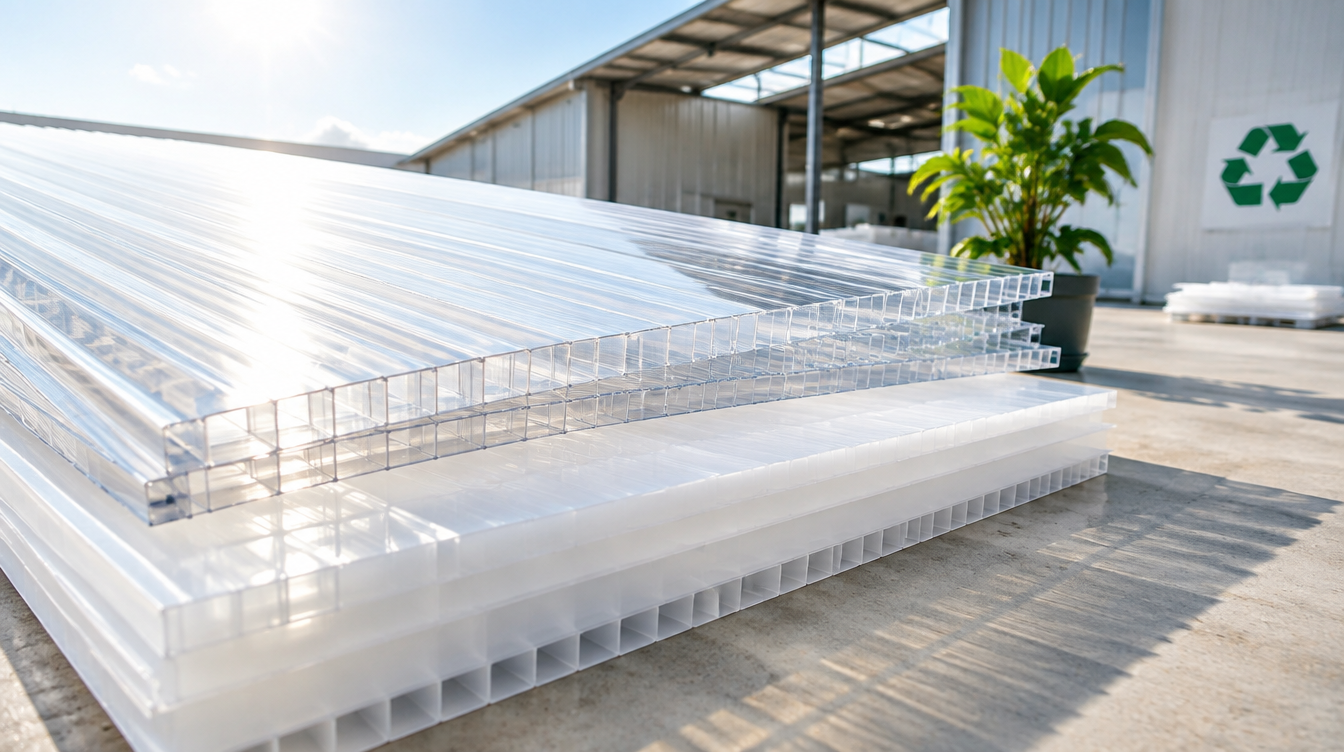
Sustainability questions come up more often now on polycarbonate roofing projects, and the honest answer is more nuanced than a simple yes or no. Polycarbonate is a plastic — and "plastic" tends to trigger an assumption of poor environmental performance. But roofing sustainability isn't just about the material's origin; it's about recyclability, the carbon cost of making it versus the carbon it saves over decades of use, and how long it lasts before needing replacement. This post walks through each of those honestly.
Recyclability: What Resin Code 7 Actually Means
Polycarbonate carries plastic resin identification code 7 ("other plastics"), which means it is technically a thermoplastic that can be melted down and reprocessed — unlike thermoset materials, which cannot. In principle, polycarbonate roofing sheets are recyclable at end of life.
In practice, recycling is more complicated than the resin code suggests. Most weatherable polycarbonate roofing panels are coextruded with a UV-protective surface layer bonded to the structural core, which means the material entering a recycling stream is a composite, not a single homogeneous plastic. Recovering high-quality recycled polycarbonate from this composite requires appropriate processing, and the infrastructure for it is still limited in India compared with more established recycling streams like PET or metal.
What this means practically: ask your supplier directly whether they operate or participate in a take-back or recycling programme for off-cuts and end-of-life panels, and what percentage recycled content (if any) goes into their sheet production. A supplier who can answer this specifically is a meaningfully different proposition from one who simply points to the resin code.
Embodied Carbon vs. Operational Carbon
Every building material carries embodied carbon — the emissions associated with extracting raw materials, manufacturing, and transporting it to site. Polycarbonate, as a petrochemical-derived plastic, has a non-trivial embodied carbon footprint per kilogram compared with some traditional materials.
But roofing sustainability shouldn't be judged on embodied carbon alone, because the whole reason to specify a translucent roofing material is its effect on the building's operational energy use over its lifetime. A well-daylit space needs less artificial lighting during daytime hours — often the single largest recurring energy draw in warehouses, retail floors, and industrial sheds. Our warehouse daylighting energy savings post works through the numbers for one common building type.
Over a well-specified roof's 15–20 year life, in a building with daylight-responsive lighting controls (so the lighting savings are actually captured) and a climate or building type where the reduced cooling load is meaningful, the accumulated operational energy savings can substantially outweigh the material's embodied carbon. That outcome depends on the project's specifics — rooflight area, lighting control strategy, local grid emissions factor, and HVAC design — so it should be confirmed with a project-specific life-cycle assessment rather than assumed. Without daylight-responsive controls, or where added solar gain increases cooling demand, the operational saving can be small or even negative. This whole-life view, not a factory-gate embodied-carbon number alone, is the basis green building frameworks use for assessing a material's sustainability case.
Durability Is a Sustainability Factor Too
The most sustainable material, in practice, is often the one that doesn't need replacing. A polycarbonate roof that yellows, delaminates, or leaks within five to seven years because of poor UV protection or manufacturing defects isn't just a performance failure — it's a sustainability failure, because the embodied carbon of the replacement roof gets added on top of the original, and the failed panels typically end up in landfill rather than any recycling stream.
This is why UV protection quality and manufacturing consistency matter as much to a sustainability case as the resin itself. Our posts on UV yellowing and long-term transparency and common sheet defects cover what separates a panel that reaches its full 15–20 year design life from one that doesn't.
Green Building Rating Credits
Polycarbonate roofing can contribute meaningfully to green building certifications, though the credits come from its performance characteristics rather than the material category itself:
- Daylighting credits under IGBC, GRIHA, and LEED frameworks reward reduced reliance on artificial lighting, which a well-specified translucent roof directly supports.
- Thermal performance (U-value) credits reward the envelope's contribution to reducing heating/cooling loads — see our ECBC/GRIHA compliance guide for how polycarbonate U-value data feeds into these calculations.
- Low-VOC / material emissions credits, where relevant frameworks recognise polycarbonate's low off-gassing once installed — but this is not automatic. Eligibility depends on the specific rating framework, product category, and project location, and generally requires a recognised emissions or VOC test report from the manufacturer, not just a general claim of inertness.
- Recycled content credits, where applicable — dependent on the specific supplier's recycled content percentage, which needs to be documented and verified, not assumed.
None of these credits are automatic. They require documentation from the manufacturer — tested U-values, light transmission data, and, where claimed, recycled content percentages — submitted as part of the project's certification package.
How to Evaluate a Supplier's Sustainability Claims
Ask directly, and ask for documentation, not just a statement:
- "What percentage recycled content is in this specific product, and can you provide a certificate?"
- "Do you operate a take-back or recycling programme for off-cuts and end-of-life panels?"
- "What is the tested U-value and light transmission for this panel, for use in a green building credit submission?"
- "What warranty period backs the UV protection, and what does that imply about expected service life?" — see our warranty checklist for what a credible answer looks like.
- "Do you have a recognised emissions or VOC test report for this product, if we need to support a low-VOC material credit?"
A supplier who can answer these with data is making a genuine sustainability case. A supplier who answers only with "it's plastic, so it's recyclable" is not.
Coxwell provides tested performance data — U-value, light transmission, and warranty documentation — to support green building credit submissions. Talk to our technical team about the data your certification package needs.
Frequently asked questions
Is polycarbonate roofing recyclable?
Polycarbonate carries plastic resin code 7 and is technically a recyclable thermoplastic. In practice, most weatherable roofing panels are coextruded with a UV-protective layer, making them a composite that is harder to recycle than single-resin plastics, and recycling infrastructure for this stream is still limited in India. Ask suppliers directly about take-back programmes and recycled content.
Does polycarbonate roofing help with green building certification?
Yes, primarily through daylighting credits (reduced artificial lighting need), thermal performance credits based on tested U-value, and low-VOC material credits under frameworks like IGBC, GRIHA, and LEED. These require documented, tested performance data from the manufacturer to be submitted as part of the certification package.
Does polycarbonate's embodied carbon outweigh its energy savings?
Generally no, over the roof's full service life. The embodied carbon of manufacturing polycarbonate is typically offset by operational energy savings from reduced daytime artificial lighting and, with a well-specified panel, reduced cooling load — savings that accumulate over the roof's 15–20 year design life.
Why does UV protection quality matter for polycarbonate sustainability?
A roof that yellows or fails prematurely due to poor UV protection needs early replacement, which adds a second roof's worth of embodied carbon and typically sends the failed panels to landfill. Strong UV protection that lets a roof reach its full design life is itself a sustainability factor, not just a performance one.
Next step
Speak to a Coxwell engineer.
Our team can help you specify the right system, review your BOQ, or answer technical questions about your project.