
What Is Daylighting? The Concept Every Architect Needs to Understand
Daylighting is not just "letting in light." It is one of the most powerful tools in an architect's kit — with measurable effects on human performance, health, and energy consumption. Here's what the research actually says.
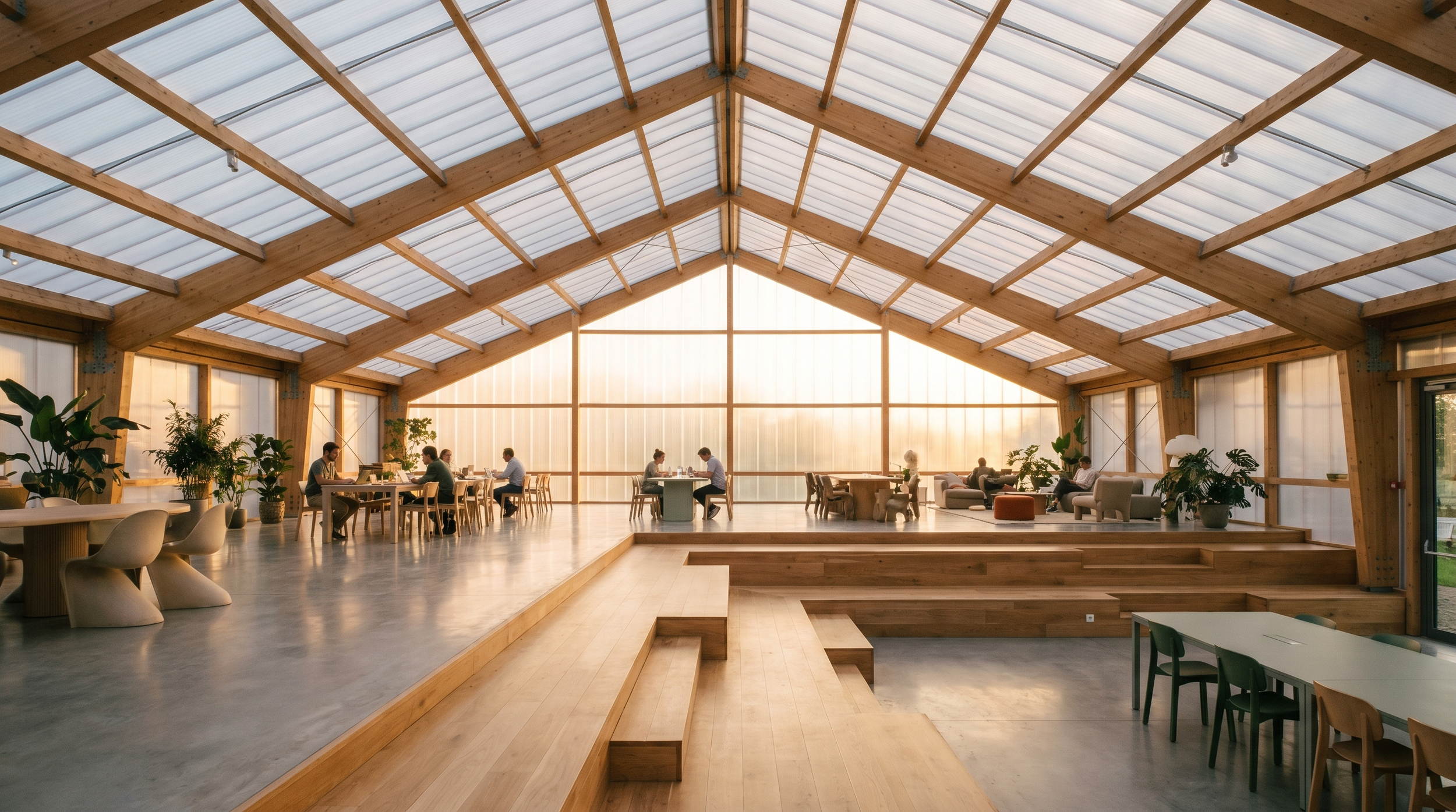
Daylighting is the deliberate use of natural light as a primary illumination source within a building. It is not the same as having windows. It is not "letting in light." It is a design discipline — one that, when done well, reduces energy consumption, improves occupant health, and creates spaces that people find genuinely preferable to their artificially lit equivalents.
Most architecture graduates receive less formal instruction on daylighting than on any other major design variable. This post is an attempt to correct that gap — beginning at the beginning.
The Difference Between Light and Daylighting
A room with a window has natural light. A room designed with daylighting in mind has something more: a considered relationship between the space's geometry, the openings that admit daylight, and the quality and distribution of light across the surfaces and occupied zones inside.
The distinction matters because:
- Direction matters. North light in the northern hemisphere is cool, diffused, and constant throughout the day — ideal for studios, galleries, and tasks requiring accurate colour perception. South light is warmer, more variable, and carries more solar heat gain — productive for passive solar design but potentially problematic without shading.
- Distribution matters. A skylight that floods one zone with 1,200 lux and leaves the back wall at 80 lux creates an uncomfortable contrast that forces occupants to either shield the bright zone or supplement the dark one. Good daylighting aims for uniformity.
- Quality matters. Diffused daylight — light that has been scattered before it reaches the occupied zone — creates soft, even illumination without harsh shadows or specular glare. Direct sunlight, uncontrolled, is the enemy of visual comfort in most building types.
The Human Dimension: What Research Shows
The case for daylighting is not aesthetic. It is physiological and behavioural.
Circadian rhythm regulation. The human body's 24-hour internal clock is primarily set by exposure to natural light, specifically the blue-spectrum wavelengths (460–490nm) that are most abundant in daylight and significantly filtered by artificial light. Disrupted circadian rhythms are associated with poor sleep quality, reduced alertness, lowered mood, and a range of long-term health consequences. Buildings that admit meaningful quantities of natural daylight throughout the day support healthier circadian cycles in their occupants.
Seasonal Affective Disorder. Insufficient daylight exposure is the primary cause of Seasonal Affective Disorder (SAD), a form of depression that affects a significant portion of the population in low-sunlight climates. Research published by Avery and colleagues found that approximately 6% of the US population and over 10% of Finland's population experience SAD. While India's latitudes and climate make severe SAD less common, the principle — that light deprivation has measurable psychological consequences — is universal.
Cognitive performance. A series of influential studies by the Heschong Mahone Group between 1999 and 2003 examined the relationship between natural light and human performance across multiple settings. In one study of retail environments, stores with skylights achieved 31–49% higher sales than comparable stores with fluorescent lighting. In educational settings, students in classrooms with the most daylight showed consistently better test performance than those in classrooms with the least. These are not small effects. They represent meaningful, measurable differences in how well human beings function in a space.
Post-operative recovery. A frequently cited 1984 study by Roger Ulrich found that post-surgical patients assigned to rooms with window views of nature required fewer doses of pain medication, experienced fewer complications, and were discharged earlier than patients with equivalent rooms facing a brick wall. The study — later replicated in multiple contexts — established what environmental psychologists call the "restorative environment" hypothesis: that connection to natural light and nature genuinely accelerates recovery. For hospital architects, this is not a soft aspiration. It has implications for patient outcomes and bed occupancy.
The Energy Dimension
The International Energy Agency estimates that lighting accounts for approximately 15% of global electricity consumption. In commercial buildings, the proportion is higher — often 20–30% of total energy use. Effective daylighting design reduces artificial lighting load during occupied daytime hours, which represents the most cost-effective passive energy intervention available in most building types.
The mechanism is straightforward: when daylight can reliably deliver 300–500 lux at the working plane, artificial light can be dimmed or switched off. In a 5,000 sqm office building, this can represent savings of 40,000–80,000 kWh per year depending on climate, orientation, and control system quality.
In Indian conditions — where outdoor illuminance on an overcast day ranges from 5,000 to 15,000 lux — the potential to daylight buildings is high relative to most European climates. The challenge is managing heat gain alongside light transmission, which is why material selection matters.
The Three Components of a Daylighting System
Good daylighting design involves three things working together:
1. Apertures — where the light enters. Skylights deliver more daylight per unit area than side windows in deep-plan buildings, because they admit high-angle light that penetrates further into the interior. Vertical facades admit lower-angle light that is directional and potentially glare-producing. The right aperture type depends on the building form and the daylight quality required.
2. Controls — how the light is managed. Diffusing materials, louvres, baffles, reflectors, and overhangs all modify the quality and direction of light after it enters the building. A high-LT clear skylight with no diffusion delivers raw sunlight that is often uncomfortable. A lower-LT diffusing panel delivers softer, more evenly distributed light that may be more useful for occupants.
3. Distribution — how the light reaches the occupied plane. Internal surface colours, ceiling heights, partition placement, and furniture arrangement all affect how far daylight penetrates from the aperture. Pale ceilings and light wall colours can double the effective depth of daylight penetration compared to dark finishes.
What Daylighting Is Not
It is worth being explicit about what daylighting design is not, because misconceptions shape bad specifications.
It is not about maximising light transmission. The product with the highest light transmission percentage is not automatically the best daylighting product. High LT without diffusion creates glare. High LT without thermal control creates overheating. The right LT is the one that, in combination with the aperture geometry and the building use, delivers the required lux at the working plane with acceptable uniformity and without causing discomfort.
It is not a substitute for artificial lighting. Daylighting design aims to reduce the hours during which artificial light is needed, not to eliminate it. Any building designed with the assumption that daylight alone is always sufficient will fail its occupants on overcast days, in the early morning and late evening, and in interior zones beyond the effective daylight depth.
It is not the same as solar gain. Light and heat enter together through transparent and translucent materials, but they can be partially decoupled through material selection (infrared-reducing finishes reduce the heat component without reducing light transmission), orientation, and shading. In hot climates, failing to address solar gain in a daylighting design produces overheated buildings — and occupants who draw the blinds, eliminating both the heat and the light simultaneously.
Where to Start
For architects new to daylighting, the most useful habit is to ask the following questions at the very beginning of design:
- What is the required lux level at the working plane for each space?
- What is the orientation of each primary daylight aperture?
- What depth does the daylight need to penetrate from that aperture?
- What material light transmission and diffusion characteristics are needed to achieve adequate illumination without glare?
- What thermal load does that aperture introduce, and how is it managed?
These are design questions, not product questions. The product decisions follow from the answers.
Coxwell manufactures translucent polycarbonate systems designed for daylit buildings — from industrial skylights to façade systems. We provide product selection guidance, U-value data, and light transmission documentation for architect and engineer teams working on daylighting-driven briefs.
Next step
Speak to a Coxwell engineer.
Our team can help you specify the right system, review your BOQ, or answer technical questions about your project.