
The Hidden Details That Make Polycarbonate Roofing Truly Leak-Proof
Most polycarbonate roof leaks don't come from the panels — they come from the details. Here are the installation elements that separate a watertight system from one that fails in its first monsoon.
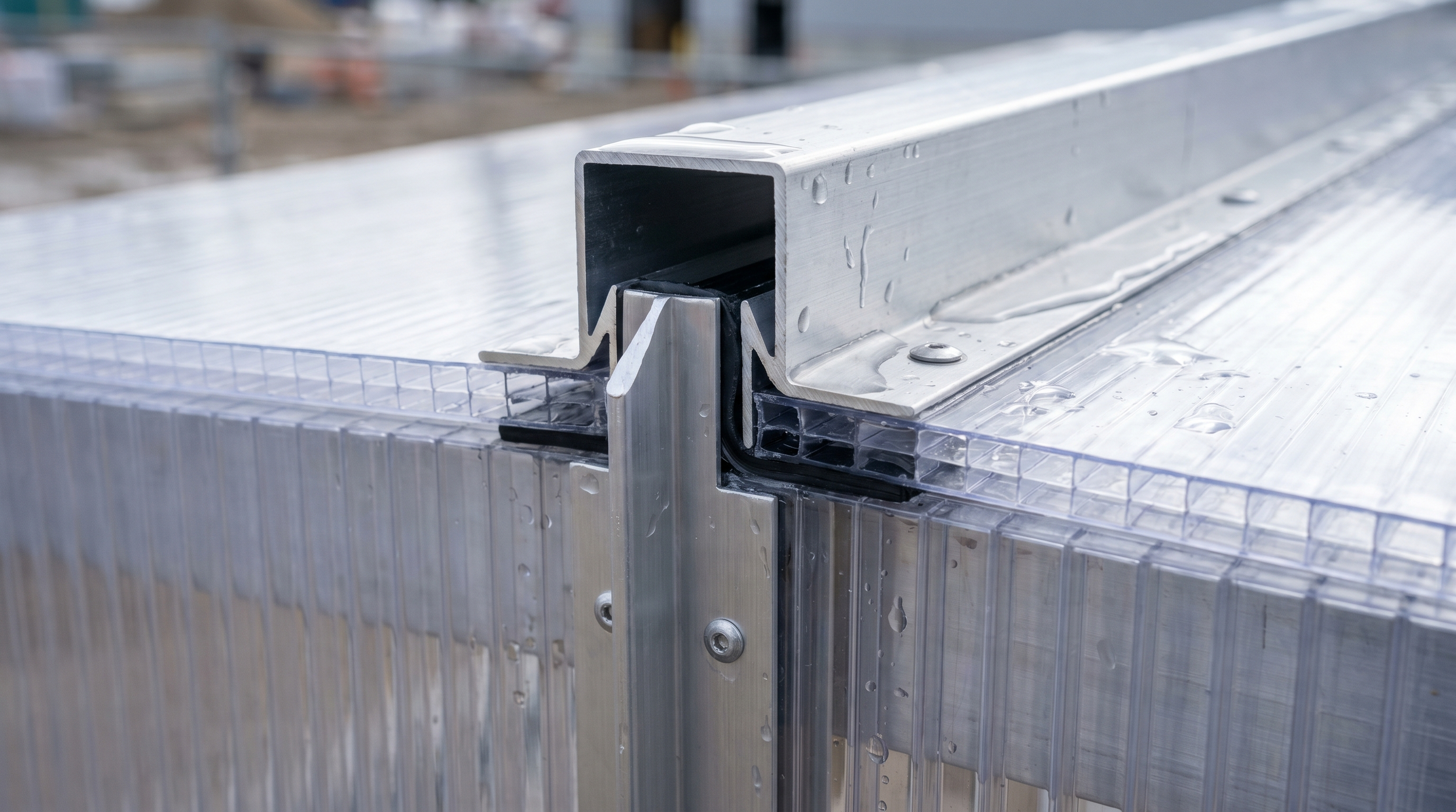
The panel itself is rarely the source of a polycarbonate roof leak. In the vast majority of installation failures, the leak originates at the edges, the ends, the fixings, or the transitions — not the panel body. This post identifies the critical detailing requirements that determine whether a polycarbonate roof stays watertight for 15 years or starts dripping in its first monsoon.
Why Polycarbonate Roofs Leak (And It's Usually Not the Panel)
A well-manufactured standing seam polycarbonate panel is inherently watertight along its main body. The standing seam connector system creates a mechanical interlock that, when correctly installed, does not admit water across the panel-to-panel joint.
Leaks happen at:
- Panel ends (top and bottom of each panel in the slope direction)
- Penetrations (structural members passing through the roof plane)
- Edge conditions (wall junctions, gutter connections, ridge details)
- Inadequate slope (insufficient gradient for water to drain)
- Failed fixings (fasteners through the panel face, improperly sealed)
Understanding this failure map is the first step toward specifying a system that doesn't leak.
Detail 1: The Aluminium U-Profile (Glazing Bar)
Every panel end — the cut edge at the top and bottom of the slope — must be closed with a purpose-designed aluminium U-profile, also called a glazing bar.
The U-profile serves three functions:
- Watertightness: It creates a physical barrier against wind-driven rain entering at the panel end
- Structural termination: It provides a rigid anchor point at the edge of the system
- Aesthetics: It gives a clean, finished appearance at the roof perimeter
A U-profile without proper sealing is insufficient. The profile must be bedded with a compatible sealant or tape to create a continuous watertight seal between the aluminium and the polycarbonate surface.
Critical failure mode: Using sealant alone without a proper U-profile. Sealant-only end closures are a maintenance liability — they crack, UV-degrade, and allow water ingress within a few seasons.
Detail 2: Aluminium Tape at Panel Ends
Multicell polycarbonate panels have an open cellular structure. At cut ends, these cells are exposed — and if not sealed, they allow:
- Dust and debris ingress, accumulating inside the cells and creating permanent visual contamination
- Water entry via capillary action, especially with wind-driven rain or when condensation occurs inside the panel
- Insect and small pest ingress in certain environments
The correct treatment is aluminium tape applied across the full width of each panel end, sealing all cells, before the U-profile is fitted. The tape must be compatible with polycarbonate (not all tapes are), must cover the full end section without gaps, and must be pressed firmly to create a continuous bond.
Installation note: Apply tape on-site immediately before fitting the U-profile. Do not rely on factory-applied tape that may have been damaged in transport or handling.
Detail 3: Polycarbonate End Caps
For standing seam systems, polycarbonate end caps are fitted over the connector body at each panel end. Their function is to:
- Close the top of the connector channel to prevent dust ingress into the interlocking joint
- Improve the watertight performance of the connector end
- Provide UV-resistant closure at the panel end zone
End caps are a small component with disproportionate impact on long-term performance. A standing seam system without end caps will admit dust into the connector channel, eventually creating a soil pathway that also allows water ingress.
Detail 4: The Minimum Slope Requirement
This is the most commonly ignored detail in polycarbonate roofing design. Polycarbonate panel systems require a minimum slope of 5° to 7° for adequate water drainage.
Below this minimum:
- Water does not drain reliably under gravity alone
- Puddling occurs at intermediate connector points
- Leaf litter and debris accumulate and hold moisture
- Wind-driven rain can reverse flow direction and enter end closures
For projects where the architectural design requires a flatter pitch, discuss drainage alternatives with the system supplier before proceeding. Some systems have enhanced watertight connector designs that tolerate lower slopes, but this requires explicit manufacturer sign-off.
Detail 5: The Fixing System (Why Face-Fixed = Future Leak)
The fixing method determines whether you have a leak-free roof or one that punctures itself into failure.
Standing seam systems fix through the aluminium cleat, not the panel face. The cleat is anchored to the structural purlin, and the panel seam grips the cleat through the connector mechanism. The panel body itself is never penetrated.
Face-fixed systems — where fasteners pass through the panel face — create an immediate vulnerability. Every fastener hole is a potential leak point. Even with sealing washers, these points are subject to:
- Thermal expansion and contraction cycling that progressively loosens the seal
- UV degradation of rubber or neoprene washers
- Water tracking along the fastener shank via capillary action
Standing seam systems avoid all of this by design. When evaluating any system, the question is simple: does the fastener penetrate the panel face? If yes, the system has a structural leak risk.
Detail 6: Purlin Tie-Down at Both Ends
This is a structural detail with waterproofing consequences. The purlins supporting the polycarbonate panels must be tied down at both ends of the structure — not just at intermediate spans.
An unsecured purlin end can allow panel movement under wind uplift, which in turn breaks the sealing integrity of the connector system, U-profiles, and end closures simultaneously.
For double-layer systems, both sheet layers must be individually supported and the air gap must be sealed on all exposed edges using the supplied U-profile aluminium closure system. An unsealed air gap is a cavity directly connected to the building interior.
Detail 7: The Ridge and Eave Flashing
Where the polycarbonate roof meets a wall, ridge, or gutter:
- At the ridge/high side: A purpose-designed ridge flashing must lap over the top of the panel end and U-profile, with a minimum 100mm lap and sealant at the overlap
- At the eave/low side: The U-profile must drain freely into the gutter — do not seal the lower end cap in a way that creates a dam
- At wall junctions: A continuous aluminium flashing with a kick-out profile prevents water from running behind the roof edge into the wall cavity
These details follow the same principles as any metal roofing system. But because polycarbonate contracts and expands more than metal under thermal cycling (approximately 3mm per 1.2m of length), the flashing details must accommodate movement. Rigid sealed connections at long spans will crack and fail.
The Bottom Line
A leak-free polycarbonate roof is a systems outcome, not a materials outcome. The panel can be perfect, but without the right end closures, slope, fixing method, and flashings, it will leak. Specify the system — including every accessory — not just the panel.
All Coxwell standing seam systems are supplied as complete systems including aluminium U-profiles, PC end caps, aluminium tape, cleat hardware, and connector accessories. The panel alone is not the product — the complete installation package is.
Next step
Speak to a Coxwell engineer.
Our team can help you specify the right system, review your BOQ, or answer technical questions about your project.