
Polycarbonate Roofing Installation: Step-by-Step Site Guide
A practical step-by-step site guide for installing polycarbonate standing seam roofing systems — from structure verification to final inspection, written for on-site installation teams.
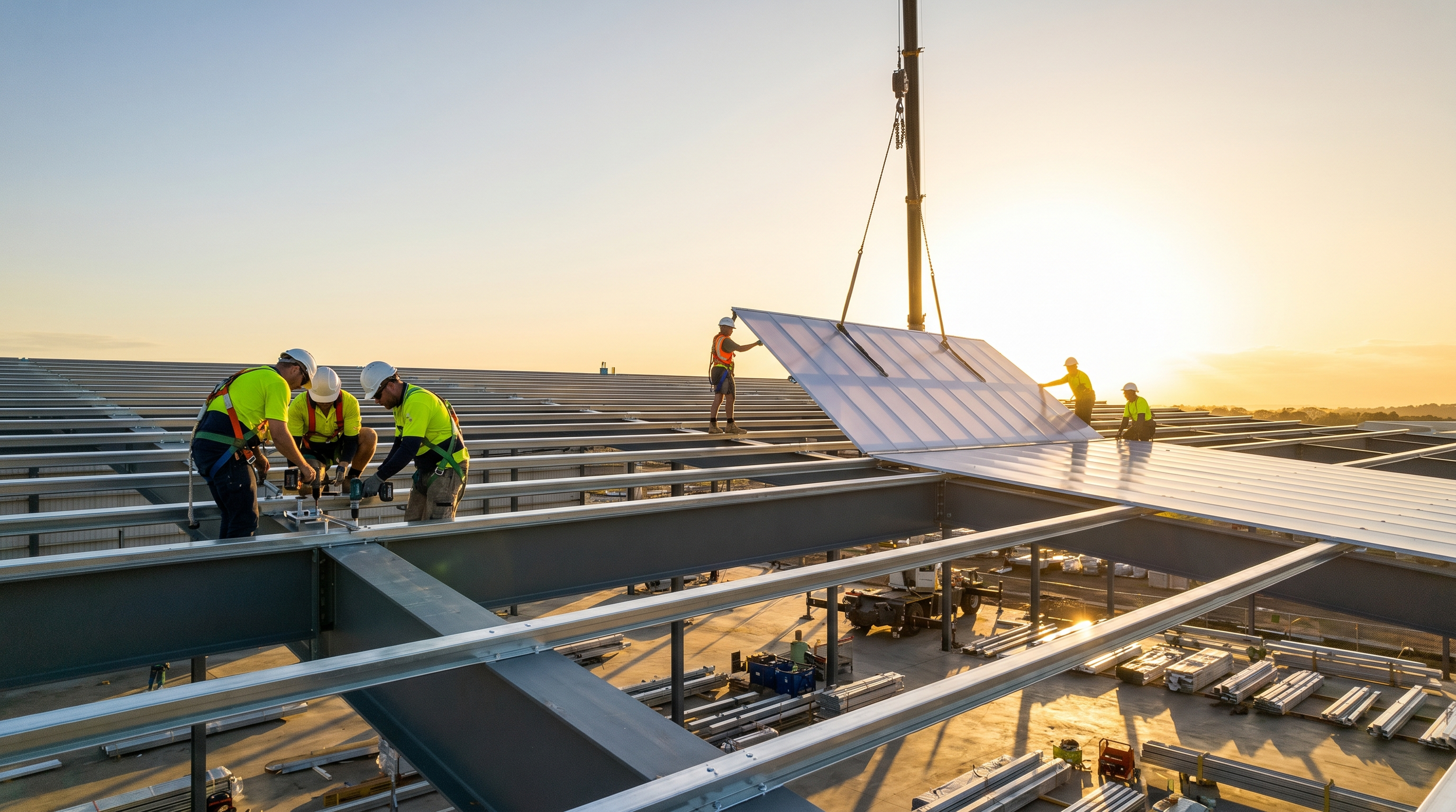
This is a practical on-site reference for installation teams fitting a standing seam polycarbonate roofing system. It follows the correct sequence of operations and includes the checks that prevent the most common failure modes.
Note: This guide covers the general standing seam system installation logic. Always refer to the specific manufacturer's installation manual for the system being installed. This guide is intended as a site reference complement, not a replacement for system-specific documentation.
Phase 1: Pre-Installation Verification
Before any polycarbonate is touched, the structure must be verified.
Step 1.1 — Structural check
- Confirm purlin spacing matches the approved installation drawing (measure at least 5 random spans — don't assume all bays are equal)
- Check purlin levelness along the slope direction (high/low points of more than 5mm require correction)
- Check purlin alignment in plan (purlins must be parallel — not converging or diverging)
- Confirm minimum slope: 5° is the absolute minimum; 7° or more is preferred
- Check that purlin ends are tied down at both ends of the structure
Step 1.2 — Accessory check
- Count and verify all accessories against the delivery note and accessory schedule
- Check panel length matches the project dimension (never assume factory length = design length)
- Inspect first 10 panels for any transport damage, dimensional variation, or protective film damage
- Confirm which side is the UV-protected top face (check film markings)
Phase 2: Cleat Installation
Step 2.1 — Cleat positioning
- Mark cleat positions on purlins according to the installation drawing (cleats run along the standing seam of the panel, parallel to the slope)
- Cleats must be positioned to fall exactly at the panel seam location — not at random intervals
- For continuous cleat systems: cut cleats to panel length minus the thermal expansion clearance specified by the manufacturer (typically 5mm at each end)
Step 2.2 — Cleat fixing to purlin
- Fix cleats to purlins using the specified fasteners — SS self-drilling screws for steel purlins, SS bolts for predrilled structures
- Cleats must be fixed at maximum 500mm intervals along their length (or per manufacturer's requirement)
- Check cleat alignment with a string line before fixing — crooked cleats mean crooked panels and connector engagement problems
- Do not over-tighten fixings to the point that the cleat deforms
Phase 3: First Panel Installation
Step 3.1 — Starting panel placement
- Place the first panel at the edge of the roof with the UV-protected face upward (film markings up)
- The standing seam on one side of the panel engages the cleat — check that the seam clicks fully into the cleat grip-lock mechanism
- At the eave end: leave a minimum 3mm gap between the panel end and any fixed stop in the eave trim (thermal expansion clearance)
- At the ridge end: same gap required
Step 3.2 — End closure on starting panel
- Apply aluminium tape across the full width of both the eave end and ridge end of the panel, covering all open cells
- Fit the PC end cap over the connector body at both ends
- Fit the aluminium U-profile over the taped end — the profile should sit flush against the panel face without forcing
Phase 4: Subsequent Panels
Step 4.1 — Panel interlocking
- Place the next panel adjacent to the first, engaging the standing seam on its free side into the connector slot
- Press the connector into position — it should click audibly when correctly engaged
- Do not use excessive force; if a connector resists engagement, check that the panel edge is properly aligned and that no panel end is overhanging a fixed stop
Step 4.2 — Connector sequence check
- At every purlin, press down on the connector to confirm it is seated against the cleat
- A correctly installed connector is flush with the top of the standing seam and does not rock when pressed
- If there is any visible gap between the connector underside and the cleat, the connector has not engaged properly — remove and re-seat
Step 4.3 — Progressing across the roof
- Work from one edge to the other in a consistent direction
- Do not skip panels or jump to non-adjacent panel positions
- Do not remove protective film from installed panels until the area is complete
Phase 5: Ridge and Eave Closure
Step 5.1 — Ridge closure
- At the ridge, fit the aluminium U-profile to close the upper panel ends (tape and end caps must already be fitted)
- The ridge flashing laps over the U-profile by a minimum of 100mm
- Fix the ridge flashing with the specified fasteners at maximum 400mm spacing
- Apply compatible flexible sealant at the lap between ridge flashing and U-profile — do not use rigid epoxy
Step 5.2 — Eave closure
- At the eave, the U-profile at the panel bottom must drain freely into the gutter
- Do not seal the lower end of the U-profile — it must remain open for drainage
- Fit the eave trim to close the visual gap between the panel and the gutter fascia
Phase 6: Wall Abutments and Penetrations
Step 6.1 — Wall abutments
- At wall junctions, the wall flashing must lap over the top of the panel by a minimum of 150mm
- The flashing must be fixed to the wall, not to the polycarbonate panel — polycarbonate moves thermally; a flashing fixed rigidly to both wall and panel will crack
- Apply a bead of compatible sealant between the flashing and the wall surface
- Use a kick-out profile at the lower edge of all wall flashings to direct water away from the wall cavity
Step 6.2 — Penetrations
- For structural column or hanger penetrations through the roof plane, use purpose-designed penetration flashings
- The flashing collar must be flexible or have a movement joint to accommodate thermal movement of the panel
- Do not seal panel-to-column gaps with silicone alone — this will split within two years
Phase 7: Final Inspection
Before protective film removal and handover:
□ All connectors seated and flush
□ All cleats fixed at correct spacing
□ End tape and end caps fitted at all panel ends
□ U-profiles fitted at ridge and eave
□ Ridge flashing lapped and sealed
□ Eave trim fitted, lower U-profile drain point clear
□ Wall flashings fixed to wall (not to panel), kick-out profile fitted
□ All penetrations flashed
□ Protective film intact on all panels
□ No visible oil canning or panel deformation
□ No gaps or misalignments visible at connector joints
□ Slope verified at minimum 5°
□ Site is clean — no debris on panel surfaces
Remove protective film only after all work is complete and the site is clean.
Coxwell can provide system-specific installation manuals for all Coxwell standing seam systems. Contact your sales contact or download from coxwell.in.
Next step
Speak to a Coxwell engineer.
Our team can help you specify the right system, review your BOQ, or answer technical questions about your project.