
Recommended Lux Levels by Building Type: An Architect's Reference Guide
How much light does a classroom need? A hospital ward? A warehouse? This reference guide covers IES, CIBSE, and IS 3646 lux targets for every major space type — with an interactive table architects can actually use.
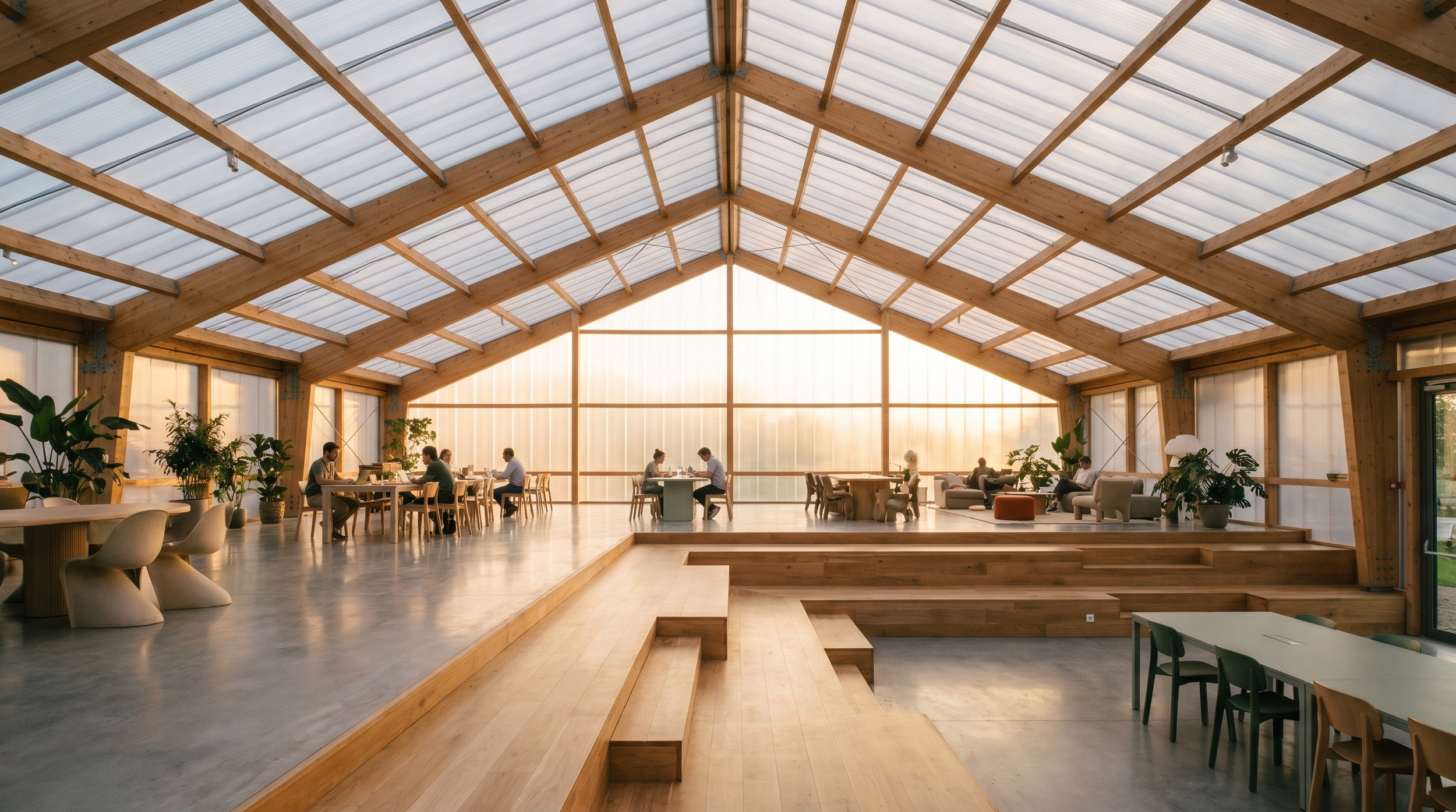
Lux is one of the most useful numbers in a lighting design brief — and one of the least understood by the people writing them. This reference guide exists to fix that. Whether you're designing a school, a hospital ward, a warehouse, or a metro station concourse, the following tables give you the maintained average illuminance targets from the IES Lighting Handbook, CIBSE Code for Lighting, and IS 3646 — the standards that consultants, building services engineers, and building code reviewers actually use.
Use this page as a reference. Bookmark it. Bring it into briefs.
What Is Lux and Why Does It Matter?
Lux (lx) is the SI unit of illuminance — the amount of visible light falling on a surface, measured in lumens per square metre. One lux is the illuminance of a surface receiving one lumen spread over one square metre.
It measures not how bright a light source is, but how much light actually lands on the plane where people work, read, or move. That distinction is important. A high-output luminaire mounted 12 metres above a warehouse floor delivers far fewer lux at working plane than the same fitting at 4 metres. Architects who specify glazing area or skylight percentage without considering the geometry of daylight delivery are working blind.
In daylighting design, lux at the working plane is determined by:
- The amount of daylight entering the space (governed by glazing area, light transmission of the material, and sky condition)
- The sun angle and orientation of the opening
- The geometry and depth of the space
- The internal surface reflectances
None of these is a product property. Lux is a project outcome, not a material specification. A product's light transmission percentage tells you how much light the panel lets through. Lux tells you what arrives at the desk, floor, or operating table.
How to Read These Standards
The values in the table below are maintained average illuminance (Em) at the working plane. "Maintained" means the design should deliver at least this level at the end of the luminaire's design life — not just when the installation is new. For daylighting, it means the target should be achievable on a representative overcast day during occupied hours.
The reference standards are:
- IES Lighting Handbook (Illuminating Engineering Society, USA) — the global reference for commercial and institutional lighting
- CIBSE Code for Lighting (Chartered Institution of Building Services Engineers, UK) — widely used in India for premium projects and government specifications
- IS 3646 (Part 1) — Indian Standards specification for interior illumination
Where values differ between standards, the ranges given reflect the spread across all three.
Recommended lux levels by space type
Sources: IES Lighting Handbook, CIBSE Code for Lighting, IS 3646. Values at working plane height (0.75–0.8m).
These are maintained average illuminance targets. Actual design must account for sky condition, orientation, geometry, and surface reflectance. Daylight simulation recommended for all occupied spaces.
Important Caveats for Daylighting Design
These values apply to the working plane, not the ceiling or wall. For most buildings, the working plane is 0.75–0.80m above finished floor level — roughly desk height.
Uniformity matters as much as average lux. A room where one zone gets 800 lux and another gets 100 lux has a poor average uniformity ratio. CIBSE recommends a minimum uniformity ratio (minimum ÷ average) of 0.7 for working areas, and BREEAM requires 0.4 as a minimum. Very uneven daylight creates visual discomfort even where the average is adequate.
Over-lighting is as problematic as under-lighting. The IES guidance is explicit: spaces receiving much more than the target lux are more likely to have glare problems and higher HVAC loads from solar heat gain. For daylighting from above, an average daylight factor above 5% is considered "cheerfully lit" by CIBSE — but can produce uncomfortable brightness differentials if not diffused.
Colour rendering matters alongside quantity. Natural daylight has a high colour rendering index (CRI 100). Where tasks require accurate colour perception — colour matching, art studios, pharmacies, operating theatres — the quality of the light source matters, not just its quantity.
Daylight Factor as a Design Tool
For spaces primarily daylit from above (skylights, clerestories, translucent roofing), the Daylight Factor (DF) is a useful design tool alongside lux targets. DF expresses the ratio of internal illuminance to external illuminance under a standard overcast sky, as a percentage.
Key benchmarks from CIBSE and BS 8206:
- DF < 2%: typically perceived as inadequate, electric light will be used throughout the day
- DF 2–5%: adequate to good; the range for most well-designed daylit offices and schools
- DF > 5%: "cheerfully lit" — this is the target for spaces designed to be used without supplementary artificial light during daylight hours
A classroom design targeting DF > 5% at the back of the room will almost certainly meet its 300–500 lux target without electric light during most occupied hours in Indian climatic conditions.
Using This Table in a Daylighting Brief
When setting the daylighting brief for a translucent roofing or skylight system:
- Start with the lux target for the space from the table above
- Determine the required Daylight Factor to achieve that lux level at your latitude (typically 1.5–2.2% DF per 100 lux for Indian conditions)
- Work with your daylight consultant or use simulation software to determine what glazing area, roof geometry, and material light transmission is needed to achieve that DF
- Select the polycarbonate system based on its tested light transmission value, diffusion characteristics, and U-value — not on its marketing description
The lux target is the destination. Everything else is the route.
Coxwell supplies polycarbonate systems across a light transmission range from 30% to 80% depending on product and colour selection, allowing daylighting designs to be calibrated to specific lux targets. Contact us for product selection assistance on your project.
Next step
Speak to a Coxwell engineer.
Our team can help you specify the right system, review your BOQ, or answer technical questions about your project.