
How to Read a Polycarbonate Roofing BOQ Before You Quote
Before you price a polycarbonate roofing job, you need to know what's actually in the BOQ. Here's what experienced contractors check — and what catches out those who don't.
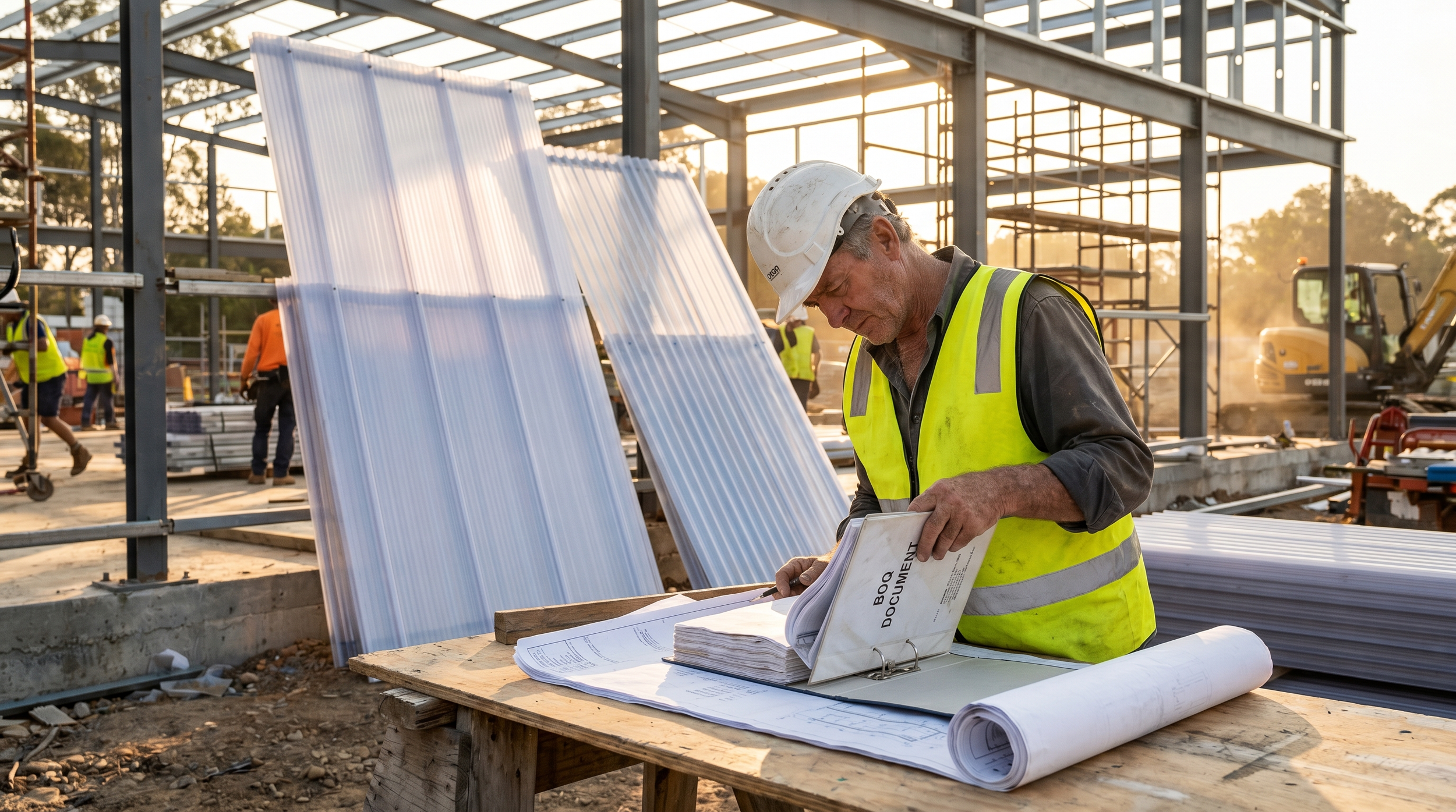
A polycarbonate roofing BOQ that looks straightforward rarely is. The panel area is easy to price. Everything else — the fixing system, accessories, end closures, wastage, and scope boundaries — is where contractors either protect their margins or lose them. This post walks through every line item you need to interrogate before you submit a rate.
1. Thickness and System Specification
The first thing to confirm is whether the BOQ specifies a system or just a material. "16mm polycarbonate sheet" is not the same as "16mm Multicell standing seam system with aluminium cleat and connector." The former is a loose material supply. The latter is an engineered assembly.
Check:
- Is a specific thickness stated? (Thinner panels are cheaper but may not meet span requirements)
- Is a specific cell configuration required? (3-cell vs 5-cell affects U-value, stiffness, and price)
- Is the system named? (Multicell, X-Fix, Vivid, Prism — each has different accessories)
- Is UV protection specification stated? (Min. 45–50 microns co-extruded — if not stated, a cheap surface-coated panel can be substituted by a supplier at your expense later)
If the BOQ just says "polycarbonate sheet" without system detail, request a clarification or add a qualifying note to your quote that prices are based on a specified system.
2. Support Structure
The BOQ should clearly state who is responsible for the MS/SS purlin structure. This is the single most common scope dispute on polycarbonate jobs.
Check:
- Is structural steelwork in your scope or "by others"?
- Is purlin alignment and levelness guaranteed before you start? (Misaligned purlins cause panel stress and installation delays — if the structure is out of tolerance, you need a variation clause)
- Is purlin spacing stated? (It must match the system's rated span — if the client's structure has wider spans than the panel can handle, that needs to be flagged, not priced in)
- Who supplies anchor bolts, base plates, and welding for purlin connections?
3. Fixing System and Hardware
The connector system and cleat hardware are often omitted or vaguely described in BOQs, especially from clients who don't understand polycarbonate systems.
Check:
- Is the connector type specified? (Polycarbonate U-connector vs aluminium spacer — each has different labour and material cost)
- Is cleat type specified? (Standard single-tooth vs continuous double-tooth grip-lock — the latter is more expensive but may be required by the spec)
- Are fasteners included? (SS vs galvanised — SS costs more but is required in coastal or high-humidity environments)
- Pull-out load requirement stated? (≥7,000N per ISO 6892 is the industry standard)
If fasteners and cleats are not itemised in the BOQ, price them in your quote and call them out explicitly. Projects regularly go to dispute because a contractor assumed hardware was supplied and it wasn't.
4. Accessories: The Hidden Cost Items
The accessories for a standing seam polycarbonate system can add 15–25% to the material cost. A BOQ that prices "panels only" and lumps accessories into a single line item is a risk.
Verify that each of the following is explicitly included or excluded:
| Item | What to check |
|---|---|
| Aluminium U-profile (glazing bar) | Linear metres at eave, ridge, and raking edges |
| Aluminium tape | Roll count based on total panel end length |
| PC end caps | Count based on number of connectors at ends |
| Ridge flashing | Linear metres, profile type |
| Eave trim | Linear metres, whether gutter connection is included |
| Wall flashing / abutment details | Linear metres at each wall junction |
| Fasteners | Count, specification (SS vs GI), diameter |
| Sealant (if required) | Type, quantity, application locations |
Any item not in the BOQ that appears in the specification drawings is your responsibility to price — or to exclude in writing.
5. Wastage and Overlaps
Panel areas in a BOQ are almost always calculated on net roof coverage area. You need to add wastage on top.
Typical wastage factors:
- Straight roofs, no penetrations: 5–8%
- Hip and valley roofs, multiple ridges: 10–15%
- Curved or shaped roofs: 12–20%
- Panel offcuts at edges and ridge: depends on panel length vs run
Check whether the BOQ area is gross (including overlaps and trims) or net (coverage area only). Most are net. Apply your wastage factor to the net area before pricing material.
For multiwall panels, also check whether end-laps are required and at what overlap. End-lapping panels require additional length and affect the number of panels needed per run.
6. End Closures and Sealing
This is the most under-priced element on polycarbonate jobs. End closures — the aluminium U-profiles, aluminium tape, and PC end caps at the top and bottom of every panel run — are labour-intensive and material-significant.
Count the total linear metres of panel ends:
- Top end (ridge or high side): total width of roof
- Bottom end (eave or low side): total width of roof
- Any internal joints where panel runs end mid-slope
Each metre of panel end requires: U-profile + aluminium tape + sealant bead + end caps at each connector. This is roughly 20–25 minutes of skilled labour per metre in addition to materials.
7. Warranty and Test Certification Scope
Some BOQs require the contractor to submit product test certificates and provide a warranty on installed work. Check:
- What test certs are required? (ASTM E-313, ASTM G-155, IS 14443-97, UL-94 — can you get these from your supplier?)
- What warranty period on materials? (10 years against manufacturing defects is standard)
- What warranty period on installation workmanship? (Typically 1–2 years; clarify scope)
- Are liquidated damages tied to performance failures? (Leakage, deformation — quantify your exposure)
If your supplier cannot provide current third-party test certificates from NABL-accredited labs, you have a procurement risk, not just a pricing risk.
8. Installation Scope Boundaries
BOQs frequently leave installation scope ambiguous. Before you price, confirm in writing:
- Access and scaffolding: In your scope, or by others? (If by others, confirm it will be in place before you mobilise)
- Handling and storage on site: Who is responsible for panel damage before installation?
- Shop drawings and mock-up: Is a pre-installation shop drawing submission required? Is a mock-up panel required for approval?
- Supervision: Is a manufacturer's technical supervisor required on site during installation?
- Protection film removal: Who removes and disposes of the protective film?
Each of these is a real cost. None of them appears automatically in a panel rate.
The BOQ Review Habit
Make it a rule: never price a polycarbonate roofing BOQ without spending 30 minutes working through the checklist above. The jobs that look attractive at a glance are often the ones with the most ambiguity baked in. The contractors who price confidently are the ones who've read the document, not just the area schedule.
Coxwell provides BOQ review support and specification assistance to contractors. If you're quoting a project that uses Coxwell systems, we can help you verify quantities and accessory lists before you submit.
Next step
Speak to a Coxwell engineer.
Our team can help you specify the right system, review your BOQ, or answer technical questions about your project.