
Polycarbonate Acoustic Barriers — Transparent Sound Barriers for Metro, Rail & Highway
India's largest polycarbonate sound barrier system — supplied by Coxwell for the NCRTC RRTS project in Meerut. Engineered transparent barriers for metro, highway, and industrial applications.
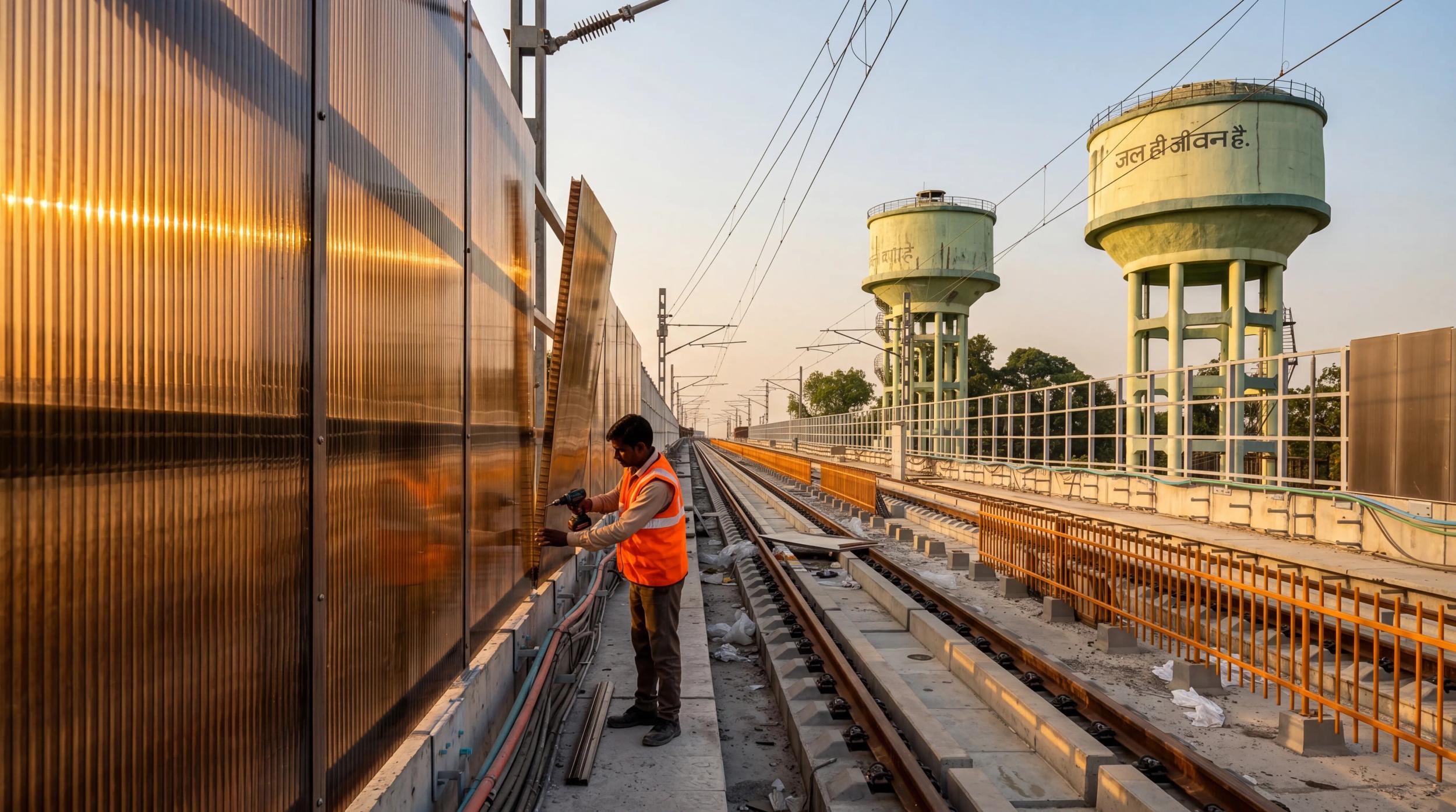
Most noise barrier systems are opaque — concrete, metal, or absorptive panels that block both sound and light, turning elevated corridors into dark tunnels. Polycarbonate acoustic barriers solve the problem differently: they attenuate noise while remaining fully transparent, preserving natural light and sightlines for passengers, residents, and workers on both sides of the barrier.
Coxwell designed and supplied India's largest polycarbonate sound barrier system for the NCRTC Rapid Rail Transit System (RRTS) project in Meerut — over 2 km of continuous transparent barrier along the elevated corridor.
How Polycarbonate Works as a Sound Barrier
Sound transmission through a panel is governed by its mass, stiffness, and surface damping. Polycarbonate multiwall panels — specifically engineered thick-wall systems in the 16–40 mm range — achieve sound reduction indices (Rw) of 28–36 dB, which places them in the same performance class as laminated glass at a fraction of the installed weight.
Polycarbonate panels weigh approximately 4–5 kg/m², compared to 25–30 kg/m² for equivalent-performance laminated glass. This reduces structural load on elevated rail corridors and bridges substantially, which typically translates to a lower civil cost for the overall project.
Polycarbonate is virtually unbreakable under the impact loads relevant to rail and highway applications (ballast strike, maintenance access, wind-driven debris). Glass panels in barrier applications have a well-documented fragmentation failure mode that polycarbonate eliminates.
Natural light transmission of 78–88% depending on thickness and colour. Passengers on elevated metro corridors experience the route rather than a solid wall. Residents adjacent to highway barriers retain views and natural light.
Panels can be cut to length on site, handled without specialist lifting equipment, and installed in extruded aluminium or steel sub-frames using standard building practices. Glass requires specialist glazing contractors and crane-assisted handling.
The NCRTC RRTS Meerut Project
The Meerut RRTS corridor presented a specific design challenge: an elevated section running through dense urban fabric, where the noise impact on adjacent residential and commercial buildings required mitigation, but where solid barriers would have created unacceptable visual obstruction.
The project remains the largest installation of its type in India and the reference benchmark for polycarbonate acoustic barriers on infrastructure projects.
Applications
The primary application class. Elevated sections through urban areas require noise mitigation that doesn't create visual obstruction or increase structural dead load significantly.
National and state highway projects increasingly specify transparent sections in noise barriers adjacent to urban areas. Polycarbonate offers a significantly lower cost than glass for long continuous runs.
Manufacturing and logistics facilities required to meet noise emission standards at their property boundary. A polycarbonate barrier system is faster to install and easier to modify than masonry or metal panel alternatives.
Covered platforms where the roof structure also needs to attenuate track noise. Polycarbonate roofing systems can be specified for combined acoustic and weather protection function.
Technical Specification
Engineering documentation, acoustic test certificates, and load calculation support are available for projects requiring formal specification submission.
Why Specify Coxwell
Infrastructure projects — particularly those funded by central or state government — require a supplier who can document performance, provide project references, and support the specification and approval process. Coxwell is the only Indian polycarbonate manufacturer with:
- A completed large-scale infrastructure sound barrier installation (NCRTC RRTS)
- In-house engineering support for load and acoustic calculations
- A manufacturing facility with ISO-qualified quality management
- Experience working within government tendering and approval frameworks
We work directly with PMCs, architects, and civil contractors at the pre-bid stage to develop specifications that are technically sound and deliverable within project constraints.
Get the Technical Brief
Engineering documentation, acoustic test data, and specification support for infrastructure projects.
Request technical documentation →Frequently Asked Questions
Engineered multiwall polycarbonate panels in the 16–40 mm thickness range achieve sound reduction indices (Rw) of 28–36 dB. The specific value depends on panel thickness, panel mass, and the mounting and sealing system used. Coxwell can provide acoustic test certificates for the relevant panel specifications.
At equivalent acoustic performance, polycarbonate panels weigh approximately 5–6 times less than laminated glass, making them significantly preferable for elevated structures where dead load matters. They also offer better impact resistance, faster installation, and lower installed cost. The main limitation is scratch resistance on the panel face, which is manageable with appropriate coatings and maintenance protocols.
Yes — Coxwell supplied the transparent barrier system for the NCRTC Rapid Rail Transit System in Meerut, which is the largest polycarbonate sound barrier installation in India to date.
For highway and rail applications targeting 30+ dB noise reduction, 25–32 mm multiwall polycarbonate is the standard specification. Thinner panels (16 mm) are appropriate for lower-traffic applications or where the primary requirement is containment rather than attenuation. Coxwell's engineers will recommend the correct specification for your project's noise mitigation brief.
Yes. Polycarbonate sound barriers are suitable for national and state highway projects and can be designed to NHAI and state highway authority standards. Coxwell provides project-specific engineering calculations to support specification approval.